

Cognitive-behavioral therapy isn’t just another talk therapy. It’s the most researched, most trusted, and most widely used psychological treatment in the world. If you’ve ever felt stuck in negative thought loops-constantly worrying, blaming yourself, or expecting the worst-CBT gives you real tools to break free. Unlike therapies that dig deep into childhood or dreams, CBT focuses on what’s happening right now: your thoughts, your actions, and how they feed each other. And it works. Decades of clinical trials show it reduces symptoms of anxiety, depression, PTSD, OCD, and more-often in just 12 weeks.
How CBT Actually Works
CBT is built on three simple but powerful ideas:
- Your thoughts shape how you feel and behave.
- Many of those thoughts are distorted, exaggerated, or flat-out wrong.
- You can learn to spot and change them.
It’s not about positive thinking. It’s about accurate thinking. For example, someone with social anxiety might think, “Everyone will think I’m awkward if I speak up.” CBT doesn’t tell them to think, “I’m awesome!” Instead, it asks: What’s the evidence for that thought? What’s the evidence against it? What’s a more realistic possibility?
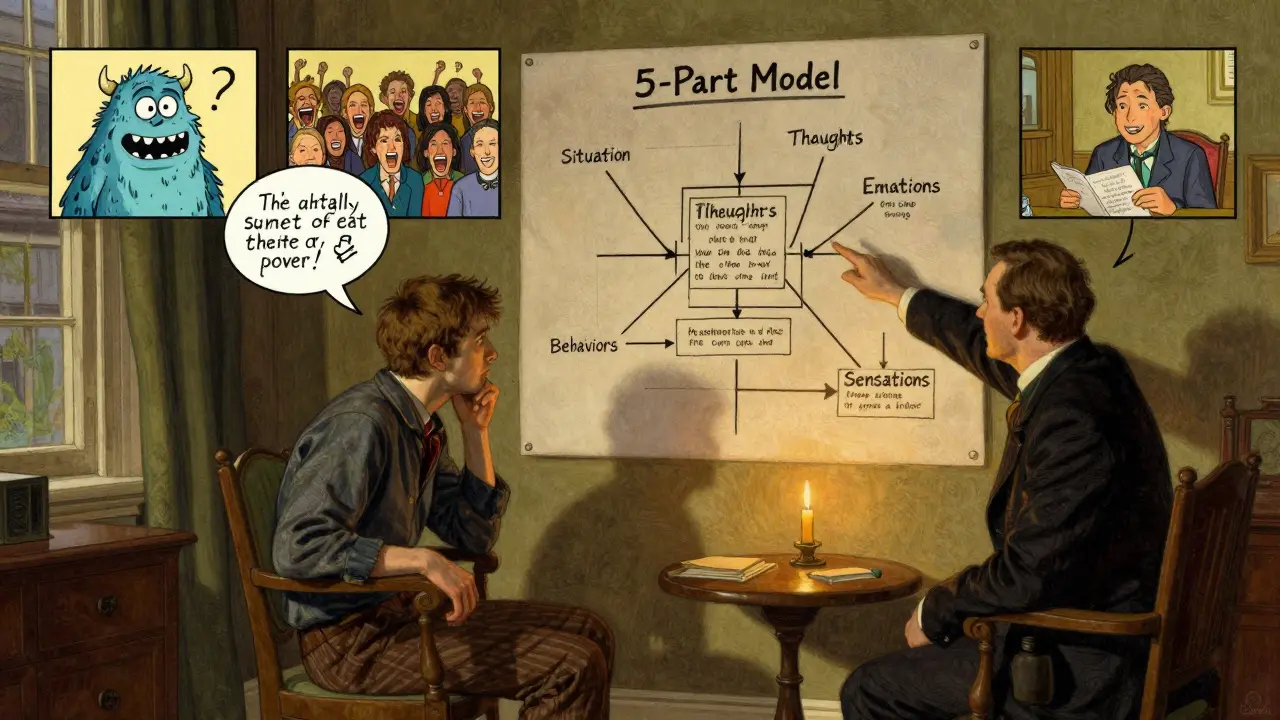
Therapists use structured techniques like the 5-Part Model: Situation → Thoughts → Emotions → Behaviors → Physical Sensations. You map out a recent moment of distress, then walk through each piece. This turns vague feelings into something you can examine, like a scientist looking at data.
What Happens in a Typical CBT Session
CBT isn’t open-ended. It’s focused, time-limited, and goal-driven. Most people meet with a therapist once a week for 5 to 20 sessions. Each session lasts about 45 to 60 minutes.
Here’s what a typical session looks like:
- Check-in (5-10 min): How did your mood change since last week? Any big events?
- Agenda setting (5 min): What do you want to work on today?
- Review homework (10 min): Did you complete your thought record? What did you learn?
- New skill or technique (20-25 min): Learning to challenge a belief, practicing exposure, or role-playing a tough conversation.
- Assign new homework (5-10 min): Something to try before next week-like tracking anxious thoughts or trying a small social interaction.
Homework isn’t optional. It’s where real change happens. You’re not just talking about change-you’re practicing it. One person with panic disorder might be asked to ride the elevator instead of taking the stairs. Another might write down three times they were judged unfairly versus five times they weren’t.
What Conditions Does CBT Actually Help?
CBT isn’t a one-size-fits-all fix, but it’s been proven effective for a wide range of issues. The National Institute for Health and Care Excellence (NICE) recommends it as a first-line treatment for:
- Major depressive disorder
- Generalized anxiety disorder
- Panic disorder
- Social anxiety disorder
- Obsessive-compulsive disorder (OCD)
- Post-traumatic stress disorder (PTSD)
- Eating disorders (like bulimia)
- Insomnia
- Chronic pain
For depression, studies show CBT leads to remission in about 52% of cases after 12 months-slightly better than antidepressants alone, and with much lower relapse rates. For anxiety disorders, 60-80% of people see major improvement. In OCD, a CBT variant called Exposure and Response Prevention (ERP) leads to full symptom remission in many cases after 16-20 sessions.
How CBT Compares to Other Treatments
Is CBT better than medication? Better than other therapies?
Let’s look at the data:
| Condition | CBT Effectiveness | Medication Only | Other Therapies |
|---|---|---|---|
| Depression | 52% remission at 12 months | 47% remission at 12 months | Similar short-term results, higher relapse |
| Anxiety Disorders | 77-114 effect size | 58-89 effect size | Lower than CBT |
| Substance Use | 40-60% abstinence at 6 months | 25-35% abstinence at 6 months | 12-step programs less effective alone |
| Borderline Personality Disorder | Effective | Limited benefit | DBT 30% more effective |
For most people, CBT is more effective than medication alone-and when combined, the results are even stronger. But it’s not always the best choice. For complex trauma or borderline personality disorder, Dialectical Behavior Therapy (DBT) often works better. For children with severe behavioral issues, Parent-Child Interaction Therapy has stronger outcomes.
Who CBT Doesn’t Work For (And Why)
CBT is powerful, but it’s not magic. It requires active participation. You have to show up, do the work, and face uncomfortable thoughts. That’s why it doesn’t work for everyone.
People who struggle most with CBT often have:
- Severe cognitive impairment (difficulty concentrating or remembering)
- Acute psychosis (losing touch with reality)
- Extreme emotional overwhelm (too much distress to reflect)
- Strong resistance to homework or self-reflection
One study found that 45% of clients initially resist doing homework. Therapists handle this with motivational interviewing-not by forcing it, but by exploring why it feels impossible. “I don’t have time,” “It’s too hard,” “What’s the point?”-these are common barriers. A good therapist meets you where you are.
Also, CBT can feel emotionally raw at first. Exposure therapy for phobias or trauma means facing fears you’ve avoided for years. It’s not pleasant-but it’s often the only way to break the cycle.
Real People, Real Results
Thousands of people share their CBT experiences online. On Psychology Today, 87% of users rate it as “very effective” or “extremely effective” for anxiety. Reddit threads are full of stories like:
- “I had 15 panic attacks a week. After 12 sessions of graded exposure, I had 2. Now I go to parties.”
- “I used to think I was a failure. My thought record showed I’d actually completed 17 projects last year. I didn’t see it until I wrote it down.”
- “I hated homework. But writing down my thoughts made me realize I was catastrophizing everything. It changed everything.”
One case study in the Journal of Clinical Psychology followed a man with severe OCD. He avoided touching doorknobs for 10 years. After 18 sessions of ERP, he was shaking hands with strangers. No medication. Just structured exposure.
How to Find a Good CBT Therapist
Not all therapists are trained in CBT. Look for:
- Certification from the Academy of Cognitive Therapy
- Training from the Beck Institute or similar accredited programs
- Experience treating your specific issue (e.g., OCD, PTSD, depression)
Many therapists list their specialties on their websites. Ask directly: “Do you use CBT? Can you describe how you’d treat my issue?”
If you’re in the U.S., check if your insurance covers CBT. It’s reimbursable under CPT codes 90832-90837 in 22 state Medicaid programs. The National Alliance on Mental Illness (NAMI) offers free CBT workbooks online. Apps like Woebot (FDA-cleared in 2021) can supplement therapy but aren’t a replacement for in-person care.
The Future of CBT
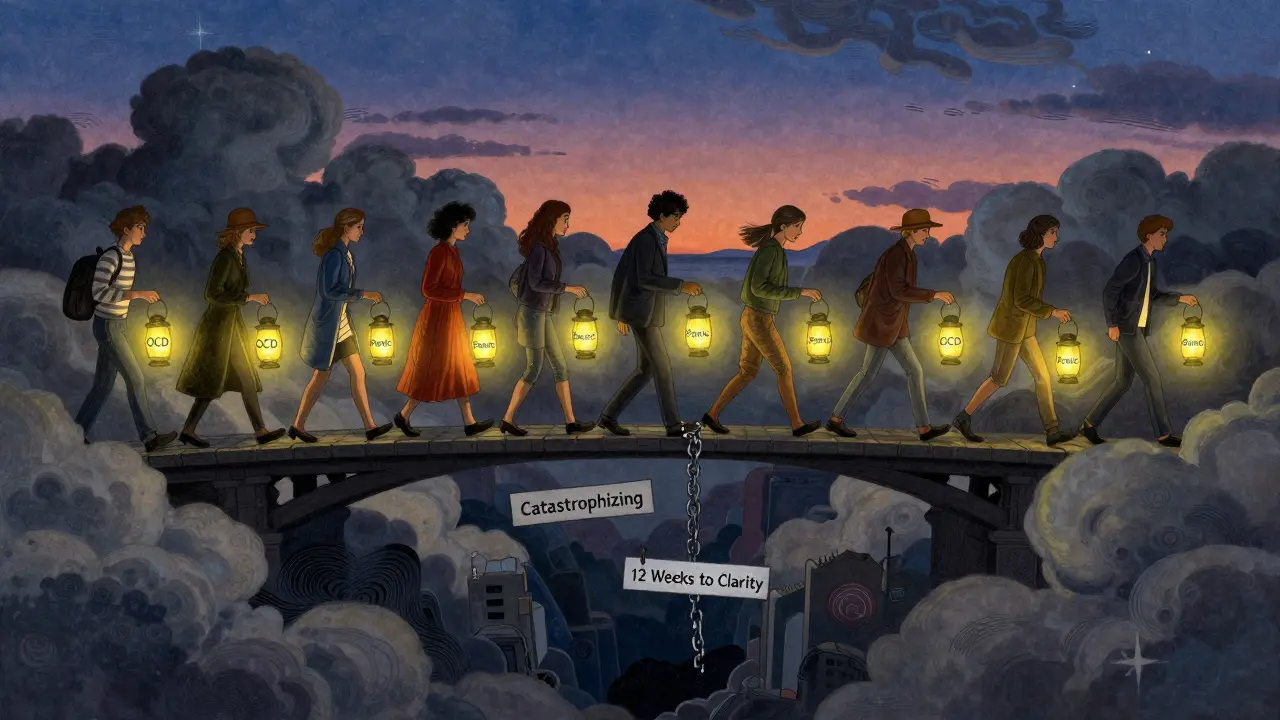
CBT isn’t stuck in the past. It’s evolving. The “third wave” includes approaches like Acceptance and Commitment Therapy (ACT) and mindfulness-based CBT, which focus less on changing thoughts and more on accepting them while taking action. ACT shows 15% better results for chronic pain, according to a 2023 Cochrane Review.
AI is entering the picture too. Tools are being developed to analyze thought records in real time using natural language processing. The goal? Personalized CBT that adapts to your thinking patterns. The National Institute of Mental Health is already testing CBT protocols tied to brain activity patterns.
But here’s the catch: a 2024 meta-analysis in World Psychiatry found app-based CBT is 22% less effective than in-person therapy. Human connection still matters. The therapist’s empathy, timing, and ability to adjust the approach can’t be replaced by an algorithm.
Is CBT Right for You?
If you’re tired of feeling trapped by your thoughts-if you’ve tried to “just relax” or “think positive” and it didn’t work-CBT might be the missing piece. It’s not about fixing who you are. It’s about fixing how you think. And it’s backed by more science than any other therapy out there.
You don’t need to be “ready.” You just need to be willing to try. One thought record. One exposure. One small step. That’s how it starts.
How long does CBT take to work?
Most people start noticing changes within 4 to 6 weeks. Significant improvement typically happens in 12 to 16 sessions. For anxiety and depression, many see a 50% or greater reduction in symptoms by week 8. It’s not instant, but it’s faster than most other therapies.
Can I do CBT on my own?
Yes, but with limits. Self-help books, apps, and online programs can help with mild anxiety or low mood. But for moderate to severe symptoms-especially OCD, PTSD, or depression-working with a trained therapist leads to much better outcomes. A therapist catches blind spots, adjusts techniques, and keeps you on track when motivation drops.
Is CBT only for depression and anxiety?
No. CBT is used for over a dozen conditions, including insomnia, chronic pain, eating disorders, substance use, and even anger management. The core principles-identifying distorted thoughts and changing behaviors-apply across many mental health issues. Some versions are tailored specifically for each condition, like ERP for OCD or CBT-I for insomnia.
What if I don’t believe in CBT?
Skepticism is normal. But CBT doesn’t ask you to believe in it-it asks you to test it. Try one thought record for a week. Track your anxiety before and after a feared situation. See what happens. You don’t have to believe in the method-you just have to try the experiment. Many people who started skeptical ended up saying it changed their lives.
Does CBT work for children and teens?
Yes, but it’s adapted. For kids, therapists use games, drawings, and role-play to explain thoughts and feelings. Parents are often involved, especially for younger children. Studies show CBT helps children with anxiety, OCD, and behavioral issues-with success rates around 63%. It’s less effective for very young kids or those with severe developmental delays.
What’s the difference between CBT and DBT?
CBT focuses on changing thoughts and behaviors. DBT (Dialectical Behavior Therapy) adds emotional regulation and acceptance skills. It was developed for borderline personality disorder and intense emotional pain. DBT teaches mindfulness, distress tolerance, and interpersonal effectiveness. For complex trauma or self-harm, DBT often works better than standard CBT.
What to Do Next
If you’re considering CBT, start small. Download a free CBT thought record from NAMI or Beck Institute. Pick one situation this week where you felt overwhelmed. Write down: What happened? What were you thinking? How did you feel? What did you do? Then ask: Is this thought 100% true? What’s another way to see it?
You don’t need to have it all figured out. You just need to begin. The science is clear: your thoughts aren’t facts. And you have the power to change them-one step at a time.
Peyton Feuer
January 4, 2026 AT 06:39josh plum
January 4, 2026 AT 22:00Ashley Viñas
January 5, 2026 AT 16:27Brendan F. Cochran
January 6, 2026 AT 12:10jigisha Patel
January 6, 2026 AT 18:08Jason Stafford
January 7, 2026 AT 09:56Mandy Kowitz
January 7, 2026 AT 16:30Justin Lowans
January 8, 2026 AT 02:18Michael Rudge
January 9, 2026 AT 05:35Ethan Purser
January 9, 2026 AT 20:50