

When we talk about crossover trial design, the goal is to see if a generic drug is bioequivalent to the reference drug. In simple terms, does it get into the bloodstream at the same rate and to the same extent? By using the same subject for both products, we don't have to worry if someone's age, weight, or genetics are skewing the data. It's a powerful way to get precise results with far fewer people.
The Standard 2x2 Crossover Structure
For most standard drugs, the go-to approach is the two-period, two-sequence design, often called the 2x2 or AB/BA design. Here is how it actually works in a clinic: participants are split into two groups. Group one gets the test drug first (A), then the reference drug (B). Group two does the opposite, starting with the reference (B) and finishing with the test (A).
This sequence prevents "period effects" from ruining the data. For example, if participants get tired or their health changes slightly over the course of the study, having balanced sequences ensures those changes don't look like a drug effect. To make this work, the most critical piece of the puzzle is the Washout Period is a designated interval between treatment periods to ensure the first drug is completely cleared from the body . Regulatory bodies like the European Medicines Agency (EMA) generally require this period to be at least five elimination half-lives. If you cut this too short, you get "carryover effects," where the first drug is still in the system when the second one is administered, effectively poisoning your data.
| Feature | Crossover Design | Parallel Design |
|---|---|---|
| Subject Comparison | Self-controlled (Same person) | Between groups (Different people) |
| Sample Size | Low (High statistical power) | High (Required to offset variability) |
| Study Duration | Longer (Due to washout phases) | Shorter (One dose per person) |
| Inter-subject Variability | Eliminated | Significant Factor |
Dealing with Highly Variable Drugs
Not all drugs behave predictably. Some are "highly variable," meaning the concentration in the blood fluctuates wildly from person to person-technically, when the intra-subject coefficient of variation is over 30%. In these cases, a simple 2x2 design often fails because the "noise" in the data is too loud to see the signal.
To solve this, the FDA (U.S. Food and Drug Administration) suggests a Replicated Crossover Design is a study where each formulation is administered multiple times to the same subject to better estimate within-subject variability . This usually involves four periods instead of two. You might see patterns like TRTR (Test-Reference-Test-Reference). By dosing the person twice with each version, you can calculate the drug's specific variability for that individual, which allows for a more flexible statistical approach called Reference-Scaled Average Bioequivalence (RSABE).
While this sounds safer, it comes at a price. Industry data shows that replicate designs can add 30-40% to the total study cost. However, they are often the only way to avoid a total study failure for complex generics. For instance, a statistician might find that a 2x2 design failed because of high variability, forcing a costly restart with a replicate design.

The Math Behind Bioequivalence
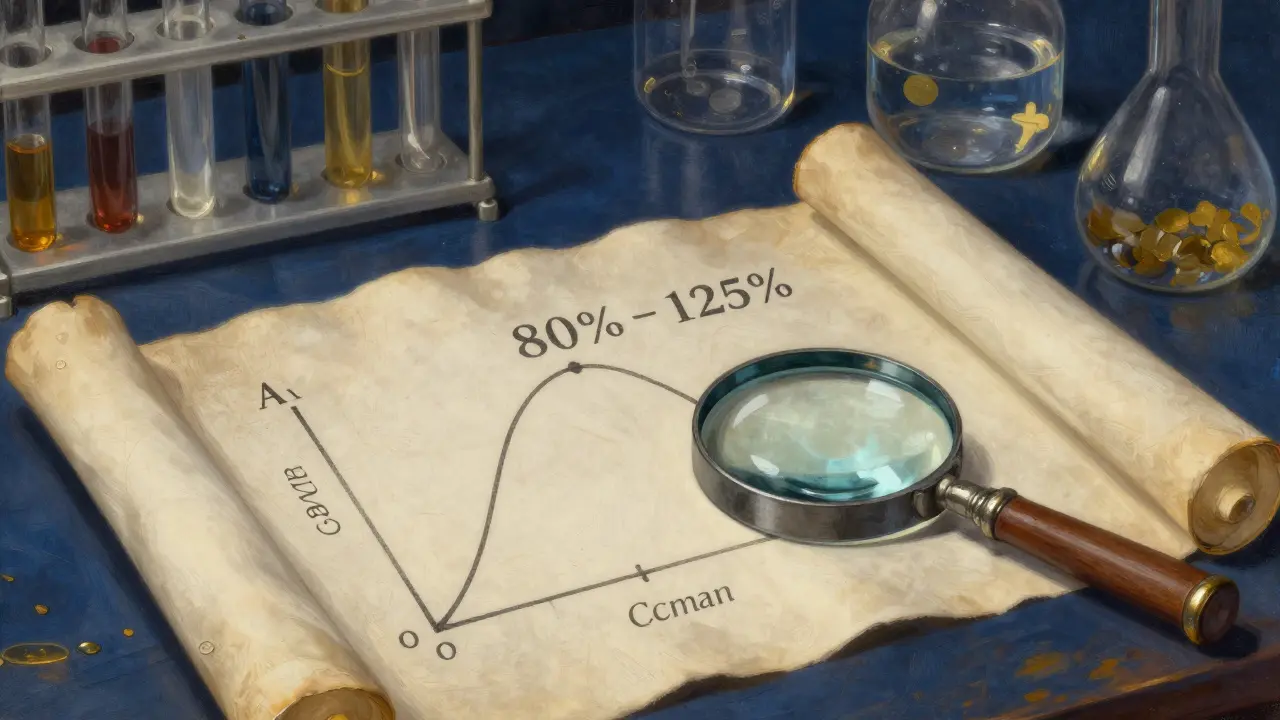
Once the blood samples are collected, the data is plugged into linear mixed-effects models. The researchers aren't just looking for a "yes" or "no"; they are looking for a specific range. For most drugs, bioequivalence is proven if the 90% confidence interval for the ratio of the geometric means between the test and reference product falls between 80% and 125%.
This applies to two main metrics: AUC (Area Under the Curve), which measures the total drug exposure over time, and Cmax, which is the peak concentration the drug reaches in the blood. If both of these fall within that 80-125% window, the drugs are considered bioequivalent. For those highly variable drugs mentioned earlier, the FDA may allow a widened window of 75% to 133.33% if the RSABE approach is used.
Practical Pitfalls and Implementation
Setting up these trials isn't just about following a template; there are several traps that can lead to a rejected submission. One of the biggest is improper randomization. You cannot randomize by treatment; you must randomize by sequence (AB vs. BA). If you don't, you might accidentally create a bias where the time of the dose affects the outcome more than the drug itself.
Another common mistake is the "missing data" trap. Because the power of a crossover design relies on the subject serving as their own control, losing a participant halfway through (or missing a blood sample) is a bigger blow than in a parallel study. If you lose too much data, you lose the very advantage that made you choose the crossover design in the first place.
Then there is the issue of drug half-life. If a drug stays in the system for a very long time-say, more than two weeks-a crossover design becomes impractical. You can't ask a volunteer to wait two months for a washout period. In those rare cases, researchers have to switch back to a parallel design, despite the need for a much larger group of people.
The Future of BE Testing
We are seeing a shift toward more adaptive designs. Instead of picking a sample size and hoping for the best, some studies now use a two-stage approach. They run a small initial group, re-estimate the variance, and then adjust the final sample size. This reduces the risk of under-powering a study and wasting resources.
There is also a growing trend toward using digital health tools for continuous monitoring. Instead of taking a few blood snapshots, we might eventually have ways to monitor drug levels in real-time. This could potentially change how we think about washout periods and sequence effects, though for now, the crossover remains the gold standard for getting a generic drug to market.
Why is a crossover design better than a parallel design for bioequivalence?
The primary advantage is that it eliminates inter-subject variability. Since each participant acts as their own control, differences in metabolism, age, or genetics between different groups of people don't skew the results. This significantly increases statistical power and allows researchers to use much smaller sample sizes-sometimes up to six times fewer participants than a parallel study.
What happens if the washout period is too short?
If the washout period is inadequate, "carryover effects" occur. This means the drug from the first period is still present in the subject's system when the second drug is administered. This contaminates the second set of results, making it impossible to tell if the observed effect is from the current drug or a remnant of the previous one, often leading to the study being rejected by regulatory agencies.
When should a replicate crossover design be used instead of a 2x2?
Replicate designs should be used for highly variable drugs, specifically those with an intra-subject coefficient of variation greater than 30%. In these cases, a standard 2x2 design often lacks the power to prove bioequivalence. Replicate designs (like 4-period studies) allow researchers to estimate within-subject variability more accurately and use reference-scaled bioequivalence approaches.
What are the standard acceptance limits for AUC and Cmax?
For most drugs, the 90% confidence interval for the ratio of the geometric means (test/reference) must fall between 80.00% and 125.00% for both AUC and Cmax. For highly variable drugs using reference-scaled average bioequivalence, these limits may be widened to 75.00% - 133.33%.
Can any drug be tested using a crossover design?
No. Drugs with extremely long half-lives (typically those staying in the system for more than two weeks) are unsuitable for crossover designs. The required washout period would be too long to be practical for the participants, making a parallel design the only viable option.
Ben Jima
April 23, 2026 AT 15:26The breakdown of the 2x2 design is spot on. For those working in the field, remembering that randomization must happen by sequence and not by treatment is a critical detail that prevents a lot of regulatory headaches during submission.