
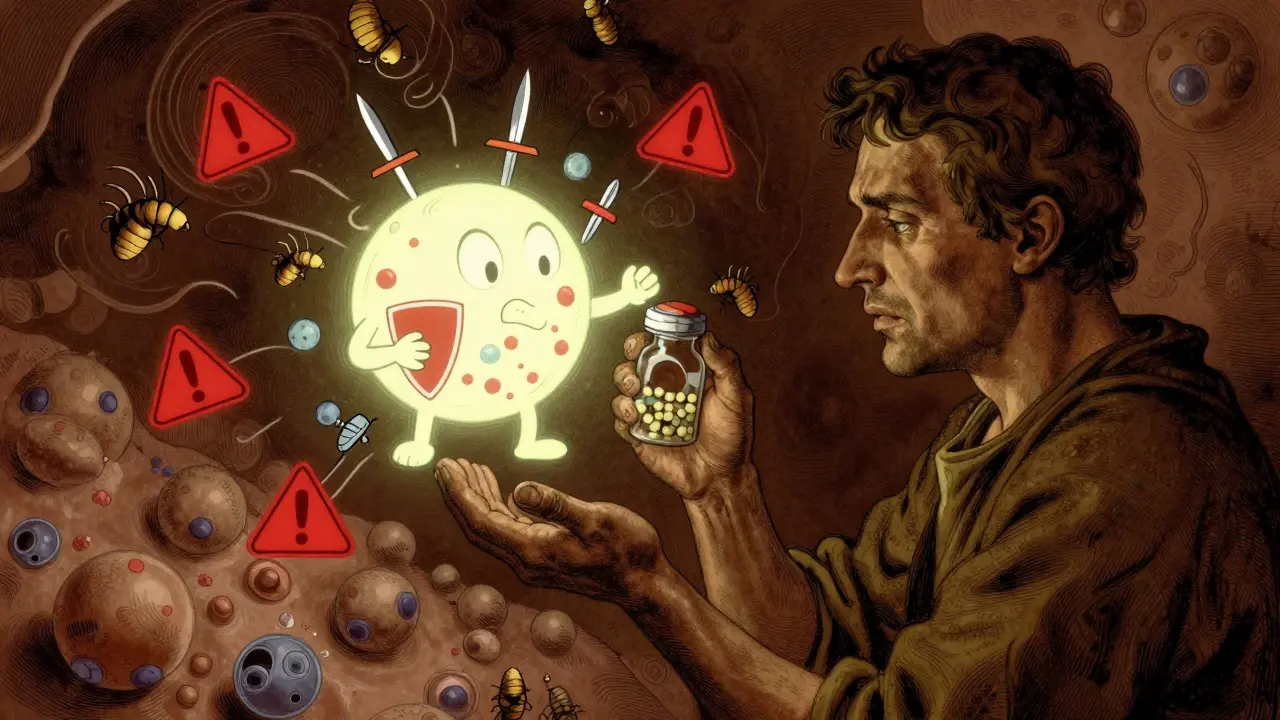
When you take a pill and get a rash, feel nauseous, or break out in hives, it’s natural to think: drug allergy. But what if it’s not? Most people who say they’re allergic to a medication aren’t. In fact, up to 90% of people labeled as allergic to penicillin can take it safely-once they’re properly tested. This confusion isn’t just a minor mix-up. It leads to worse treatments, higher costs, and even deadly infections. Understanding the difference between a true drug allergy and a side effect isn’t just helpful-it’s life-saving.
What’s Really Happening in Your Body?
A drug allergy means your immune system thinks the medication is a threat. It reacts like it’s fighting off a virus or pollen. Your body produces antibodies-usually IgE-that trigger histamine release. That’s what causes hives, swelling, trouble breathing, or anaphylaxis. These reactions are rare but dangerous. They can happen within minutes or hours after taking the drug.
Side effects, on the other hand, are just how the drug works. They’re not your immune system reacting. They’re predictable, dose-related, and built into the drug’s chemistry. For example, statins can cause muscle aches because they interfere with muscle cell energy production. Antibiotics like amoxicillin can cause diarrhea because they upset the good bacteria in your gut. These aren’t allergies. They’re side effects-and they often fade as your body adjusts.
Timing Tells the Story
When did the reaction happen? That’s your first clue.
If you got a rash, swelling, or breathing trouble within an hour of taking penicillin or another antibiotic, that’s a red flag for a true allergy. About 80-90% of immediate allergic reactions show up this fast. Anaphylaxis? That’s a medical emergency. You need epinephrine and a hospital.
But if you started feeling sick two or three days after beginning a new pill-nausea, dizziness, a mild rash-it’s probably a side effect. Many side effects appear in the first 72 hours and improve with continued use. For example, metformin causes diarrhea in up to 30% of users at first, but most people tolerate it fine after a few weeks.
Delayed reactions are trickier. A rash that shows up two to eight weeks after starting a drug like allopurinol or sulfamethoxazole could be DRESS syndrome-a rare but serious immune reaction with a 10% death rate. It comes with fever, swollen lymph nodes, and high eosinophil counts. This is a true allergy, but it’s not obvious. Doctors need to test for it.
Common Drugs, Common Confusions
Some drugs are more likely to be mislabeled as allergies than others. Penicillin tops the list. Eighty percent of all reported drug allergies involve penicillin or related antibiotics. But here’s the twist: only 5-10% of those people actually have a real allergy. Most had a rash as a kid with a virus, got labeled allergic, and never got tested again.
Other big culprits:
- NSAIDs like ibuprofen: Cause stomach upset, headaches, or kidney issues-not allergies. True allergy is rare.
- Statins: Muscle pain is common. It’s not an allergy. Stopping them can raise heart attack risk.
- Sulfa drugs: Many people say they’re allergic because they got a rash. But most rashes are viral, not drug-related.
- ACE inhibitors: Dry cough? That’s not an allergy. It’s from bradykinin buildup. Switching to a different blood pressure med fixes it.
Side effects like itching from opioids (30-50% of users) or frequent urination from SGLT2 diabetes drugs (1.5-2.2 times baseline) are normal. You don’t need to stop the drug-you just need to manage it.
Why Mislabeling Costs Lives (and Money)
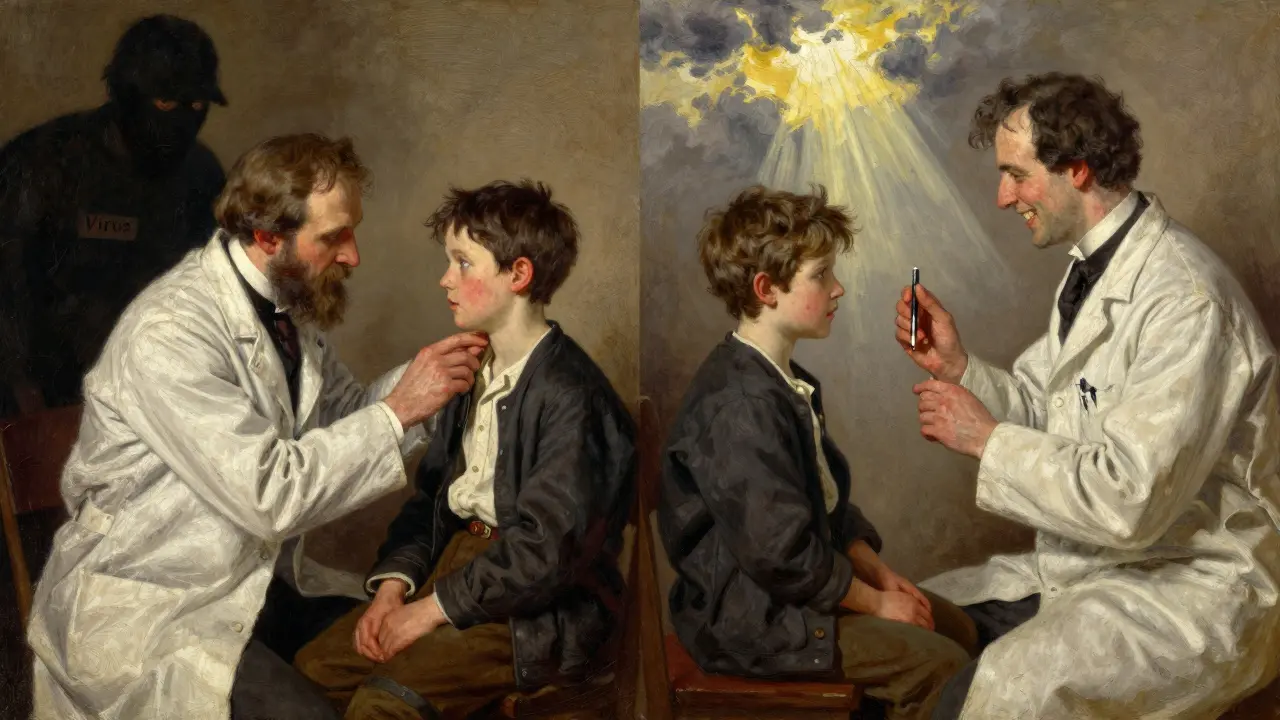
When you’re labeled allergic to penicillin, doctors avoid it. They give you something stronger-like vancomycin or clindamycin. Those drugs are broader-spectrum, more expensive, and more likely to cause C. diff infections. Patients with a mislabeled penicillin allergy have 2.5 times the risk of getting a C. diff infection. That means longer hospital stays, more antibiotics, and higher death rates.
The cost? In the U.S. alone, mislabeling adds over $1 billion a year in extra drug and hospital costs. One study found patients with a penicillin allergy label paid $1,025 more per hospital stay. That’s not just a bill-it’s a ripple effect across the whole healthcare system.
And it’s not just about money. People miss out on the best treatment. A woman with a UTI was denied trimethoprim-sulfamethoxazole for years because she thought she was allergic to sulfa. Turns out, she’d never had a real reaction. She got better within days after switching to the right drug.
How to Know for Sure
Don’t guess. Get tested.
If you think you’re allergic to penicillin, ask for a referral to an allergist. Standard testing includes skin prick and intradermal tests using penicillin derivatives. If both are negative, you’re likely not allergic. Then comes the oral challenge: you take a small, controlled dose under supervision. Over 85% of people who’ve been labeled allergic pass this test.
For delayed reactions like DRESS or Stevens-Johnson syndrome, blood tests and HLA gene testing (like HLA-B*15:02 for carbamazepine) are used. These aren’t routine, but they’re critical if you’ve had a severe reaction.
Don’t rely on memory. Did you get hives? Swelling? Trouble breathing? Or just a stomachache? Write it down. Tell your doctor exactly what happened-timing, symptoms, what you were taking, and whether you’ve taken it since. Vague labels like “allergic to antibiotics” are useless.
What You Can Do Right Now
You don’t need to wait for a specialist to start making smarter choices.
- Check your records. Look at your electronic health record. Does it say “penicillin allergy”? What symptoms were listed? If it just says “rash,” ask for clarification.
- Ask your pharmacist. They see your full history. They can flag if you’re on a more expensive or riskier drug because of a mislabeled allergy.
- Don’t self-diagnose. If you got sick after a drug, it doesn’t mean you’re allergic. Talk to your doctor before stopping anything.
- Use the decision aid. The American College of Physicians has a free tool to help patients describe reactions correctly. Print it. Bring it to your next appointment.
Some hospitals now have pharmacist-led allergy clinics. They review your history, run tests, and update your record. If you’re in a major city, ask if your hospital offers this. The Veterans Health Administration cut inappropriate penicillin avoidance by 80% using this model.

What’s Changing in 2026
Things are getting better-slowly. By 2027, 75% of U.S. hospitals will have automated alerts in their electronic systems. If you’re labeled penicillin-allergic and your doctor tries to prescribe vancomycin, the system will pop up: “Verify allergy status. Consider penicillin challenge.”
The FDA now requires drug labels to include clear “Allergy vs. Side Effect” guides in patient handouts. Researchers are working on blood biomarkers to detect true allergies without skin tests. And MedSafetyWeek 2024 made this distinction a global priority.
But progress depends on you. If you’ve been told you’re allergic to a drug, don’t accept it without proof. Ask questions. Demand testing. Your next prescription could depend on it.
Real Stories, Real Consequences
A man in Melbourne was told he was allergic to amoxicillin after a rash at age 7. He avoided all penicillins for 40 years. When he needed antibiotics for a heart valve infection, his doctors had to use a drug that caused severe kidney damage. After testing, he was cleared. He’s now on penicillin again-no problems.
A woman in Sydney stopped her statin because of muscle pain. She thought it was an allergy. Her cholesterol spiked. She had a heart attack. Her doctor later explained: muscle pain from statins is common. It’s not an allergy. She restarted the drug at a lower dose, added CoQ10, and stayed healthy.
These aren’t rare cases. They’re the norm. And they’re preventable.
Can you outgrow a drug allergy?
Yes, especially with penicillin. About 80% of people who had a true penicillin allergy as children lose it within 10 years. But you won’t know unless you get tested. Never assume you’ve outgrown it-get it confirmed by an allergist.
If I had a rash with amoxicillin as a kid, am I still allergic?
Probably not. Up to 90% of childhood rashes from amoxicillin are caused by viruses like Epstein-Barr, not the drug. The rash is a coincidence, not an allergy. Testing can confirm this safely.
Is it safe to try a drug again if I had a side effect?
Usually, yes. Side effects like nausea, dizziness, or mild itching often improve with time, dose adjustment, or adding another medication. For example, anti-nausea drugs can help with chemo side effects. But if you had a serious reaction-like swelling, breathing trouble, or a severe rash-don’t try it again without medical supervision.
Can a side effect become an allergy?
No. Side effects and allergies are different biological processes. But you can develop a true allergy to a drug even if you’ve taken it safely before. Your immune system can change. That’s why you should never assume you’re safe just because you’ve used a drug before.
What should I do if I think I’m allergic to a drug?
Write down exactly what happened: what drug, when, what symptoms, how long they lasted, and if you’ve taken it since. Then ask your doctor for a referral to an allergist. Don’t just rely on your old chart. Get tested. It’s the only way to know for sure.
What to Do Next
If you’ve ever been told you’re allergic to a drug, take five minutes today. Look up your medical records. Check how your allergy is documented. Is it vague? Just “allergic to penicillin”? That’s not enough. Ask for specifics. Then ask if you can be tested.
If you’re a parent, check your child’s record. Many childhood rashes are mislabeled. That label can follow them for life.
And if you’re a patient or caregiver: speak up. If your doctor prescribes a drug you think you’re allergic to, ask: “Is this a true allergy or a side effect?” That simple question can change your treatment-and maybe your life.
steve ker
January 13, 2026 AT 12:49Drug allergies are overblown. Most people just hate how meds make them feel and call it an allergy. I took amoxicillin once, got a little itchy, and now my whole family thinks I'm allergic. Whatever.
Stop wasting doctors' time.
George Bridges
January 14, 2026 AT 21:39I appreciate how clearly this breaks down the difference between side effects and true allergies. My sister was labeled penicillin-allergic after a childhood rash-turned out it was roseola. She avoided antibiotics for 15 years until she got tested. Now she’s fine. This kind of info saves lives.
Thanks for sharing the real data, not just fear.
Faith Wright
January 15, 2026 AT 06:39Oh wow, so if you get diarrhea from antibiotics it’s not an allergy? Shocking. I guess I should’ve known that when I was vomiting in the ER at 12. My mom just said ‘you’re allergic’ and that was that.
Thanks for the 2024 enlightenment, doc.
Also, why is this post 17 pages long? I just wanted to know if I could take ibuprofen.
Rebekah Cobbson
January 16, 2026 AT 05:57If you’ve ever been told you’re allergic to a drug, please don’t just accept it. I was told I was allergic to sulfa after a mild rash during a UTI in college. I believed it for 10 years. Then I got a kidney infection and my doctor insisted I get tested. Turns out I was fine. I took the sulfa drug, felt great, and saved myself $3000 in unnecessary antibiotics.
You deserve the best treatment-not the one based on a 20-year-old mistake.
Ask for a referral. Bring this article. Be your own advocate.
Audu ikhlas
January 17, 2026 AT 01:32USA doctors always overcomplicate everything. In Nigeria we just say ‘this drug bad’ and stop. Why waste time with tests? Your body knows. If you feel bad, the drug is evil. No need for science. We don’t need your Western overthinking.
Also, penicillin is for weak people. We use garlic and prayer.
Sonal Guha
January 18, 2026 AT 13:3990% of penicillin allergies are misdiagnosed? That’s statistically implausible. You’re ignoring confounding variables: viral rashes, placebo effects, and the fact that most patients can’t describe symptoms accurately. This article reads like a pharma-funded op-ed.
Also, statins causing muscle pain? That’s a known mechanism. Not a side effect. It’s direct toxicity. Stop sugarcoating.
TiM Vince
January 18, 2026 AT 22:15My mom had a rash after penicillin as a kid. We always assumed it was an allergy. Last year she got pneumonia. They gave her amoxicillin anyway-she was fine. No reaction. She’s 72. Never got tested. I’m going to get her records pulled next week.
Thanks for the nudge.
gary ysturiz
January 20, 2026 AT 12:18This is so important. If you think you’re allergic to a drug, don’t assume. Get tested. It’s simple. It’s safe. It could save your life. I used to avoid NSAIDs because I got a headache once. Turns out I just needed to take them with food. No allergy. Just bad timing.
You don’t need to suffer because of a mistake from 10 years ago.
Ask your doctor. Do the thing.
Jessica Bnouzalim
January 22, 2026 AT 09:38Okay, I just read this whole thing and I’m crying a little. I’ve been avoiding penicillin since I was 8 because I got a rash after a cold. I thought I was doomed to always get the ‘stronger, worse’ antibiotics. I just called my doctor and asked for a referral. I’m so glad I didn’t ignore this. Thank you for writing this. I feel like I just got my health back.