

When a drug has a narrow therapeutic index (NTI), even tiny changes in dosage or blood levels can lead to serious side effects-or worse, treatment failure. This isn’t just a technical detail; it’s a matter of life and death for patients taking medications like warfarin, digoxin, or phenytoin. The FDA doesn’t treat these drugs the same way as regular generics. If you’re wondering why some generic versions of these drugs are approved while others raise red flags, the answer lies in the FDA’s strict bioequivalence standards for NTI drugs.
What Makes a Drug an NTI Drug?
An NTI drug is defined by the FDA as one where the difference between a safe dose and a toxic dose is very small. In 2022, the agency settled on a clear cutoff: a therapeutic index of 3 or less. That means the dose that causes toxicity is no more than three times the dose that works. Out of 13 drugs studied, 10 fit this definition. Examples include carbamazepine, tacrolimus, lithium, and valproic acid. These aren’t just random medications-they’re used for critical conditions like epilepsy, organ transplants, and heart failure. A 10% change in blood concentration might mean the difference between controlling seizures and causing brain damage.
Not every drug with a narrow range is automatically labeled an NTI drug. The FDA uses five criteria to decide:
- The maximum difference between the lowest effective dose and the lowest toxic dose is no more than 2-fold.
- The range of drug concentrations that work therapeutically is no wider than 2-fold.
- The drug requires regular blood monitoring to stay in the safe zone.
- Within-subject variability (how much a person’s own levels fluctuate) is low to moderate-no more than 30%.
- Dosage adjustments are made in small increments, often less than 20%.
These aren’t guesses. They’re based on pharmacometric modeling using real clinical data. The FDA doesn’t publish a full list of NTI drugs. Instead, each drug’s requirements are spelled out in product-specific guidance documents. If you want to know whether a generic version of your medication meets the standard, you have to check the FDA’s guidance for that exact drug.
Why Standard Bioequivalence Doesn’t Work for NTI Drugs
For most generic drugs, the FDA accepts bioequivalence if the generic’s absorption rate falls between 80% and 125% of the brand-name drug. That’s a 45-percentage-point window. For NTI drugs, that’s far too wide. A 20% difference in blood levels could mean a patient’s anticoagulant level drops below therapeutic range-or spikes into dangerous territory. In 2010, the FDA’s Advisory Committee voted 11-2 to reject the standard range for NTI drugs. Their solution? A tighter 90% to 111% range.
But it’s not that simple. The FDA doesn’t just slap on a new number. They use a scaled approach called Reference Scaled Average Bioequivalence (RSABE). This method adjusts the acceptable range based on how much the original brand-name drug varies from person to person. If the reference drug has high variability, the limits widen slightly. But for NTI drugs, even with scaling, the upper limit can’t exceed 111.11%. And here’s the kicker: the generic must also pass the traditional 80%-125% test. It has to satisfy both.
There’s another layer: variability between the test and reference products. The FDA requires that the ratio of within-subject variability (how much the generic varies compared to the brand) must have an upper 90% confidence interval of 2.5 or less. That means the generic can’t be more inconsistent than 2.5 times the brand. This prevents manufacturers from making a product that’s average but unpredictable.
How NTI Bioequivalence Studies Are Done Differently
Testing a generic NTI drug isn’t like testing a regular one. Standard bioequivalence studies use a two-period, two-sequence crossover design-patients get the brand, then the generic, or vice versa. For NTI drugs, that’s not enough. The FDA requires replicate designs. That means each patient takes both the brand and the generic at least twice. This gives researchers more data points to measure consistency.
These studies need larger sample sizes, too. A typical study for a non-NTI drug might include 24 to 36 people. For NTI drugs, studies often include 40 to 60. More participants mean more reliable data when the acceptable range is so narrow.
The analysis is more complex as well. Instead of just comparing average blood levels, regulators look at the full distribution. They check not just whether the average is close, but whether the spread of results stays within strict bounds. A generic might have the same average as the brand, but if some patients get 130% of the expected level and others get 70%, it fails-even if the average is 100%.
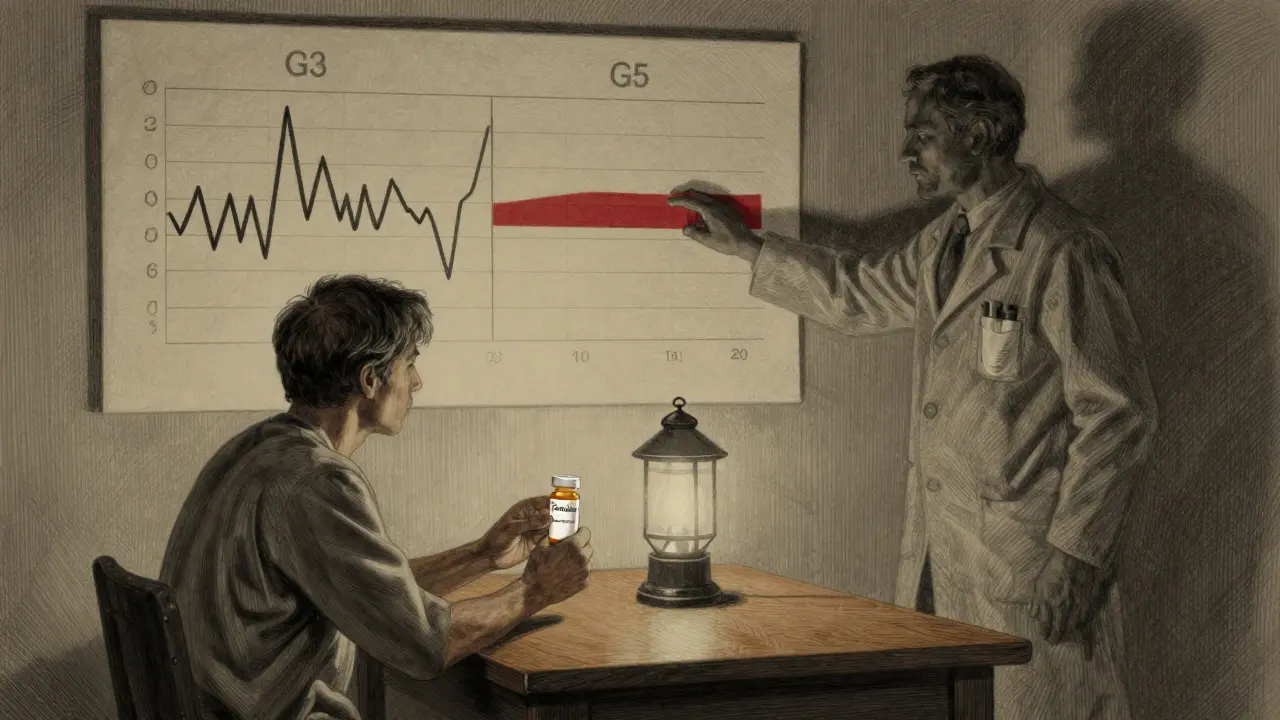
One study showed that two generics (G3 and G4) passed the standard 80%-125% test but failed to be bioequivalent to each other. Another pair (G5 and G6) passed the stricter NTI criteria and were equivalent to each other. This proves that the standard test isn’t good enough. Only the tighter rules catch the inconsistencies that matter.

Which Drugs Are Affected?
The FDA has applied these stricter standards to a handful of high-risk drugs. The most common NTI drugs include:
- Immunosuppressants: Cyclosporine, tacrolimus, sirolimus, mycophenolic acid
- Antiepileptics: Carbamazepine, phenytoin, valproic acid
- Anticoagulants: Warfarin
- Cardiac glycosides: Digoxin, digitoxin
- Mood stabilizers: Lithium carbonate
These drugs are often taken for life. A patient on tacrolimus after a kidney transplant can’t afford a drop in blood levels-rejection could follow. A small spike in phenytoin could cause seizures or coma. That’s why even small differences matter.
Interestingly, the FDA doesn’t have a public list of all NTI drugs. You won’t find it on their website. Instead, each drug’s requirements are buried in product-specific guidance documents. For example, if you’re looking at a generic version of digoxin, you have to check the FDA’s guidance for digoxin specifically. This makes it hard for patients and even pharmacists to know whether a generic is truly equivalent.
How This Compares to Other Countries
Other regulators handle NTI drugs differently. Health Canada and the European Medicines Agency (EMA) usually just tighten the bioequivalence range to 90%-110% or 90%-111%. They don’t use scaling. The FDA’s approach is more sophisticated because it accounts for the brand’s own variability. But this also makes it harder to compare results across borders.
For example, a generic tacrolimus approved in the U.S. might not meet EMA standards, or vice versa. This creates challenges for global drug supply chains and limits patient access. The FDA admits this is a problem and says harmonization with other agencies is a priority. But for now, U.S. standards remain the strictest.
Are Generic NTI Drugs Safe?
Yes-when they meet the FDA’s requirements. The agency insists that any generic approved under these rules is therapeutically equivalent to the brand. Real-world data supports this. Studies of transplant patients switching from brand to generic tacrolimus show no increase in rejection rates. Warfarin users on generics have similar INR control as those on the brand.
But here’s the catch: not all generics are created equal. Research shows that two generics approved under NTI standards can still differ from each other. That’s why switching between different generic brands-even if each is FDA-approved-can be risky. The FDA doesn’t require generics to be equivalent to each other, only to the brand. So if your doctor switches you from Generic A to Generic B, you might not be getting the same dose.
Some states still require patient consent before substituting an NTI generic. Pharmacists in some places are trained to avoid automatic substitution. The FDA says this isn’t necessary if the drug meets their standards-but changing practice takes time.
What Patients Should Know
If you’re taking an NTI drug, here’s what you need to do:
- Know your drug. Is it on the list? Ask your pharmacist or check the FDA’s product-specific guidance.
- Stick with the same generic brand if possible. Switching between generics-even if they’re both approved-can cause instability.
- Monitor your levels. If your drug requires blood tests, don’t skip them. Even small changes matter.
- Don’t assume all generics are interchangeable. The FDA approves them as equivalent to the brand, not to each other.
There’s no need to fear generics. The FDA’s standards are designed to protect you. But understanding how they work helps you make smarter choices about your treatment.
What drugs are classified as NTI drugs by the FDA?
The FDA classifies drugs as NTI based on specific pharmacometric criteria, not a public list. Common examples include warfarin, digoxin, phenytoin, carbamazepine, tacrolimus, cyclosporine, lithium, and valproic acid. These drugs have a therapeutic index of 3 or less, meaning small changes in dose can lead to serious side effects or treatment failure. Each drug’s requirements are detailed in product-specific FDA guidance documents.
Why is the bioequivalence range for NTI drugs narrower than for other drugs?
For most drugs, the FDA allows a bioequivalence range of 80% to 125%. But for NTI drugs, a 20% difference in blood concentration can be dangerous-potentially causing toxicity or treatment failure. That’s why the FDA tightens the range to 90% to 111% for NTI drugs. This ensures that generic versions deliver nearly identical exposure, reducing the risk of harm.
Do all generic versions of NTI drugs meet the same standards?
No. Each generic must meet the FDA’s stricter bioequivalence criteria for the brand-name drug, but generics from different manufacturers can still differ from each other. Two generics approved under NTI standards may not be bioequivalent to each other. This is why sticking with the same generic brand is recommended, especially for drugs like tacrolimus or warfarin.
How does the FDA test bioequivalence for NTI drugs?
The FDA requires replicate studies for NTI drugs, where patients take both the brand and generic versions multiple times. This gives more data to measure consistency. The study must show that the generic passes both the scaled bioequivalence limits (90%-111%) and the conventional limits (80%-125%). It must also demonstrate that the variability between the generic and brand is no more than 2.5 times higher. These requirements are much stricter than for non-NTI drugs.
Can I safely switch between different generic brands of an NTI drug?
The FDA says generics approved under NTI standards are therapeutically equivalent to the brand-but not necessarily to each other. Switching between different generic brands may cause fluctuations in drug levels, especially for drugs like warfarin or phenytoin. It’s safest to stay on the same generic brand unless your doctor or pharmacist advises otherwise and monitors your levels closely.
jared baker
March 15, 2026 AT 14:47So if you're on warfarin or digoxin, stick with the same generic brand. No switching. Simple. The FDA says they're all good, but real life? Not so much. I've seen patients go off the rails after a pharmacy switch. Blood tests don't lie. Keep it consistent. Your body remembers.
Linda Olsson
March 16, 2026 AT 14:19Oh please. The FDA doesn't care about you. They're just protecting Big Pharma's profits under the guise of 'safety.' You think these 'strict standards' are science? Nah. It's a loophole. The same companies that make the brand-name drugs also make the generics. They're playing the system. And you? You're the sucker paying extra because you can't switch to a cheaper version. Wake up.
They don't publish the full list because they don't want you to know how many drugs are actually being sneaked through. I dug into the product-specific guidance docs last year. Half of them had hidden loopholes. One drug had a 108% upper limit disguised as 'scaled bioequivalence.' That's not science. That's corporate theater.
And don't get me started on the 'replicate designs.' They use tiny sample sizes and cherry-pick healthy volunteers. Real patients? We fluctuate. We're sick. We're on five other meds. But the FDA doesn't test that. They test 20-year-old college kids on a controlled diet. That's not bioequivalence. That's fantasy.
They want you to believe the system works. But I've seen three people end up in the ER because their 'FDA-approved' generic didn't match their old one. And guess who got sued? The pharmacy. Not the manufacturer. Not the FDA. Just the pharmacist trying to save a buck.
MALYN RICABLANCA
March 18, 2026 AT 10:26OH MY GOD. DID YOU KNOW THAT THE FDA'S '90%-111%' RANGE IS ACTUALLY A SLEIGHT OF HAND?!?!?!?!?!
They say 'scaled bioequivalence' but what they're REALLY doing is letting manufacturers wiggle around with statistical gymnastics like they're doing a backflip on a tightrope while juggling flaming chainsaws!!!
And the 'within-subject variability ratio'?!?! That's just corporate-speak for 'we let them be up to 2.5x more inconsistent than the brand'-which, if you're on tacrolimus after a transplant, means your body could be in a war zone every time you take a pill!!!
AND THEY WON'T EVEN TELL YOU WHICH GENERICS ARE WHICH?!?!?!?!?!? You have to dig through PDFs buried in the FDA's digital graveyard like some kind of archaeologist hunting for the lost scrolls of Atlantis!!!
I had a cousin who switched from Generic A to Generic B for his lithium-and he had a seizure. TWO WEEKS LATER. The pharmacy said 'they're both FDA-approved.' The FDA said 'they're equivalent to the brand.' But NO ONE TOLD HIM THEY WEREN'T EQUIVALENT TO EACH OTHER!!!
THIS ISN'T HEALTHCARE. THIS IS A TERRIFYING GAME OF CHINESE WHISPERS WHERE THE PATIENT IS THE LAST PERSON IN THE LINE AND THE WHISPER IS 'YOU'RE GOING TO DIE.'!!!
WHY ISN'T THIS ON THE EVENING NEWS?!?!?!?!?!?!
Michelle Jackson
March 20, 2026 AT 08:46Ugh I hate this stuff. I'm on carbamazepine and my pharmacist switched me to a cheaper generic last month. I felt like garbage for two weeks. Headaches, foggy brain, like my thoughts were underwater. I called my doc, they said 'it's FDA-approved'-yeah, but so is that $10 Walmart brand of ibuprofen that gives me a stomachache. Why do they even let this happen???
And now I have to pay $80 for my old brand because the pharmacy won't refill the other one. So much for 'cost savings.' I'm just out money and feeling like a lab rat.
gemeika hernandez
March 20, 2026 AT 20:03It's so simple. If your drug is on the list, don't switch generics. Ever. I'm on lithium. My doctor told me to stick with one brand. I did. I'm stable. My blood levels are perfect. My friend switched because her insurance changed. She ended up in the psych ward. Don't be her. Just don't.
Ayan Khan
March 21, 2026 AT 19:09There is a deeper truth here. We speak of bioequivalence as if it is a mathematical certainty-but medicine is not mathematics. It is the meeting of chemistry, biology, and human suffering. Each pill, even if statistically identical, carries the weight of a life. A mother on warfarin. A child with epilepsy. A man waiting for a new kidney.
The FDA's standards, however strict, are still a human construct. They are born from data, yes-but also from compromise, from politics, from the limits of what we can measure.
Perhaps the real question is not whether two generics are bioequivalent-but whether our system honors the dignity of those who depend on them. Can we say we care for the patient if we allow their medicine to be a lottery?
Maybe the answer is not more data, but more humility. More transparency. More listening to those who live with these drugs every day.
Science gives us tools. But compassion gives us purpose.
becca roberts
March 23, 2026 AT 19:00Oh wow. So the FDA is basically saying 'we trust these generics... unless they're not the same as each other.' That’s like saying 'this car is safe... as long as you don’t switch to a different model of the same car.' What a joke.
And yet, somehow, we’re supposed to be grateful? 'Oh thank you, FDA, for making it harder to get cheap medicine so we can be confused about whether we’re getting the same thing!'
I’m just here wondering how many people died because someone switched generics and no one told them to watch their levels. And how many of those deaths were quietly buried under 'unrelated causes.'
Andrew Mamone
March 24, 2026 AT 10:44👏 This is one of the clearest breakdowns I’ve seen. Seriously. The FDA’s approach is complex, but you laid it out so well. The scaled bioequivalence + dual testing + variability limits? That’s actually brilliant engineering. It’s not perfect, but it’s the best we’ve got.
And yes, switching generics is risky-not because the system is broken, but because biology is messy. We’re not dealing with aspirin here. We’re dealing with drugs that live on a razor’s edge.
Patients: if you’re on one of these, keep your brand. Get your levels checked. Talk to your pharmacist. You’re not being paranoid-you’re being smart.
And to the FDA: please, please make a public list. Even if it’s just a spreadsheet. People are guessing. People are getting hurt.
Lauren Volpi
March 24, 2026 AT 19:06USA STRONG. OTHER COUNTRIES JUST TIGHTEN THE RANGE TO 90-110. WE GO ALL OUT WITH SCALING, REPLICATE DESIGNS, AND CONFIDENCE INTERVALS. THAT’S WHAT MAKES US NUMBER ONE. NO OTHER COUNTRY HAS THIS LEVEL OF 'SCIENTIFIC EXCELLENCE.' WE DON’T JUST APPROVE DRUGS. WE PERFECT THEM.
IF YOU’RE NOT USING AN FDA-APPROVED NTI GENERIC, YOU’RE LEAVING YOUR LIFE TO CHANCE. WE DID THE WORK. YOU’RE WELCOME.
jared baker
March 24, 2026 AT 23:33^^^ This. Exactly. Stick with the same brand. I’ve been a pharmacist for 18 years. I’ve seen what happens when people switch. It’s not worth the risk. Even if the FDA says it’s fine. Your body doesn’t care about regulatory approvals. It cares about consistency.