
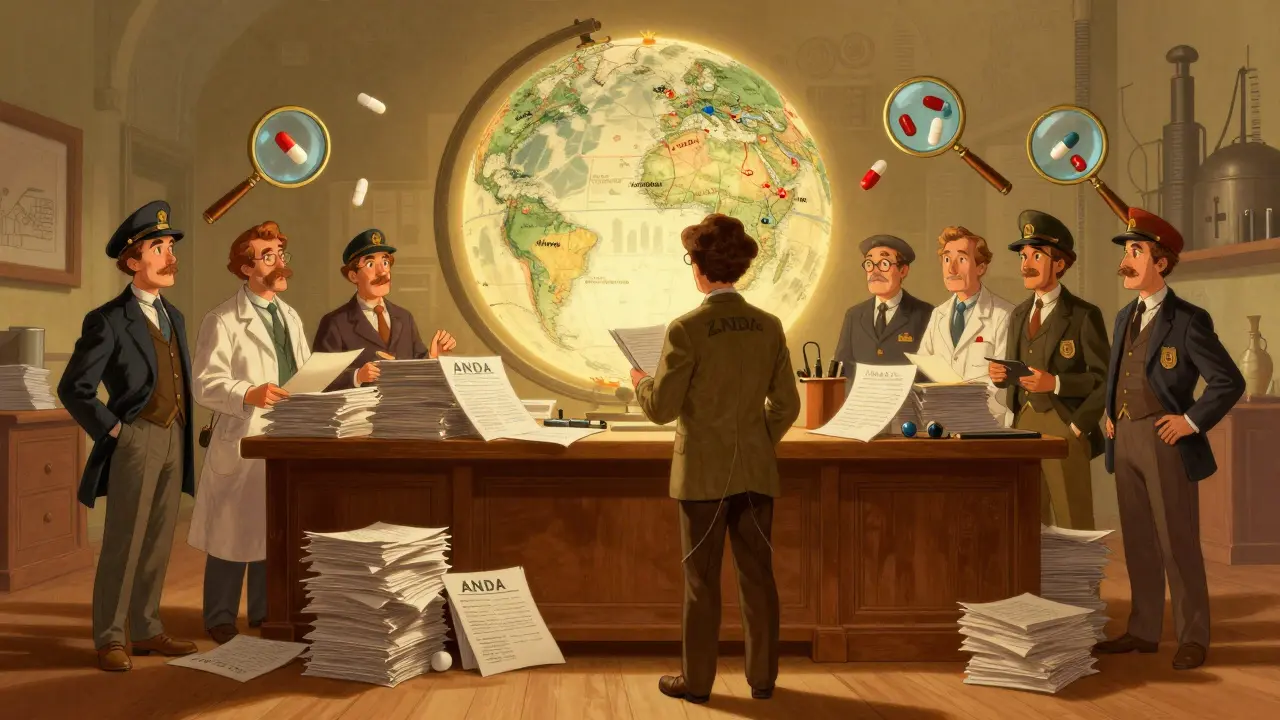
The FDA Office of Generic Drugs (OGD) is the engine behind every generic medication you pick up at your pharmacy. It’s not a behind-the-scenes footnote - it’s the team that makes sure your $4 prescription for metformin or lisinopril is just as safe and effective as the brand-name version, even if it costs a fraction of the price. Without OGD, the U.S. generic drug market - which now supplies over 90% of all prescriptions - would collapse under its own weight. This office doesn’t just approve pills; it manages the entire lifecycle of generic drugs, from the first lab test to the last pill bottle on the shelf.
How OGD Fits Into the FDA
OGD sits inside the Center for Drug Evaluation and Research (CDER), which is the part of the FDA responsible for reviewing all new drugs. But in 2013, the FDA gave OGD a major upgrade. It was elevated to a "super office," meaning it reports directly to the CDER director, not through layers of bureaucracy. This wasn’t just a title change. It was a signal: generic drugs matter. They’re not second-class medicines. They’re the backbone of affordable healthcare. Before this reorganization, generic drug reviews were scattered across different teams, leading to delays and inconsistent standards. Now, OGD brings everything under one roof: science, policy, regulation, safety, and global coordination. This structure lets the office move faster, make smarter decisions, and respond quickly when a drug shortage hits or a new generic enters the market.The Five Sub-Offices That Keep Generic Drugs Moving
OGD isn’t one big team. It’s five specialized units, each with a clear job:- Immediate Office (IO): The command center. This team sets the strategy, handles legal and policy questions, and talks to Congress, foreign regulators, and the media. It includes the Global Generic Drug Affairs Team, which works with agencies in Europe, Canada, and India to align standards - because a pill made in India must meet U.S. safety rules.
- Office of Bioequivalence (OB): This is where the science gets real. Bioequivalence means proving a generic drug works the same way in your body as the brand-name version. OB runs the tests, sets the standards, and reviews data on how the drug is absorbed. If the generic doesn’t match the brand’s performance within strict limits, it gets rejected. No exceptions.
- Office of Generic Drug Policy: This unit handles the legal gray zones. Think patents, exclusivity periods, and the Hatch-Waxman Act - the 1984 law that created the modern generic drug system. If a brand company tries to delay a generic by filing a new patent, this office decides if it’s valid or just a tactic to block competition.
- Office of Regulatory Operations (ORO): The project managers. ORO’s Regulatory Project Managers (RPMs) are the ones tracking every single generic application. They make sure reviews stay on schedule under GDUFA deadlines. If a company submits an ANDA (Abbreviated New Drug Application), an RPM owns it from start to finish - assigning reviewers, checking deadlines, and pushing through bottlenecks.
- Office of Research and Standards (ORS): This team builds the tools for the future. They develop new ways to test drug quality, use modeling to predict how a drug behaves in the body, and create standards for complex generics like inhalers or injectables. Without ORS, the FDA would be stuck using 1980s methods to evaluate 2020s medicines.
There’s also the Office of Safety and Clinical Evaluation, embedded within OB, which watches for side effects after generics hit the market. It’s not enough to prove a drug works in a clinical trial - OGD needs to know it’s safe when millions of people use it for years.
What OGD Actually Reviews: The ANDA Process
The main job of OGD is reviewing Abbreviated New Drug Applications, or ANDAs. Unlike new drugs, which require full clinical trials, generics don’t need to repeat those studies. Instead, they prove they’re bioequivalent and manufactured to the same quality standards. But that doesn’t mean it’s easy. An ANDA has to show:- The active ingredient is identical to the brand drug
- The strength, dosage form, and route of administration (pill, injection, etc.) match
- The generic dissolves in the body at the same rate and amount
- The manufacturing facility meets FDA quality rules
- The labeling is accurate and matches the brand
OGD doesn’t just read paperwork. It inspects factories - sometimes unannounced - to make sure the pills you get aren’t just chemically similar, but made in clean, controlled environments. In 2024, OGD conducted over 1,200 inspections worldwide, from plants in New Jersey to facilities in Hyderabad.
How GDUFA Keeps the System Running
The Generic Drug User Fee Amendments (GDUFA) is the financial engine behind OGD. Before GDUFA, the FDA relied on taxpayer money, and generic reviews took years. Now, generic drug makers pay fees to fund the review process. That money pays for scientists, inspectors, and software systems. GDUFA isn’t just about money - it’s about deadlines. Under GDUFA, OGD must review 90% of first-time generic applications within 10 months. For priority applications - like those for drugs in short supply - the goal is 7.5 months. These aren’t suggestions. They’re legally binding targets. If OGD misses them, Congress takes notice. That’s why the office tracks every application like a clock.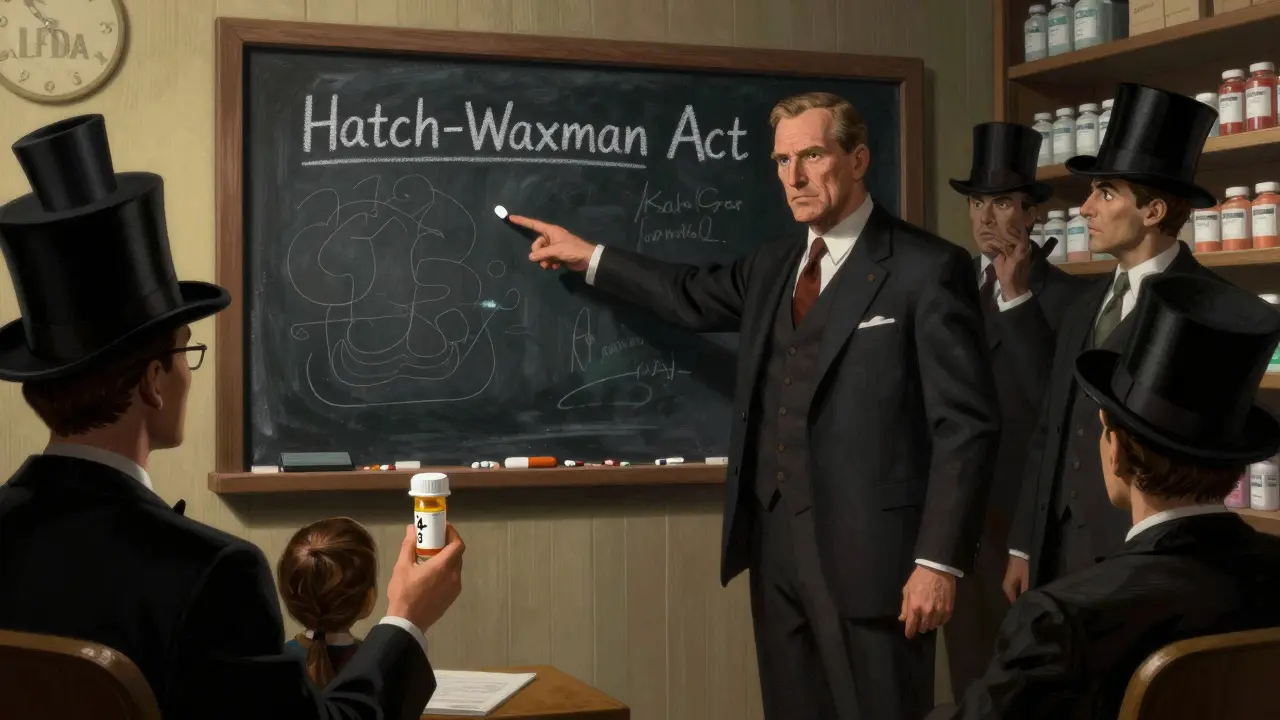
Patents, Exclusivity, and the Hatch-Waxman Act
The Hatch-Waxman Act of 1984 was the game-changer. It let generic companies file ANDAs before a brand drug’s patent expired - as long as they certified the patent was invalid or wouldn’t be infringed. This created a legal path for competition. OGD’s Division of Legal and Regulatory Support is the gatekeeper here. They track every patent listed in the FDA’s Orange Book. They decide if a generic applicant’s certification is valid. They determine if a company qualifies for 180-day exclusivity - a reward for being the first to challenge a patent. This is where legal battles begin. If a brand company sues a generic maker, OGD doesn’t get involved in court - but it does pause approval until the dispute is resolved.Why OGD Matters to You
Every time you save $50 on a prescription because you chose the generic, you’re benefiting from OGD’s work. In 2024, generic drugs saved the U.S. healthcare system over $370 billion. That’s not just a number - it’s insulin for diabetics, blood pressure pills for seniors, antibiotics for kids. OGD also steps in during shortages. When a brand drug runs out or a manufacturer shuts down, OGD fast-tracks generic alternatives. In 2023, they approved 17 priority generics for drugs in short supply - including a critical chemotherapy and a life-saving heart medication. And it’s not just about pills. OGD now handles complex generics: inhalers, injectables, patches, and even biosimilars. These aren’t simple copies - they’re technically advanced products that require new science, new testing, and new standards. OGD is building that science now, so tomorrow’s generics are just as reliable as today’s.Global Reach, Local Impact
OGD doesn’t work in isolation. Its Global Generic Drug Affairs Team talks regularly with regulators in the EU, Canada, Australia, and India. Why? Because many U.S. generics are made overseas. If India’s drug regulator finds a quality issue, OGD needs to know - fast. That team helps align standards so a pill made in China meets U.S. safety rules without requiring a whole new review. This global coordination is critical. The U.S. imports over 80% of its active pharmaceutical ingredients. OGD ensures those ingredients are safe, even if they come from halfway around the world.
What Happens When OGD Says No?
Not every application gets approved. About 15% of ANDAs get a complete response letter - meaning the FDA found problems that need fixing. Common reasons:- Bioequivalence data doesn’t meet thresholds
- Manufacturing defects or cleanliness issues
- Labeling inaccuracies
- Patent or exclusivity conflicts
Companies can resubmit. But they have to fix the issue - and OGD won’t cut corners. If the data is shaky, the application is rejected. No exceptions. That’s why generic drugs are trustworthy.
| Goal | Target | 2024 Actual Performance |
|---|---|---|
| First-time ANDA review | ≤10 months | 87% met deadline |
| Prioritized ANDA (shortage drugs) | ≤7.5 months | 92% met deadline |
| Inspections completed | 1,200+ per year | 1,243 inspections |
| Generic approvals issued | 1,000+ per year | 1,184 approvals |
Frequently Asked Questions
Is a generic drug the same as the brand name?
Yes, in every way that matters. A generic drug must have the same active ingredient, strength, dosage form, and route of administration as the brand. It must also be bioequivalent - meaning it works the same way in your body. The only differences are in inactive ingredients (like fillers or dyes) and packaging. These don’t affect how the drug works.
Why are generic drugs cheaper?
Because generic manufacturers don’t have to repeat expensive clinical trials. They rely on the brand’s existing safety and effectiveness data. Their main costs are manufacturing and FDA review fees. That’s why a 30-day supply of generic lisinopril can cost $4 instead of $120 for the brand.
Does the FDA inspect foreign generic drug factories?
Yes. OGD inspects facilities worldwide, including in India, China, and other countries that supply active ingredients. In 2024, over 70% of inspections were conducted outside the U.S. The FDA doesn’t trust labels - it sends inspectors to see how drugs are made.
Can a generic drug cause different side effects?
Rarely. Side effects come from the active ingredient, which is identical. But some people may react to different inactive ingredients - like dyes or preservatives. If you’ve had a reaction to a brand, switching to a different generic might help. Always talk to your pharmacist.
How long does it take to get a generic approved?
Under GDUFA, OGD aims to review first-time applications within 10 months. Priority applications - like those for drugs in short supply - are targeted for 7.5 months. Actual times vary based on complexity, but the average is under 9 months. That’s a big improvement from the 3-5 years it took before GDUFA.
Susie Deer
January 15, 2026 AT 23:17OGD is why my insulin costs $30 instead of $300. No more hand-wavy corporate BS. If you're not for generics you're against affordable healthcare. Period.
TooAfraid ToSay
January 15, 2026 AT 23:48Wait so you're telling me the FDA actually does its job? That's a first. Next you'll say the moon landing was real and aliens don't control the FDA through subliminal messages in pill coatings.
Allison Deming
January 16, 2026 AT 04:07It is imperative to recognize that the structural reorganization of the Office of Generic Drugs represents a paradigmatic shift in regulatory prioritization, wherein the historical marginalization of generic pharmaceuticals has been systematically dismantled through institutional elevation and resource reallocation. This is not merely bureaucratic reform-it is a moral imperative in public health equity.
The integration of global coordination under the Immediate Office signifies a critical evolution in transnational regulatory alignment, particularly with respect to the importation of active pharmaceutical ingredients from nations with divergent quality control frameworks. Without such harmonization, the integrity of the U.S. pharmacopeia would be untenable.
Furthermore, the enforcement of GDUFA deadlines is not simply an administrative target; it is a societal covenant between the state and its citizens, ensuring that life-sustaining medications are not withheld due to bureaucratic inertia.
The bioequivalence standards maintained by the Office of Bioequivalence are among the most rigorous in the world, surpassing even the European Medicines Agency in methodological precision. This is not coincidence-it is excellence.
One must also consider the ethical implications of patent evergreening, wherein brand manufacturers exploit legal loopholes to delay market entry. The Office of Generic Drug Policy serves as the sole bulwark against such predatory practices, and its existence must be defended with unyielding resolve.
It is no exaggeration to state that the 1,243 inspections conducted in 2024 represent a monumental safeguarding of public trust. Each inspection is a silent promise to the diabetic, the hypertensive, the asthmatic-your life depends on this work.
The notion that generics are inferior is not merely incorrect-it is dangerous, rooted in ignorance and reinforced by pharmaceutical marketing. The active ingredient is identical. The efficacy is identical. The outcome is identical.
Therefore, to question the legitimacy of generic drugs is to question the very foundation of evidence-based medicine.
says haze
January 17, 2026 AT 03:58Let’s be real-OGD is the only part of the FDA that doesn’t suck. Everything else is a bureaucratic swamp, but here? They’re actually doing the work. No fluff, no delays, no corporate hand-holding. Just science, standards, and accountability.
And yet, people still think generics are ‘inferior’ because they’re cheaper. That’s not a medical concern-it’s a psychological one. We’ve been trained to equate price with value, even when the science says otherwise.
The real villain isn’t the Indian manufacturer. It’s the marketing machine that convinced us branded pills taste better. Spoiler: they don’t. They just cost more.
Also, the fact that OGD inspects 70% of its facilities overseas and still maintains 92% on-time approval for shortage drugs? That’s not luck. That’s competence. We should be giving them medals, not memes.
Sarah -Jane Vincent
January 18, 2026 AT 20:46EVERYTHING YOU JUST SAID IS A LIE. OGD doesn’t inspect factories-they just rubber stamp what Big Pharma tells them. The 1,243 inspections? Half were done by contractors hired by the drug companies themselves. The data? Manipulated. The deadlines? Faked with paperwork.
And don’t get me started on India. Over 80% of our pills come from there. Do you know how many Indian plants got shut down by the FDA in 2023? 47. But they still get approved. Why? Because Congress gets kickbacks from pharma. That’s why GDUFA exists-to hide the corruption.
They say generics are safe? Tell that to the 12,000 people who died from contaminated valsartan in 2018. OGD knew. They just didn’t act until the media found out.
And now they’re pushing biosimilars? That’s just a Trojan horse for biotech monopolies. You think Humira biosimilars are cheaper? They’re not. They’re just branded under a new name. Same price. Same profit. Same scam.
OGD isn’t protecting you. It’s protecting the system that’s killing you.
Anna Hunger
January 19, 2026 AT 07:57Thank you for this comprehensive and meticulously detailed overview. The structural clarity of the Office of Generic Drugs, particularly the delineation of its five sub-offices, provides a vital framework for public understanding of how essential medications are regulated with scientific rigor and administrative precision.
The implementation of GDUFA has demonstrably transformed a once-inefficient system into one of remarkable operational efficiency, and the performance metrics presented here are not merely data points-they are benchmarks of public service excellence.
It is imperative that healthcare providers, pharmacists, and patients alike recognize the profound impact of OGD’s work. The affordability and reliability of generic medications are not accidents of market dynamics-they are the direct result of sustained, disciplined regulatory oversight.
Continued public education on this topic is not optional. It is a moral obligation.
Sarah Triphahn
January 20, 2026 AT 12:49People act like OGD is some hero. Nah. They’re just the middlemen between Big Pharma and your wallet. You think they care about you? They care about hitting their 10-month deadline so they don’t get yelled at by Congress.
That 87% approval rate? That means 13% got rejected. Who’s that 13%? Probably the small companies that can’t afford to bribe the reviewers. Big pharma gets priority. Always.
And don’t forget-the FDA approves drugs based on *data*. Not real-world results. So yeah, your generic might be ‘bioequivalent’ in a lab. But what happens when 10 million people take it for 5 years? Nobody’s watching.
OGD doesn’t protect you. It just makes sure the paperwork looks good.
Dylan Livingston
January 22, 2026 AT 01:16Oh wow. A 1,200-page essay on how the FDA isn’t totally broken. How refreshing. Let me grab my monocle and a cup of chamomile while I weep over the noble bureaucrats in their white coats approving pills made in Hyderabad.
Meanwhile, my cousin’s husband’s neighbor’s cousin got kidney failure from a generic metformin. The label said ‘Made in USA’ but the batch code said ‘Made in China’. OGD didn’t catch it. Why? Because they’re understaffed and overworked-just like the rest of us.
And let’s not pretend the Hatch-Waxman Act was some noble compromise. It was a backroom deal between pharma lobbyists and Congress to keep generics *just* slow enough to protect profits.
You think OGD is saving you money? They’re just making sure the system doesn’t collapse under its own corruption. That’s not a win. That’s damage control.
And now they’re ‘building science’ for biosimilars? Cute. The same people who approved the opioid crisis are now ‘innovating’? Give me a break.
It’s not about trust. It’s about survival. And I’m not trusting anyone in a suit with a clipboard anymore.
Andrew Freeman
January 23, 2026 AT 05:34generic drugs r the only reason i can afford my bp med. no cap. ogd might be the only thing keeping me alive. why do ppl even doubt this?
also why is everyone mad at india? they make the pills. we buy em. end of story.
Alvin Bregman
January 23, 2026 AT 19:47It’s wild how much work goes into something most people never think about. I used to think generics were just cheaper copies. Now I get it-they’re the same medicine, just without the marketing budget.
I’m glad someone’s actually checking those factories overseas. I don’t care where it’s made, as long as it’s safe. And it looks like OGD is doing that job, even if no one’s cheering for them.
Also, the fact that they approved 1,184 generics last year? That’s a lot of people getting their meds. That’s not bureaucracy. That’s service.
Henry Sy
January 25, 2026 AT 02:04OGD is the unsung hero of American healthcare and nobody gives a shit. You think your $4 pill is magic? Nah. It’s a team of scientists in Maryland staring at chromatograms at 2am because some dude in Hyderabad didn’t clean his reactor right.
And yeah, some generics fail. So what? The system catches them. The brand-name ones? They get approved with half the data and then sue anyone who tries to copy them.
Next time you save $50 on a prescription, say thanks to the guy who checked the dissolution profile. Not the CEO who got a $10M bonus.
Also, biosimilars are gonna be the next big thing. And yeah, they’re gonna be messy. But if OGD can handle injectables and inhalers? They can handle anything.
Jason Yan
January 26, 2026 AT 11:05It’s easy to take this for granted until you need it. My mom’s on seven generics. None of them are fancy. But they keep her alive. And that’s not luck. That’s OGD doing its job quietly, without fanfare.
I used to think generics were risky. Then I read the science. Then I met the inspectors. Then I realized-this isn’t just regulation. It’s care.
The fact that they’re working with India, China, and Europe to align standards? That’s global health leadership. Not politics. Not profit. Just science.
Maybe the real question isn’t ‘Can we trust generics?’
It’s ‘Can we trust a system that doesn’t reward transparency?’
OGD proves we can. And that’s worth protecting.
shiv singh
January 26, 2026 AT 15:07India makes 80% of the world’s generics. But you Americans act like we’re cheating you. We make the pills. You make the profits. You call it ‘pharmaceutical innovation.’ We call it survival.
OGD inspects our factories? Good. But why don’t you inspect your own pharmacies that sell expired generics? Why don’t you fix your broken insurance system that makes people choose between insulin and rent?
Don’t praise OGD like it’s a savior. It’s just doing what it’s paid to do. The real problem? You.
Susie Deer
January 26, 2026 AT 21:48Someone actually said OGD is corrupt? Bro. I’ve been on metformin for 10 years. Still works. Still $4. You want to believe in conspiracies? Fine. But my blood sugar doesn’t lie.