
Tyramine Food Safety Checker
Check if your food is safe
Enter any food item to see if it's dangerous while on MAOI antidepressants
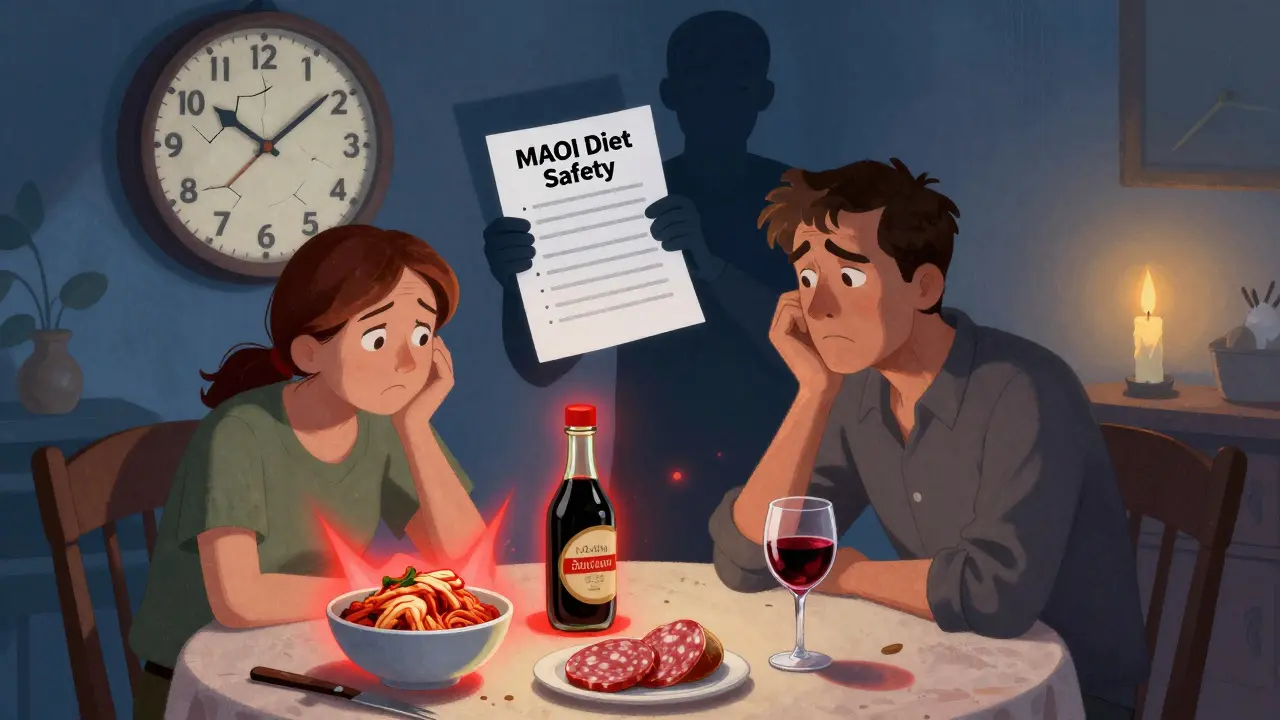
When you're on an MAOI antidepressant, the danger isn't just from blue cheese or aged cheddar. It's from the miso in your ramen, the soy sauce on your stir-fry, the kimchi beside your rice, or even the Worcestershire in your salad dressing. The myth that cheese is the only problem has left many people blindsided-some ending up in the ER with blood pressure spikes so severe they needed emergency treatment. If you're taking an MAOI like phenelzine or tranylcypromine, your diet isn't just about eating healthy-it's about avoiding hidden tyramine traps that can turn a normal meal into a medical crisis.
What Exactly Is Tyramine and Why Does It Matter?
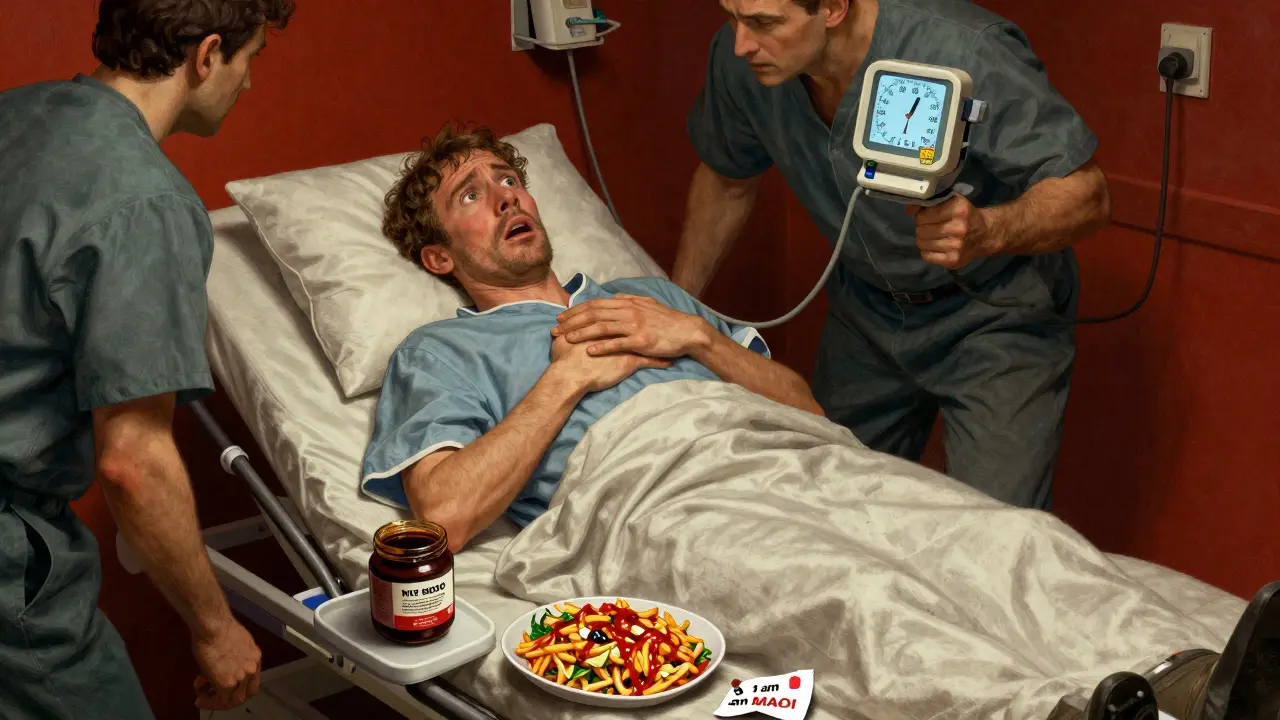
Tyramine is a natural compound formed when proteins in food break down during aging, fermentation, or spoilage. Your body normally handles it with an enzyme called monoamine oxidase. But MAOIs block that enzyme. Without it, tyramine builds up in your bloodstream and causes your blood pressure to spike-sometimes over 180 mmHg systolic. That's not just a headache. It's a hypertensive crisis: pounding headache, chest pain, blurred vision, and risk of stroke or heart attack. This isn't theoretical. In 2022, the FDA reported three deaths linked to mislabeled fermented products that patients thought were safe.
Most people know cheese is risky. But what they don’t realize is that fermented foods are the real problem. The longer a food sits, the more tyramine it makes. Refrigeration slows it down-but doesn’t stop it. A block of tofu can go from 5 mg/kg to 25 mg/kg in just three days in your fridge. That’s why even fresh-looking foods can be dangerous.
The Hidden Tyramine Culprits You’re Probably Eating
Forget cheese. The top offenders are things you wouldn’t think twice about:
- Dry-aged meats: Salami (95-115 mg/kg), pepperoni (80-100 mg/kg), and smoked bacon or fish (75-90 mg/kg) are loaded with tyramine. A single slice of salami can contain more than your daily safe limit.
- Fermented soy products: Miso paste (60-85 mg/kg), soy sauce (45-70 mg/kg), and tempeh (35-60 mg/kg) are common in Asian dishes. One tablespoon of soy sauce can push you over the edge if you’re sensitive.
- Pickled and fermented veggies: Sauerkraut (50-75 mg/kg), kimchi (40-65 mg/kg), and pickled beets (30-55 mg/kg) are fermented for flavor-and tyramine buildup.
- Fermented condiments: Worcestershire sauce (25-45 mg/kg), fish sauce (35-55 mg/kg), and Marmite (40-60 mg/kg) are often used in small amounts, but they pack a punch. A single teaspoon of fish sauce in a stir-fry can trigger a reaction.
- Tomato paste: At 20-35 mg/kg, it’s not just for pasta. Canned tomato products, especially concentrated ones, can be dangerous if you eat more than a spoonful.
- Alcohol: Draft beer (15-30 mg/L) is worse than bottled because it’s exposed to air longer. Red wine (20-40 mg/L), sherry (35-55 mg/L), and vermouth (50-75 mg/L) are all risky. Even a glass can cause a spike.
And don’t forget overripe bananas, avocados, or fava beans. As they sit, they develop tyramine too. One woman on Reddit described her ER visit after eating a bowl of overripe banana smoothie-her blood pressure hit 210/115 in 45 minutes.
Why Restaurant Meals Are a Minefield
Most people think they’re safe if they cook at home. But 7 out of 10 chain restaurants in a 2023 investigation didn’t know if their menu items contained soy sauce, fish sauce, or Worcestershire. That’s not negligence-it’s ignorance. Even servers trained on allergens aren’t trained on tyramine. A dish labeled "low-sodium" might still be loaded with fermented ingredients. One patient told her doctor she avoided cheese but still got sick after eating "a simple stir-fry" at a local Thai place. The chef had used fish sauce instead of salt. No one told her it was there.
And here’s the cruel part: the symptoms don’t always show up right away. Some people feel fine for hours. Others react within 30 minutes. There’s no warning. No taste. No smell. Just a sudden, terrifying spike in blood pressure.
What You Can Actually Eat (And What to Substitute)
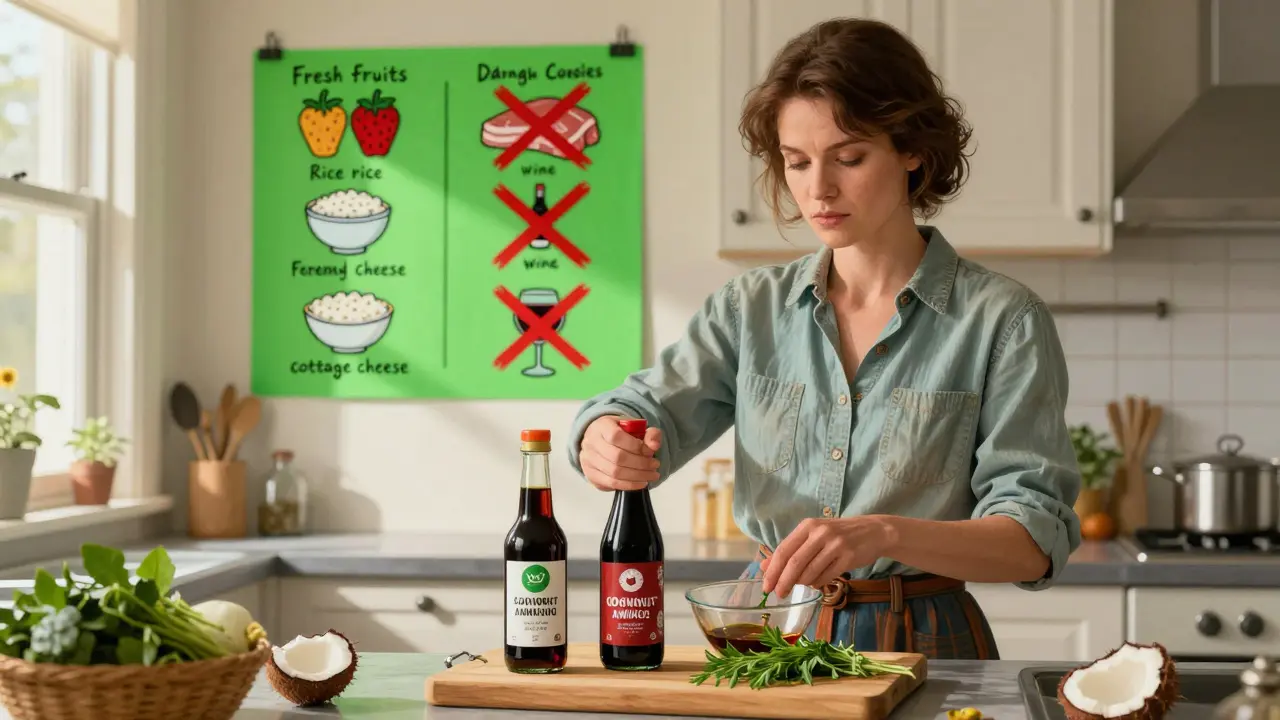
It’s not all doom. You can still eat well. Fresh, unaged foods are safe:
- Fresh meats, poultry, and fish (not smoked or cured)
- Most fruits and vegetables (avoid overripe ones)
- Fresh dairy (milk, yogurt, cottage cheese)
- Whole grains, rice, pasta
- Unfermented condiments like olive oil, vinegar, lemon juice
For flavor, swap soy sauce for coconut aminos (tyramine-free). Use fresh herbs instead of miso paste. Make your own salad dressing with olive oil and citrus. Skip the broth if it’s store-bought-many contain yeast extracts. Buy fresh tomato sauce instead of paste. And always check labels: look for words like "fermented," "aged," "cured," "smoked," or "yeast extract."
How to Stay Safe: Practical Steps
If you’re on an MAOI, here’s what works:
- Get educated: Ask your doctor for a printed list from the Mayo Clinic or the MAOI Support Network. Don’t rely on memory.
- Read every label: Even "organic" or "natural" products can have hidden tyramine.
- Use a food diary: Write down everything you eat for the first 6 weeks. You’ll spot patterns.
- Carry an emergency card: The American Psychiatric Association recommends a wallet card that says: "I am on an MAOI. Avoid tyramine-rich foods. Hypertensive crisis possible." Emergency responders respond faster if they see this.
- Plan ahead for dining out: Call the restaurant ahead. Ask: "Do you use soy sauce, fish sauce, or Worcestershire in your dishes?" If they hesitate, choose another place.
- Wait 14 days after stopping: Tyramine risk doesn’t disappear when you stop the drug. It takes two weeks for your enzyme levels to return to normal.
Most people need 8 to 12 weeks to get good at this. The hardest part? Sauces. They’re everywhere. And no one talks about them.
The Bigger Picture: Why MAOIs Still Matter
MAOIs are not first-line drugs. They’re reserved for treatment-resistant depression-when SSRIs and other meds fail. But for 15-20% of people with depression, they work where nothing else does. Studies show 65-70% improvement rates, compared to 45-50% for other antidepressants. That’s why prescriptions have grown 8.7% each year since 2020.
And there’s hope. A new enzyme supplement called TyraZyme showed a 58% reduction in tyramine absorption in trials. The Emsam patch allows small amounts of tyramine. Genetic testing is being tested to see who might tolerate more. But right now, the safest rule is simple: avoid everything fermented, aged, or spoiled.
What Happens If You Slip Up?
If you accidentally eat something risky and feel a pounding headache, chest tightness, or blurred vision, act fast. Sit down. Call 911. Don’t wait. Don’t take your blood pressure pill. Don’t try to "wait it out." This is not a headache. It’s a medical emergency. Emergency rooms now have MAOI alert protocols. But they need you to tell them you’re on an MAOI. That’s why the card matters.
And if you’ve had a reaction before? You’re more likely to have another. Your body remembers.
Final Thought: This Isn’t About Being Perfect
It’s about being aware. You don’t have to live in isolation. You don’t have to give up food entirely. But you do need to be vigilant. The people who manage this best aren’t the ones who never make a mistake-they’re the ones who learn fast, ask questions, and carry their emergency card. They’re the ones who call restaurants ahead. They’re the ones who swap soy sauce for coconut aminos and still enjoy a flavorful meal.
MAOIs can change your life. But only if you protect yourself from the hidden dangers in your food.
Can I eat soy sauce if I’m on an MAOI?
No-not safely. Soy sauce contains 45-70 mg/kg of tyramine. Even a small amount can trigger a hypertensive crisis. Some sources suggest 1 tablespoon might be okay for certain people, but there’s no reliable way to know your personal threshold. The safest choice is to avoid it completely and use coconut aminos instead.
Is kimchi dangerous on MAOIs?
Yes. Kimchi is fermented cabbage with garlic, chili, and fish sauce-all sources of tyramine. It contains 40-65 mg/kg, which is enough to trigger a reaction. Even small portions can be risky. Avoid it while on MAOIs.
What about draft beer vs. bottled beer?
Draft beer is riskier. It’s exposed to air longer during dispensing, which increases tyramine levels. Bottled beer has less exposure, so it’s slightly safer-but still not recommended. Both contain 15-30 mg/L, and even one glass can cause problems. Better to avoid all beer while on MAOIs.
Can I eat fresh cheese?
Yes. Fresh cheeses like ricotta, cottage cheese, cream cheese, and mozzarella are low in tyramine because they’re not aged. Avoid blue cheese, cheddar, Swiss, feta, and Camembert-all aged cheeses. Always check the label: if it says "aged," skip it.
Do I need to avoid all fermented foods forever?
Only while you’re taking the MAOI and for 14 days after stopping. After that, your body regains its ability to break down tyramine. But if you ever restart an MAOI in the future, you’ll need to follow the diet again. There’s no permanent exemption.
Is there a test to see if I’m sensitive to tyramine?
Not yet. While pilot studies at places like Massachusetts General Hospital are exploring genetic testing for monoamine oxidase activity, there’s no clinically approved test. Everyone reacts differently, so the only safe approach is strict avoidance.
Why don’t doctors warn people more clearly?
A 2022 JAMA study found only 43.7% of primary care doctors could name three non-cheese tyramine sources. Many still think it’s just cheese. This gap in education leads to dangerous misunderstandings. Always bring your own printed guidelines from the Mayo Clinic or MAOI Support Network to your appointments.
Can I drink wine occasionally?
No. Red wine contains 20-40 mg/L, and sherry or vermouth can go as high as 75 mg/L. Even a small glass can trigger a dangerous spike. There’s no safe amount. Avoid all alcohol while on MAOIs.
What if I’m traveling and can’t find safe food?
Plan ahead. Pack your own safe snacks: fresh fruit, plain rice cakes, boiled eggs, or pre-cooked chicken. Use apps like the MAOI Support Network’s Facebook group to find local restaurants with tyramine-free options. Many members share translated menus and restaurant tips worldwide. Never rely on hotel breakfast buffets-they often include aged cheeses, cured meats, or fermented sauces.
Are there any new treatments to make the diet easier?
Yes. A new enzyme supplement called TyraZyme showed 58% reduction in tyramine absorption in trials. The Emsam patch allows small amounts of tyramine at higher doses. Researchers are also studying genetic testing to identify who might tolerate more. But none are widely approved yet. Until then, avoidance remains the only proven safety method.
Mandy Vodak-Marotta
February 5, 2026 AT 10:08Okay but like… I just ate kimchi fried rice last night and I’m fine? 😅 I’ve been on phenelzine for 18 months and I’ve had soy sauce, miso soup, even a slice of pepperoni pizza once. No drama. Maybe I’m just lucky? Or maybe some people’s MAO enzyme levels are just… different? Like, why does everyone act like this is a death sentence? I get the warnings, but the fear-mongering is wild. I’m not dying from a snack. I’m just living. 🤷♀️
Geri Rogers
February 6, 2026 AT 09:15THIS. I’m so glad someone said this. I’m a nurse and I’ve had patients come in with BP spikes from ‘harmless’ soy sauce in their sushi. One guy thought "low-sodium" meant "safe"-nope. Fish sauce is sneaky.
Here’s what actually works: keep a food journal. Write down EVERYTHING. Even the "just a splash" of Worcestershire. I had a patient who had 3 crises in 6 months-then realized her "herb blend" had yeast extract. 🤯
And yes-coconut aminos are a GAME CHANGER. Tastes almost the same. I keep a bottle in my purse. My 7-year-old thinks it’s "adult ketchup." 😄
Nathan King
February 6, 2026 AT 23:15It is both lamentable and alarming that the medical community continues to undereducate patients regarding the pharmacodynamic implications of monoamine oxidase inhibition. The conflation of tyramine toxicity with mere dietary caution reflects a systemic failure in clinical communication. One cannot reasonably expect laypersons to discern between aged cheddar and fermented soy product biochemistry without structured, evidence-based dissemination. The FDA’s 2022 mortality reports are not anecdotal-they are sentinel events. This is not a lifestyle choice; it is a pharmacological imperative.
rahulkumar maurya
February 7, 2026 AT 06:12Let me be blunt: you're not "lucky"-you're just not dead yet. The human body doesn't always react immediately. Tyramine doesn't scream. It whispers. Then it SLAMS.
Have you ever seen someone in a hypertensive crisis? I have. Pupils dilated. Sweat like they just ran a marathon. Screaming because their head feels like it's splitting open. And then-boom-stroke. No warning. No second chance.
Coconut aminos? Cute. But if you're on an MAOI, you're not here to "experiment." You're here to survive. Your "I’m fine" attitude is why people die. You think you're special? You're not. You're a statistic in the making.
pradnya paramita
February 8, 2026 AT 10:54From a clinical pharmacology standpoint, the tyramine threshold is not binary-it’s a sigmoidal dose-response curve modulated by hepatic MAO-A expression, gut microbiota composition, and CYP450 polymorphisms. Individuals with homozygous MAOA-LPR variants may exhibit 30-40% higher tyramine clearance, potentially permitting low-dose exposure. However, clinical validation remains absent. Current guidelines remain conservative due to interindividual variability and lack of point-of-care biomarkers. Hence, the zero-tolerance protocol persists as the standard of care.
Coy Huffman
February 9, 2026 AT 02:16lol i just read this and thought "wait… so my daily miso ramen is basically a time bomb?" 😅
imma go swap my soy sauce for coconut aminos rn. also-why does no one talk about this? my doctor just said "avoid cheese" and called it a day. thanks internet for not letting me die. 🙏
Lorena Druetta
February 10, 2026 AT 15:31Thank you for sharing this vital information. As someone who supports individuals managing psychiatric medications, I urge all readers to treat this not as a restriction, but as an act of self-respect. Your body is not an experiment. Your safety is not negotiable.
Carry your emergency card. Call restaurants. Ask questions. You are not being difficult-you are being responsible. And if you slip up? Be kind to yourself. Learn. Adjust. Keep going. You are not alone. There are communities. There are resources. There is hope.
Harriot Rockey
February 12, 2026 AT 12:32I started on MAOIs last year and was terrified. I thought I’d never eat again. But guess what? I’ve never eaten better. 🥑 I cook everything from scratch now. Fresh veggies. Herbs. Lemon. Garlic. Olive oil. Coconut aminos. And my energy? Like, 10x better.
People think it’s about deprivation. It’s not. It’s about discovery. I found a whole new world of flavors. And no, I don’t miss soy sauce. I miss the *idea* of it. The real thing? It’s not worth dying for. 🌱❤️
Jamillah Rodriguez
February 13, 2026 AT 01:30so like… i read this whole thing and now i’m scared to eat anything ever again. 🥲
is there a support group for people who just wanna have a damn sandwich?
Samuel Bradway
February 13, 2026 AT 10:51Hey, I’m on tranylcypromine too. I used to eat soy sauce like water. Then I got a headache that felt like my skull was cracking. Took 3 hours to get to the ER. They gave me nitroprusside. I’ve never been so scared.
Now I use coconut aminos. I call restaurants. I read labels. I carry my card. And honestly? I feel like a superhero. Not because I’m perfect-I’m not. But because I’m alive. And I’m not letting ignorance win.