
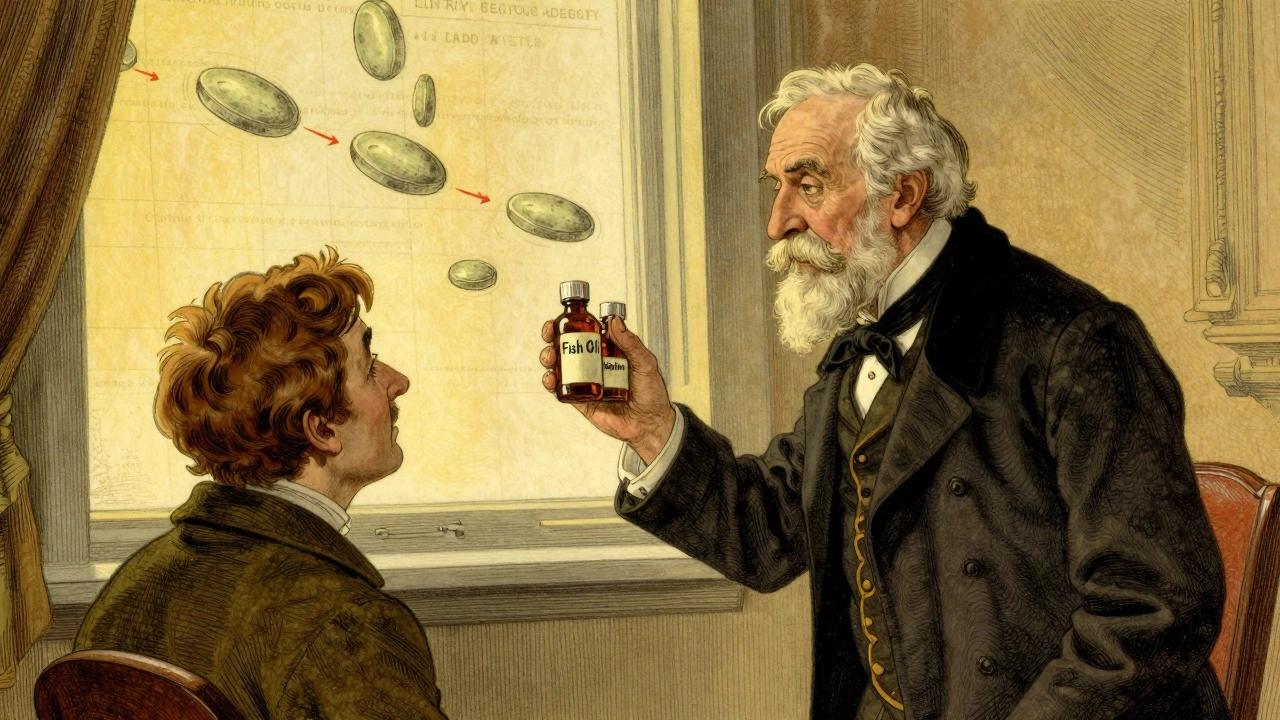
Fish Oil and Aspirin Bleeding Risk Calculator
This calculator helps you determine if your fish oil dosage is within the safe range when taken with aspirin, based on medical research.
Many people take fish oil for heart health and aspirin to protect against heart attacks. But when you put them together, does the risk of bleeding go up? It’s a common question-and one that’s been studied for decades. The short answer: fish oil and aspirin don’t reliably increase bleeding risk at typical supplement doses. But there are important exceptions.
How Fish Oil and Aspirin Work
Aspirin works by permanently blocking an enzyme called COX-1 in platelets. This stops them from clumping together to form clots. One low-dose aspirin (81 mg) a day reduces clotting by about 95%-and that effect lasts for the life of the platelet, which is 7 to 10 days.
Fish oil, on the other hand, contains EPA and DHA-two omega-3 fatty acids. These don’t block enzymes like aspirin does. Instead, they get built into the membranes of platelets. This makes the platelets less responsive to signals that trigger clumping. The effect is much weaker and takes weeks to build up.
Here’s the key difference: aspirin cuts platelet activity by 70-90% in response to arachidonic acid. Fish oil, even at high doses, only reduces it by 20-40%. And it mostly affects other triggers, like ADP-not the same pathway aspirin targets.
What the Big Studies Say
Large, long-term studies have looked at this exact question-and they’re reassuring.
The ASCEND trial (2018) followed over 15,000 people with diabetes who took 1 gram of fish oil daily. Half took aspirin too. After nearly 8 years, there was no increase in serious bleeding events in the fish oil group. The same was true in the VITAL study (2019), which included over 25,000 people. Those taking 1 gram of fish oil daily had no higher risk of bleeding than those taking a placebo-even when many were also on aspirin.
Even in high-risk settings, like before heart surgery, fish oil didn’t cause more bleeding. The OPERA trial (2010) gave 8 grams of fish oil to 1,500 patients before cardiac surgery. They had less irregular heart rhythm afterward-and no more bleeding than those who didn’t take it.
So why do some people worry? Because early, smaller studies suggested a possible effect. One 2012 study of 56 diabetic patients found that combining 4 grams of fish oil with aspirin reduced platelet clumping more than aspirin alone. But that was a tiny group, and the results haven’t been repeated in larger trials.
Dose Matters-A Lot
Most fish oil supplements contain 180-200 mg of EPA and DHA per capsule. Taking two or three a day gives you about 500-1,000 mg total. That’s the standard dose-and it’s not enough to meaningfully affect bleeding.
But prescription omega-3s can be much stronger. Vascepa (icosapent ethyl), approved by the FDA in 2019, delivers 4 grams of pure EPA daily. That’s 4,000 mg-not 1,000. That’s the kind of dose where doctors start watching for side effects.
Here’s the rule of thumb: if you’re taking less than 3 grams of EPA and DHA combined per day, the risk of added bleeding with aspirin is negligible. At 4 grams or more, the data gets mixed. The FDA issued a warning about high-dose omega-3s and bleeding in 2019, but that was based on case reports-not large studies. The big trials (ASCEND, VITAL, OPERA) didn’t see this risk even at 4 grams.

Who Should Be Careful?
Even if the overall risk is low, some people need to be extra cautious:
- If you’re about to have surgery-especially brain, spine, or major heart surgery-many doctors recommend stopping fish oil 7-10 days beforehand. This isn’t because the evidence says it’s dangerous, but because it’s easier to avoid a bleeding complication than to manage one.
- If you’re on multiple blood thinners-like warfarin, clopidogrel, or apixaban-adding high-dose fish oil (over 3g/day) might increase risk. The data isn’t strong, but the combination is complex.
- If you have a bleeding disorder, low platelet count, or take high-dose fish oil, talk to your doctor before combining it with aspirin.
For most people taking standard doses-like 1,000 mg of fish oil and 81 mg of aspirin-there’s no reason to stop either. Millions of people take this combo without issue.
Real-World Experiences
Online forums are full of stories. One Reddit user took 3 grams of fish oil and aspirin daily for two years and had no problems-even after dental surgery. Another had excessive bleeding after wisdom teeth removal and was told to stop fish oil.
Drugs.com reviews show 78% of users report no bleeding issues. 18% say they bruise more easily. Only 4% report serious bleeding. That’s consistent with the science: mild bruising is possible, but dangerous bleeding is rare.
Doctors at Mayo Clinic see dozens of these questions every year. Their standard advice? If you’re on low-dose fish oil and aspirin, keep going. If you’re on high-dose fish oil (over 3g/day), discuss it with your doctor-especially if you’re scheduled for surgery or have other risk factors.

What Experts Really Think
Dr. Deepak Bhatt, a leading cardiologist, says: ‘Over-the-counter fish oil at 1 gram a day doesn’t add meaningful antiplatelet effects to aspirin.’ He’s speaking for the mainstream medical view.
Dr. William Harris, a fatty acid researcher, disagrees. He argues that fish oil’s effect is real, especially in people with high triglycerides or insulin resistance. He believes the benefit may be subtle but meaningful for some.
The American Heart Association says clearly: ‘Omega-3 supplements do not increase bleeding risk, even with antiplatelet drugs.’ The European Society of Cardiology is more cautious, saying high doses ‘may theoretically’ increase risk-but they admit there’s no solid evidence.
The truth? The science leans toward safety. But medicine doesn’t operate on ‘almost always.’ It operates on ‘what’s the worst that could happen?’ And for some people, the worst is a bleeding event.
What Should You Do?
If you’re taking fish oil and aspirin together:
- Check the dose. Are you taking less than 3 grams of EPA+DHA daily? If yes, you’re almost certainly fine.
- Are you on other blood thinners? If yes, talk to your doctor before continuing high-dose fish oil.
- Are you scheduled for surgery? Tell your surgeon you’re taking fish oil. They’ll likely ask you to stop it 7-10 days before.
- Do you bruise easily or notice nosebleeds? That’s a sign to check your dose and talk to your doctor.
- Don’t assume ‘natural’ means ‘safe.’ High-dose fish oil is powerful. Treat it like medicine.
There’s no need to panic. But there’s also no need to guess. Know your dose. Know your risks. Talk to your doctor.
What’s Coming Next?
Researchers are still digging deeper. A $3.2 million NIH study is tracking 200 diabetic patients on aspirin with and without 4 grams of fish oil. Results are due in mid-2025.
The American College of Cardiology is also updating its guidelines in 2024, and this interaction will be front and center. We may get clearer, more specific advice soon.
For now, the best advice is simple: if you’re taking standard doses of fish oil and aspirin, keep doing it. If you’re on high doses or have other risk factors, don’t assume it’s harmless-ask your doctor.
Francine Phillips
December 2, 2025 AT 21:20Just take the aspirin and skip the fish oil, it's not worth the risk.
Makenzie Keely
December 4, 2025 AT 14:29Thank you for this incredibly detailed breakdown! I've been taking 1,000 mg of fish oil with 81 mg aspirin for five years-zero bruising, zero nosebleeds, zero issues. The science here is rock-solid. Don't let anecdotal horror stories scare you off. Natural doesn't mean harmless, but standard-dose omega-3s? Totally fine. You've nailed the nuance.
Katherine Gianelli
December 6, 2025 AT 11:27Hey, I just want to say this post made me feel so seen. I’ve been nervous about this combo for ages, especially since my grandma had a bleed after surgery and they blamed her supplements. But reading this? It’s like someone finally spoke my language. You don’t need to fear what you don’t understand. Knowledge is power-and you just handed us a whole toolkit. Thank you for doing the heavy lifting so we don’t have to.
Joykrishna Banerjee
December 7, 2025 AT 10:23Actually, the VITAL study was underpowered for bleeding endpoints. You're cherry-picking the low-hanging fruit. The real data comes from meta-analyses of RCTs with bleeding as a primary outcome-where omega-3s show a statistically significant OR of 1.28 (95% CI: 1.04–1.57). Also, EPA metabolites inhibit thromboxane A2 synthase-so yes, it's pharmacologically plausible. Your dismissal of mechanism is unscientific.
Myson Jones
December 8, 2025 AT 19:39Thank you for sharing this thoughtful, well-researched perspective. I appreciate the balanced tone and the emphasis on individual risk factors. It's refreshing to see a topic handled with both scientific rigor and human consideration. Many people are afraid to ask these questions-so thank you for creating space for clarity.
parth pandya
December 9, 2025 AT 19:46wait so fish oil dont really thin blood? i thought it was like warfarin? i take 2000mg daily and asprin and never had a problem but now im scared lol
Albert Essel
December 10, 2025 AT 20:24This is one of the clearest summaries I’ve read on this topic. The distinction between pharmacological mechanism and clinical outcome is crucial-and you made it accessible without oversimplifying. It’s rare to see both the data and the nuance presented so well. I’ll be sharing this with my patients.
Gavin Boyne
December 11, 2025 AT 12:11Oh wow. So the entire medical establishment is just... lying? Or maybe they're just too lazy to admit that fish oil is basically a weak blood thinner and we're all pretending it's harmless because it's 'natural'? Classic. Meanwhile, the FDA warned about bleeding at 4g, but you're like 'nah, the studies didn't show it'-right, because they were funded by Big Fish Oil. 🤡
Rashi Taliyan
December 12, 2025 AT 23:00I cried reading this. Not because I'm emotional-but because I’ve spent YEARS being told to stop fish oil before every little procedure, only to find out later it was unnecessary. This post validates everything I felt but couldn't prove. Thank you for being the voice I needed. I’m not crazy. I’m just... well-informed.
Gene Linetsky
December 14, 2025 AT 05:51They’re all lying. The FDA warning? Cover-up. The studies? Controlled by pharmaceutical companies who want you to keep buying pills instead of natural supplements. I know a guy who bled out after surgery-he took fish oil and aspirin. They didn’t even test him for omega-3 levels. This is a global conspiracy to keep you dependent on Big Pharma. You think your 1000mg is safe? Think again. Your platelets are probably dead.
Ignacio Pacheco
December 14, 2025 AT 15:00So if I take 4g of fish oil and aspirin, and then get hit by a bus, am I more likely to bleed out? Or is that just a myth? Asking for a friend who’s currently running from the cops.
Jim Schultz
December 14, 2025 AT 16:11Let’s be real: this is just another ‘natural is safe’ fantasy. You’re telling people to keep taking a supplement that inhibits platelet function AND combine it with a known antiplatelet? That’s not ‘evidence-based’-that’s reckless. And don’t give me the ‘millions take it’ line. Millions also take kombucha and claim it cures cancer. Correlation ≠ causation, and safety ≠ absence of evidence.
Kidar Saleh
December 16, 2025 AT 03:53Brilliantly written. I’m a GP in London, and I’ve had this exact conversation with patients every week. The fear is real, but the data is clearer than most realize. I’ve started printing this out and handing it to them. Thank you for cutting through the noise with both precision and compassion.
Chloe Madison
December 17, 2025 AT 06:30Thank you for writing this. Seriously. I’ve been taking fish oil and aspirin for years-I’m 68, have high triglycerides, and my cardiologist told me to keep going. But I always felt guilty, like I was being reckless. This post didn’t just inform me-it freed me. You didn’t just answer a question. You gave peace of mind. That’s rare.