
Drug Safety Alignment Checker
Compare Safety Alignment
See how often different countries agree on safety warnings for the same drugs. Based on data from the article showing only 10.3% agreement across major regulatory bodies.
What This Means for You
For Patients
Always check if your country's regulator has issued warnings for medications you're taking. What's safe in one country might be risky in another.
For Healthcare Providers
Ask patients where they obtained their medication, especially if it's imported or bought online. Understand that different regulatory standards apply.
For Industry
One regulatory path doesn't work everywhere. Plan for differences in approval processes and safety assessments across regions.
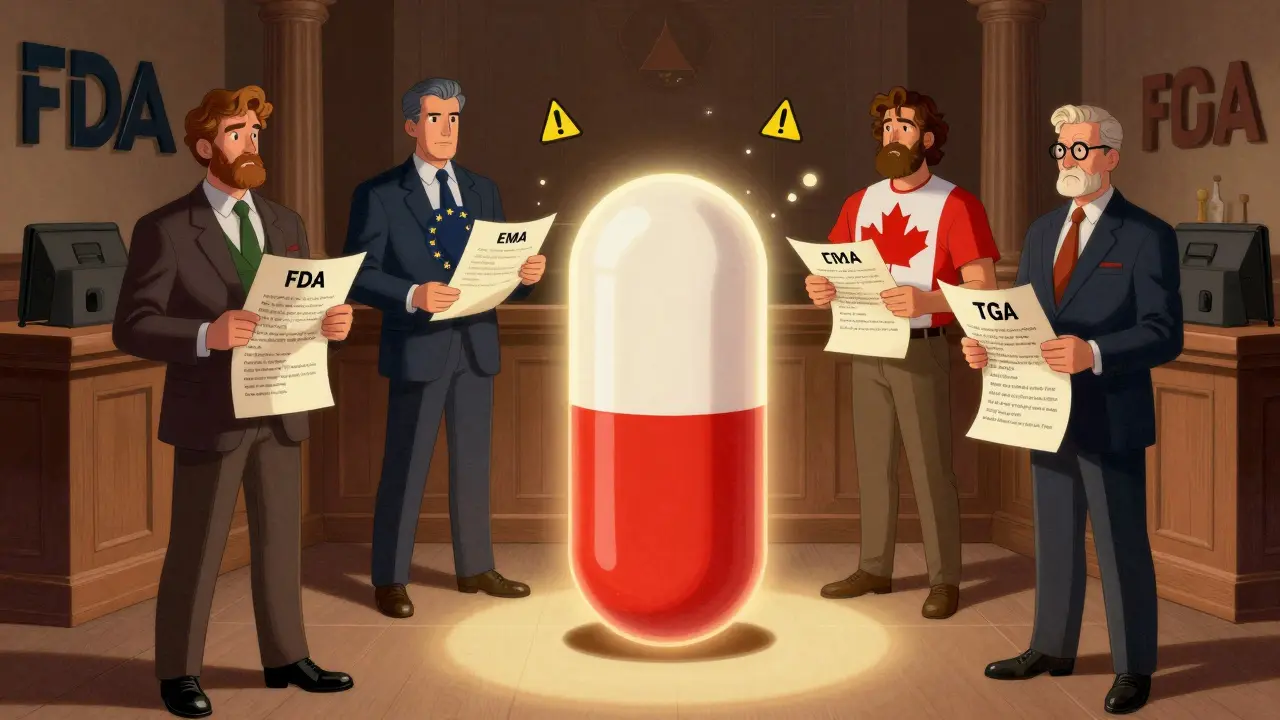
When you take a pill, you assume it’s safe. But that safety isn’t guaranteed by one global rulebook. It’s built by different governments, in different ways, with different priorities. The same drug approved in the U.S. might carry a different warning in Australia, or be delayed for months in Europe. Why? Because no single agency controls global medication safety. Instead, there are four major systems - each with its own rules, speed, and philosophy.
The U.S. FDA: Speed, Clarity, and Central Control
The U.S. Food and Drug Administration (FDA) is the most centralized drug regulator in the world. It’s the only agency that can approve a new medicine for sale across all 50 states. That means one decision applies everywhere. It also means one bottleneck. In 2022, the FDA approved new drugs in an average of 10.2 months. That’s faster than most other major regulators. How? The FDA has clear guidelines, predictable review cycles, and a single point of contact for drugmakers. Over 94% of U.S. doctors say they understand FDA safety alerts clearly. That’s not just convenience - it saves lives. But this system has trade-offs. The FDA doesn’t share a formal legal agreement with the European Union on drug inspections. That means a factory approved in the U.S. isn’t automatically approved in Europe. Companies must jump through two separate hoops. And during the pandemic, FDA review times jumped 37% because the system wasn’t built to handle a flood of emergency applications at once. The FDA also has a unique rule: it can require companies to test drugs on children. Under the Pediatric Research Equity Act, most new drugs must include pediatric data - even if the disease rarely affects kids. That’s not required everywhere else.The EU’s Hybrid System: Flexibility, Complexity, and Shared Risk
The European Union doesn’t have one regulator. It has a network. The European Medicines Agency (EMA) handles new, complex medicines - like cancer drugs or gene therapies - through a centralized process. But for older, generic drugs, each country’s own agency (like Germany’s BfArM or France’s ANSM) makes the call. This creates a slower system. The average approval time for a new drug under the EMA’s centralized route is 12.7 months - longer than the FDA’s. But it also creates more flexibility. When the painkiller Vioxx was pulled from the market in 2004, 22 EU countries acted together within 14 days. In the U.S., it took 28 days. The EU’s strength is transparency. About 71% of European doctors say EMA’s benefit-risk reports are clear and detailed. They don’t just say “this drug is risky.” They explain why, how often side effects occur, and who’s most at risk. That level of detail helps doctors make better decisions. But complexity is real. Nearly 68% of European drug companies say navigating multiple national rules is a headache. One product might need 27 different applications if it’s sold in all EU countries as a generic. That’s why the EU is pushing its 2021 Pharmaceutical Strategy - aiming to cut approval times by 25% by 2025.Health Canada: The Bridge Between the U.S. and Europe
Canada sits between two giants. It follows many U.S. standards but has a formal agreement with the EU since 2019. That means a drug factory inspected and approved by Health Canada doesn’t need a second inspection by the EU - and vice versa. This has paid off. After the EU-Canada Mutual Recognition Agreement (MRA) kicked in, Canada’s safety decisions aligned with the EU’s in 87% of major cases. That’s higher than any other country’s alignment with either the U.S. or EU. Canada’s system is smaller, but not less strict. Health Canada enforces the Food and Drugs Act, with binding legal power. It’s faster than the EU, slower than the FDA. But its real advantage is coordination. Because it shares inspections and data with both the U.S. and EU, Canadian regulators often get early warnings about drug risks - even before they’re public in either region. Still, Canada has fewer resources. It approves fewer new drugs than the U.S. or EU each year. And while it’s great at sharing data, it doesn’t always act as quickly as the FDA when urgent safety issues arise.
Australia’s TGA: Pragmatic, Independent, and Data-Driven
Australia’s Therapeutic Goods Administration (TGA) doesn’t try to copy anyone. It uses its own rules - based on science, not politics. It’s one of the few regulators that openly compares its decisions to the FDA and EMA. In 2022, the TGA agreed with the FDA on safety warnings 79% of the time. But with the EMA? Only 63%. That gap shows how different risk assessments can be. The TGA tends to be more cautious with new drugs - especially those with limited long-term data. It often requires more post-market studies before approving them. The TGA also has a strong focus on access. It uses a “priority review” system for drugs treating serious conditions with no alternatives. That lets it approve life-saving medicines faster - sometimes in under six months. But Australia’s size is a limitation. It doesn’t have the same volume of data as the U.S. or EU. So it often relies on reports from those regions. That means delays. If a safety alert comes from the FDA, the TGA might take weeks to review it before acting.Why Do Safety Warnings Differ So Much?
Here’s the startling fact: when the U.S., Canada, the UK, and Australia issued safety warnings for the same approved drugs, they agreed on only 10.3% of them. That’s not a glitch. It’s by design. Each country weighs risk differently. The FDA might approve a drug with a rare but serious side effect if it’s the only option for a deadly disease. The EU might delay approval to gather more data on long-term effects. Australia might require extra monitoring. Canada might wait for EU confirmation. This isn’t just academic. It affects real people. Imagine a patient in Australia taking a drug approved in the U.S. But the warning label there doesn’t mention a side effect that Australia flagged. That patient could be at risk - and not even know it. The World Health Organization (WHO) has tried to fix this. It offers global guidelines on manufacturing and safety. But those aren’t legally binding. Over 150 countries follow them, especially in places like Nigeria or Bangladesh, where local regulators lack resources. But even there, the lack of alignment means safety alerts often don’t reach patients at all. Only 42% of patients in low-income countries get timely warnings.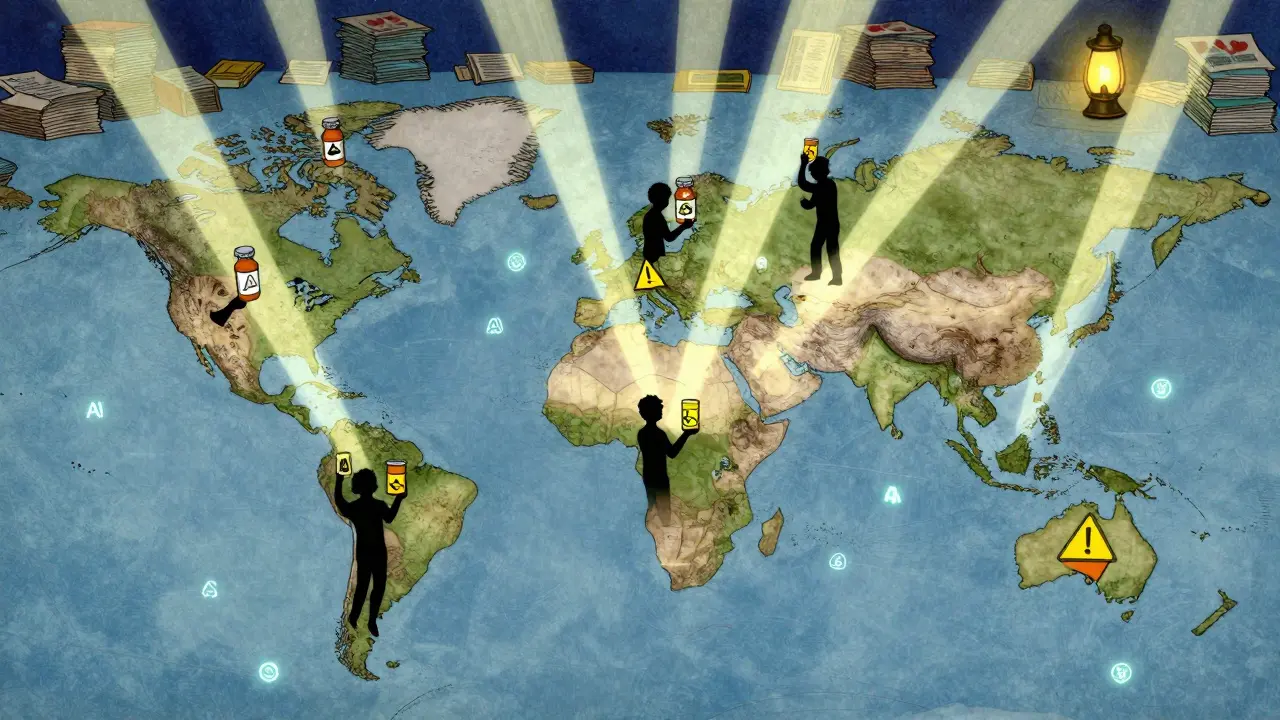
Dylan Smith
December 15, 2025 AT 20:45So the FDA moves fast but misses stuff and the EU takes forever but tells you every tiny risk? Sounds like one’s a sprinter and the other’s a librarian with a highlighter.
Randolph Rickman
December 16, 2025 AT 21:33This is actually really useful breakdown. I work in pharma logistics and seeing how the systems differ explains why our global shipments always have 3 different label versions. The ICH stuff helps, but the real bottleneck is still each country wanting to reinvent the wheel. We need more data sharing, not more paperwork.
Kayleigh Campbell
December 18, 2025 AT 02:50So the U.S. says ‘trust us, it’s fine’ and Australia says ‘prove it first’? Classic. One’s a hype man, the other’s your skeptical best friend who checks the expiration date before you take anything.
Colleen Bigelow
December 19, 2025 AT 09:08Of course the EU wants to overanalyze everything - they’re the same people who banned McDonald’s fries because of ‘potential trans fat contamination’ in 2003. Meanwhile, the FDA gets the job done. If you’re too scared to take a pill because some German bureaucrat says ‘maybe it could cause a sneeze in 2037,’ you’re not sick - you’re just weak.
Elizabeth Bauman
December 20, 2025 AT 05:34Did you know the WHO’s ‘guidelines’ are just suggestions written by people who’ve never even held a pill? Meanwhile, the FDA is the only agency that actually answers to the American people. The EU? They’re just a bunch of unelected bureaucrats in Brussels playing god with our medicine. And Canada? They’re just copying the EU to look ‘global’ while quietly letting Big Pharma slip in junk under the radar. Wake up, people.
Dave Alponvyr
December 22, 2025 AT 01:07Australia’s TGA is the quiet kid in class who actually reads the manual.
Kim Hines
December 22, 2025 AT 13:34So the real problem isn’t the regulators - it’s that we think there’s one right way. There isn’t. Just like there’s no one right way to make coffee. Some like it fast. Some like it detailed. Some just want it to not kill them.
Cassandra Collins
December 24, 2025 AT 10:56wait so the fda is in cahoots with big pharma right? and the eu is just slow because they know the truth but dont wanna scare the sheeple? and canada? theyre just the middleman getting paid to lie to both sides lol
Joanna Ebizie
December 26, 2025 AT 00:31you people are missing the point. if your drug came from a factory in China and got approved in the U.S. but not the EU, you’re basically playing Russian roulette with your liver. stop being so chill.
Aditya Kumar
December 27, 2025 AT 09:18too long. didn't read. but i'm pretty sure someone's making money off this mess.
Billy Poling
December 28, 2025 AT 03:02It is imperative to acknowledge that the structural disparities among regulatory frameworks are not merely administrative inconveniences but represent profound epistemological divergences in risk assessment paradigms - wherein the American model prioritizes utilitarian efficacy, the European model emphasizes precautionary principle-based deliberation, the Australian system exhibits epistemic independence through data-driven contextualization, and the Canadian framework functions as a pragmatic convergence node. The economic burden of compliance, estimated at $1.2 million per product, is not merely a fiscal metric but a systemic barrier to equitable global access, disproportionately impacting small biotech innovators who lack the infrastructural capital to navigate this labyrinthine bureaucracy. The ICH E6(R3) harmonization initiative, while reducing clinical trial documentation by 22%, fails to address the foundational issue: the absence of a binding, supranational authority capable of enforcing uniform safety standards. Until such an entity emerges - one that transcends national sovereignty and political expediency - the current patchwork will continue to endanger patients who cross borders, both literal and pharmaceutical.
Arun ana
December 28, 2025 AT 03:31Really appreciate this breakdown 🙏 I work in a clinic in Delhi and we get a lot of meds from the US and EU. Patients assume if it’s approved somewhere, it’s safe everywhere. This post should be required reading for every med student. Thanks for making it so clear.