

HIT Probability Checker (4Ts Score)
Answer the following questions based on your current condition. The tool will calculate your risk probability instantly.
1. Platelet Count Drop
2. Timing of Onset
3. Thrombosis Evidence
4. Other Causes (Tyranno)
Select options above
Your answers will determine the probability level.
Clinical Interpretation:
- Low (0-3): Unlikely. Monitor routine labs.
- Intermediate (4-5): Moderate suspicion. Consult hematologist.
- High (6-8): Strong likelihood. Stop heparin immediately.
Imagine you're recovering from knee surgery. Your doctors give you heparin to protect you from dangerous blood clots. Everything seems normal for a few days. Then suddenly, your calf swells painfully, your breathing becomes difficult, and your skin darkens around injection sites. You're not imagining it-something serious is happening. This paradoxical reaction where an anticoagulant actually triggers clotting is called Heparin-Induced Thrombocytopenia, and it strikes silently in approximately 5% of patients receiving certain blood thinners.
What Is Heparin-Induced Thrombocytopenia
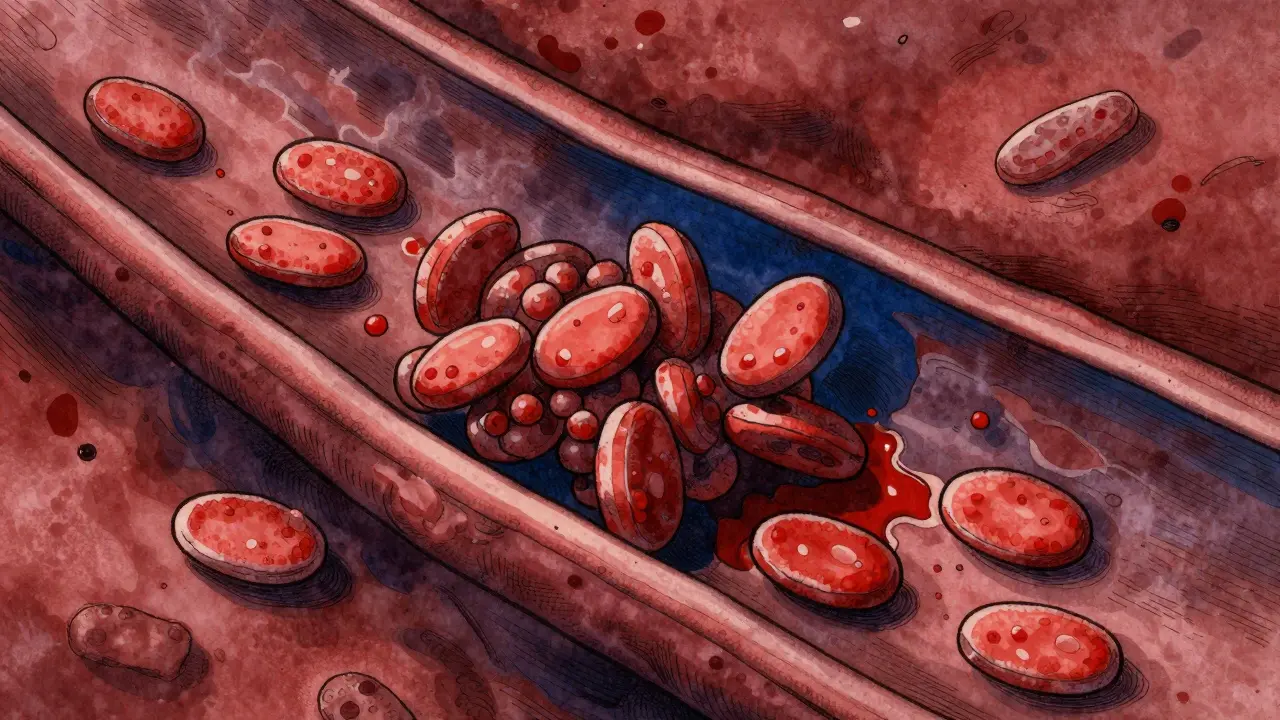
HIT represents one of medicine's most confusing paradoxes. The very medication designed to prevent blood clots ends up creating them instead. Heparin-Induced Thrombocytopenia (HIT) isan immune-mediated adverse reaction to heparin therapy characterized by significant platelet count drops and increased thrombotic risk. First documented in medical literature in the 1960s despiteheparin clinical use dating back to the 1930s, this condition occurs when your body develops antibodies against complexes of platelet factor 4 and heparin.
The mechanism works like this: these antibody complexes bind to receptors on your platelets, triggering widespread activation and consumption. Your platelet counts typically fall 30-50% below baseline levels while simultaneously entering a hypercoagulable state that dramatically increases clotting risks. Approximately half of HIT patients develop new or expanding thrombotic events including deep vein thrombosis and pulmonary embolism.
Two Distinct Types of HIT
Not all platelet drops during heparin therapy represent the dangerous form we worry about. Understanding the difference between Type I and Type II can save lives:
| Characteristic | Type I (HAT) | Type II (HIT) |
|---|---|---|
| Nature | Benign, non-immune mediated | Immune-mediated, clinically significant |
| Timing | 24-48 hours after heparin | 5-14 days after initial exposure |
| Platelet Drop | Mild, transient | Severe (30-50% below baseline) |
| Thrombosis Risk | None | High (50% develop clots) |
| Treatment Needed | No treatment required | Immediate heparin cessation mandatory |
Type I, also known as Heparin-Associated Thrombocytopenia (HAT), occurs within 24-48 hours and resolves spontaneously without complications. Type II is the dangerous immune-mediated form responsible for life-threatening thrombotic complications. When thrombosis accompanies the platelet drop, this specifically becomes Heparin-Induced Thrombocytopenia and Thrombosis (HITT), affecting approximately 50% of HIT patients with mortality rates ranging from 20-30% if left untreated.
Critical Warning Signs and Symptoms
Recognizing HIT early can be the difference between recovery and permanent disability. Symptoms typically emerge 5-14 days after starting heparin therapy, though they can appear within 1-3 days in patients with recent heparin exposure within the previous 100 days due to persistent antibodies.
You might experience pain, swelling, redness, or tenderness in your extremities-this affects 70-80% of thrombotic cases. Skin that feels warm to the touch appears in 60% of DVT cases. For pulmonary embolism symptoms, watch for shortness of breath affecting 40-50% of PE cases, chest pain in 25-35%, and changes in heart rate occurring in 20-30% of cases.
Severe manifestations include skin necrosis at injection sites, occurring in 10-15% of severe cases. This presents as bruising, blackening, or blue discoloration of skin around heparin administration sites. Dr. Stefano Baroletti notes that 'bruising or blackening around the heparin injection site as well as the fingers, toes' often signals critical progression requiring immediate intervention. Additional symptoms include fever (15-20%), chills (10-15%), dizziness (25%), anxiety (20%), and sweating (15%).
Understanding Your Personal Risk Factors
Not everyone faces equal danger when receiving heparin. Several demographic and clinical factors significantly increase HIT susceptibility:
- Gender matters: Women have a 1.5-2 times higher risk than men
- Age plays a role: Patients over 40 face 2-3 times greater risk compared to younger individuals
- Surgery type is critical: Orthopedic surgery patients represent the highest-risk population with post-operative HIT incidence reaching 7-10%
- Medical versus cardiac: Medical patients show 1-3% incidence, cardiac surgery patients 3-5%
- Heparin formulation: Unfractionated heparin carries 2-3 times higher risk than low molecular weight heparin
The duration of heparin therapy dramatically impacts risk. Less than 5 days of exposure carries minimal risk under 0.5%, while 5-10 days increases to 3-5%, and greater than 10 days reaches 5-10%. Recent exposure history is absolutely critical because re-exposure within 100 days can trigger HIT within 24-72 hours due to pre-existing antibodies. Dr. David Nicolas emphasizes that HIT represents a significant burden since heparin is widely used for treatment and prophylaxis of thromboembolism, line flushes, and heparin-coated catheters.
The 4Ts Scoring System for Diagnosis
Distinguishing HIT from other causes of platelet drops requires careful evaluation using the 4Ts scoring system. This probability assessment tool scores 0-8 points based on four criteria: Thrombocytopenia, Timing, Thrombosis, and absence of other causes (Tyranno).
Scoring breaks down as follows: 6-8 indicates high probability, 4-5 intermediate probability, and 0-3 low probability. The American Society of Hematology Guidelines emphasize that the 4Ts scoring system should be universally applied before ordering specialized HIT testing to reduce false positives and unnecessary treatment changes.
After clinical scoring, confirmatory testing involves two main approaches. Immunoassays like enzyme-linked immunosorbent assay or particle gel immunoassay demonstrate 95-98% sensitivity but lower specificity. Functional assays such as serotonin release assay serve as gold standard with 99% specificity. The diagnostic process has a known false-negative rate of approximately 1% even when following recommended testing protocols perfectly.

Emergency Treatment Protocols
When HIT suspicion arises, time becomes your most precious resource. Treatment protocols mandate immediate cessation of all heparin products, including heparin flushes and heparin-coated catheters upon clinical suspicion alone.
Alternative anticoagulation must be initiated promptly with non-heparin agents tailored to your specific health status:
- Argatroban: Direct thrombin inhibitor preferred for patients with hepatic impairment at dose 2 μg/kg/min, adjusted to maintain aPTT 1.5-3 times control
- Bivalirudin: Another direct thrombin inhibitor preferred in cardiac surgery settings with initial dose 0.15 mg/kg/h
- Fondaparinux: Factor Xa inhibitor for patients without severe renal impairment at dose 5-10 mg subcutaneously daily
- Danaparoid: Heparinoid available in some regions at initial dose 2,500 anti-Xa units followed by 3,000-15,000 units daily
A critical warning: Warfarin should never be initiated as monotherapy during acute HIT due to risk of warfarin-induced skin necrosis. It can only be added after platelet counts recover to at least 150,000/μL and alternative anticoagulation has been established for 5 days.
Monitoring, Recovery, and Long-Term Management
Vigilant monitoring protocols require checking platelet counts every 2-3 days from day 4 through day 14 of heparin therapy for all patients. Immediate 4Ts scoring becomes necessary if platelets drop 30% or fall below 150,000/μL.
Anticoagulation duration varies based on severity. Minimum duration ranges from 1-3 months for isolated HIT without thrombosis, and 3-6 months for HITT cases, with longer durations for recurrent thrombosis. Learning curve challenges for healthcare providers involve recognizing that HIT can occur with any heparin formulation, including low-dose flushes-with 15-20% of cases triggered by heparin-coated catheters or line flushes.
Common implementation challenges include delayed diagnosis due to atypical presentations (occurring in 25% of cases) and inappropriate continuation of heparin during diagnostic uncertainty (reported in 10-15% of cases). Essential skills for clinicians include interpreting 4Ts scores accurately with inter-rater reliability of 85-90% after training and selecting appropriate alternative anticoagulants based on renal and hepatic function.
How quickly does HIT develop after starting heparin?
Type II HIT typically manifests 5-14 days after initial heparin exposure. However, if you've had heparin in the previous 100 days, symptoms can appear within just 24-72 hours of re-exposure due to persistent antibodies circulating in your bloodstream.
Can low molecular weight heparin cause HIT?
Yes, though less frequently. LMWH carries a 1-2% risk compared to unfractionated heparin's 3-5% risk. Both formulations can trigger HIT, so vigilance applies regardless of which blood thinner you receive.
What's the difference between having low platelets and having HIT?
Simple low platelet count alone doesn't mean HIT. True HIT shows characteristic timing (5-14 days), significant drop (>30%), plus evidence of thrombosis. Many other medications can cause benign platelet drops without the dangerous clotting component.
Is HIT reversible once diagnosed and treated?
With prompt recognition and appropriate treatment, most patients recover fully. Platelet counts typically normalize within 1-2 weeks after stopping heparin and starting alternative anticoagulation. Mortality drops from 20-30% to less than 5% with proper management.
Should I avoid all heparin forever after developing HIT?
Generally yes, especially for the next 3-6 months until antibodies disappear. Some patients remain sensitive for years. Document this allergy clearly in your medical records and carry information identifying your HIT history in case emergency care is needed.
walker texaxsranger
March 28, 2026 AT 01:34Heparin is widely considered safe until you arent anymore.
Most people walk away thinking they are fine after surgery.
But the immune system works in mysterious ways we rarely understand fully.
Antibodies form against platelet factor four without any warning signs initially.
You see patients getting better only to crash hard weeks later.
It really highlights how dangerous modern medicine can be when protocols fail.
Doctors rely too much on the initial stability of the patient condition.
We need better screening tools before administering unfractionated products.
The current guidelines seem adequate but lack preventative focus entirely.
Many cases go undiagnosed because symptoms mimic normal recovery processes.
Swelling in the calf isnt always just DVT without checking platelets first.
Clinicians ignore the timing windows specified in older literature constantly.
Re-exposure within a hundred days triggers immediate catastrophic events.
Hospitals push volume over vigilance regarding medication administration records.
We must prioritize individual risk assessment over blanket prophylaxis orders.
kendra 0712
March 28, 2026 AT 20:52This is absolutely terrifying! We need to be more careful!
Everyone should read this info! Stay safe out there!
Medicine saves lives but also risks them!
I hope nobody gets hurt!
Keep checking your own health!
Tommy Nguyen
March 30, 2026 AT 06:23Good info here for sure. Hopefully everyone stays healthy and recovers well.
Jordan Marx
March 31, 2026 AT 21:45We must consider the immunologic cascade involved.
Platelet factor 4 binds heparin complexes readily.
The serotonin release assay remains gold standard.
Argatroban dosing requires close monitoring of aPTT.
Fondaparinux offers renal sparing alternatives.
Warfarin bridging prevents skin necrosis complications.
Clinicians must track platelet counts daily.
Delayed diagnosis increases mortality rates significantly.
Early cessation of all heparin products is crucial.
We should review catheter flush protocols strictly.
Heparin coated lines cause occult sensitization issues.
Alternative anticoagulants require therapeutic drug monitoring.
Renal function dictates dosing adjustments frequently.
Thrombotic risk persists even during treatment phases.
Long term followup detects late antibody resolution.
Monique Louise Hill
April 1, 2026 AT 12:21Please take this seriously! 🩸 Dont ignore your body signals! 🙅♀️ Safety first always! 💖 Take care friends! 🌹
Philip Wynkoop
April 2, 2026 AT 01:17Thanks for the heads up though.
Eva Maes
April 3, 2026 AT 16:48The system is rigged to overlook these errors.
Patient advocates never get the credit they deserve.
Insurance companies love delayed diagnoses best.
Dangerous drugs remain on shelves for profit reasons.
We need transparency in clinical trial data sheets.
Bureaucracy slows down emergency response protocols constantly.
Doctors face pressure to bill rather than listen.
Policies protect institutions not vulnerable patients.
Silence spreads faster than clotting factors ever could.
We deserve better risk management strategies overall.
Corporate interests override human safety concerns often.
This guide exposes cracks in standard care pathways.
Vigilance is the only shield against negligence.
Wake up to what is really happening here.
Change starts with awareness today not tomorrow.
Paul Vanderheiden
April 5, 2026 AT 04:48I totally get where you are coming from though honestly speaking i think we need balance everywhere in life and trust our teams more. Medicine is complex and we are trying to help each other through tough times together. We cant forget the good work being done every day too. Keep fighting the good fight.
Sarah Klingenberg
April 6, 2026 AT 18:36Great read :) Thanks for sharing this knowledge with us all (:
Rachael Hammond
April 8, 2026 AT 14:17Im reading this now and its really useful stuff. I dont think peopel know enough about hit syndrome. Probaly helps alot of families avoid bad outcomes. Good job writing this post. Im gonna share it with my friends who had surgery. Its scary but important info none the less. Hope no one has to deal with this.
Kameron Hacker
April 10, 2026 AT 12:45This protocol demands rigorous adherence from all staff.
Negligence causes irreversible harm to patients.
We must enforce strict timelines for testing.
Compliance reduces liability exposure significantly.
Medical errors are unacceptable in this domain.
Training standards must improve immediately.
Staff competency requires ongoing verification procedures.
Risk assessment protocols need constant updates.
Patient safety remains our primary directive always.
Documentation gaps lead to diagnostic delays routinely.
Accountability measures prevent future recurrences effectively.
Leadership must support proactive screening initiatives.
Systemic failures require structural changes urgently.
No compromise on anticoagulation safety standards.
Every dose carries potential for severe consequence.
Devon Riley
April 11, 2026 AT 21:19I feel for anyone dealing with this scary situation.
Your perspective helps others prepare mentally.
Support networks matter so much during recovery.
We stand together against difficult health challenges.
Knowledge empowers patients to advocate safely.
Community understanding builds better healthcare outcomes.
Compassion guides our interactions in hospitals.
Recovery takes time and patience is vital.
Mindfulness helps manage anxiety levels effectively.
Trust in your care team matters immensely.
Richard Kubíček
April 12, 2026 AT 02:37There is a profound lesson in biological fragility.
Our systems exist in delicate equilibrium states.
Intervention disrupts natural balances inadvertently.
Healing involves restoring lost harmony gently.
Medical science navigates these tensions daily.
Humility serves practitioners better than arrogance.
We learn from mistakes made in past decades.
Wisdom accumulates through shared experiences collectively.
Patience allows observation to inform action.
Truth emerges from careful investigation processes.
Shawn Sauve
April 12, 2026 AT 20:17Important distinction between benign and immune types.
Thanks for clarifying the differences clearly.:)