

Every year, millions of people in the U.S. take prescription drugs, over-the-counter medicines, or medical devices without issue. But for some, something goes wrong. A rash appears. The heart races. Liver enzymes spike. Or worse - a life-threatening reaction happens. When that occurs, reporting the event to FDA MedWatch isn’t just a good idea - it’s a critical part of keeping everyone safer.
You don’t need to be a doctor. You don’t need to prove the drug caused the problem. You just need to notice something unusual and speak up. The FDA doesn’t know about every bad reaction. In fact, experts estimate only 1% to 10% of adverse events are ever reported. That means most safety signals are invisible until it’s too late. Your report could be the one that triggers a warning, a label change, or even a drug recall.
What Is MedWatch, Really?
MedWatch is the FDA’s official system for collecting reports about harmful side effects from drugs, medical devices, vaccines (though vaccines go to VAERS), and other regulated products. It’s been around since 1993, but most people have never heard of it. The system takes in about 1.3 million reports annually - most from healthcare professionals, but anyone can submit one.
These reports feed into the FDA Adverse Event Reporting System (FAERS), which helps the agency spot patterns. For example, in 2022, over 1,200 MedWatch reports of a rare but deadly skin infection called Fournier’s gangrene led to new black box warnings for SGLT2 inhibitor diabetes drugs. That’s the power of real-world data.
MedWatch isn’t just for prescription drugs. It covers over-the-counter pain relievers, herbal supplements, medical devices like insulin pumps, and even cosmetics. But it doesn’t handle animal drugs - those go to the Center for Veterinary Medicine. And vaccines? Those go to VAERS. Don’t send them here.
Who Should Report?
Anyone. Patients. Family members. Nurses. Pharmacists. Doctors. Emergency responders. If you see or experience a serious side effect, you can and should report it.
There are two types of reporters:
- Voluntary reporters: Patients, caregivers, and healthcare providers who aren’t legally required to report but are strongly encouraged to.
- Mandatory reporters: Drug manufacturers, medical device companies, and hospitals - they’re required by law to report serious events within 10 days.
If you’re a patient, you’re a voluntary reporter. That means you’re not obligated - but your report matters more than you think. The FDA relies on these voluntary reports to catch problems early.
What Counts as an Adverse Event?
You don’t need to be certain the drug caused the problem. You just need to suspect it might have.
The FDA defines an adverse event as any unintended, unfavorable medical occurrence - even if the connection isn’t clear. That includes:
- New or worsening symptoms after starting a medication
- Allergic reactions like hives, swelling, or trouble breathing
- Unusual bleeding, bruising, or dizziness
- Severe nausea, vomiting, or diarrhea that lasts days
- Changes in mood, memory, or behavior
- Liver or kidney damage shown in lab tests
- Any event that required hospitalization, caused disability, or could be life-threatening
Even if the reaction seemed mild, report it. A single report might not mean much. But 50 similar reports? That’s a pattern the FDA can’t ignore.
How to Report: Two Simple Ways
There are two forms - one for healthcare professionals, one for patients and the public. Both are free, confidential, and available online.
Option 1: Use the Online Portal (Fastest for Most People)
Go to FDA.gov/MedWatch. Click on "Voluntary Reporting" and then "Online Form".
You’ll need:
- Patient info: Age, sex, weight (no full Social Security number - initials or medical record number are fine)
- Drug name: Exact brand or generic name, dosage, and how often it was taken
- Start and stop dates: When you began and stopped taking the drug
- Adverse event description: What happened, when, and how bad it was
- Outcome: Did it resolve? Did you need hospital care? Did it cause lasting harm?
- Your contact info: So the FDA can follow up if needed (optional but helpful)
It takes 15 to 20 minutes. The form walks you through each step with clear instructions. You can save your progress and come back later - no need to finish in one sitting.
Option 2: Download and Mail or Fax Form 3500B
If you prefer paper, download Form 3500B from the same MedWatch page. It’s a 3-page form designed for consumers. Fill it out, sign it, and mail or fax it to:
FDA MedWatch
PO Box 8000, Rockville, MD 20847-8000
Fax: 1-800-FDA-0178
You can also call 1-800-FDA-1088 to request a form be mailed to you. The call center answers 95% of calls within 30 seconds.
What’s Different About the Forms?
Healthcare professionals use Form 3500 - a longer, more detailed version with 45 fields. It asks for lab results, imaging findings, and detailed medical history. Patients use Form 3500B - 30 fields, plain language, no jargon. You don’t need to know medical terms. Just describe what happened in your own words.
For example: Instead of writing "hypertensive crisis," say: "My blood pressure shot up to 210/120 after taking the new pill. I felt dizzy and had a pounding headache. I called 911."
That’s all the FDA needs.
What Happens After You Submit?
Once you submit, you’ll get an automated email confirmation within minutes. The FDA doesn’t respond to every report individually - but they do review every single one.
Reports are coded using MedDRA, a global standard for medical terminology. This helps them group similar events across millions of reports. If a pattern emerges - say, 200 people reporting the same rare liver reaction to a specific generic drug - the FDA will investigate further. They might:
- Issue a safety alert to doctors and pharmacies
- Update the drug label with new warnings
- Require the manufacturer to run new studies
- Or, in rare cases, pull the drug from the market
And yes - your report could be the tipping point.
Common Mistakes and How to Avoid Them
Many reports are incomplete. Here’s what most people get wrong:
- Not listing all medications: Don’t forget vitamins, supplements, or herbal teas. They can interact.
- Being too vague: "I felt bad" isn’t enough. Say: "I felt dizzy and nauseous every morning for 3 days after taking the pill."
- Waiting too long: Report within 15 days if you can. The sooner, the better.
- Thinking it’s not serious enough: Even "minor" events matter if others are having them too.
- Not reporting because you’re not sure: Uncertainty is why the system exists. You’re not diagnosing - you’re observing.
Also, don’t attach medical records. The system doesn’t accept files. Just summarize the key details in the form.

Why This Matters - Real Impact
In 2021, MedWatch data led to 47% of all drug safety label changes in the U.S. That’s nearly half of all updated warnings based on real patient experiences.
One case: A woman reported severe skin blistering after using a new acne cream. Her report was one of 17 similar ones. The FDA investigated. The product was reformulated. Others were spared.
Another: A teenager reported sudden heart rhythm changes after taking a common cold medicine. That report, combined with others, led to a warning against use in children under 12.
These aren’t hypotheticals. They’re real events that happened because someone took five minutes to report.
What’s New in 2026?
The FDA is making reporting easier. In 2023, they launched a pilot program called MedWatch Express - a mobile app that lets doctors submit reports in under 5 minutes by pulling data from their electronic health records. By 2025, all hospitals will be required to report electronically.
They’ve also added new fields for reporting side effects from cannabis-derived products - a growing category that jumped 327% between 2020 and 2023.
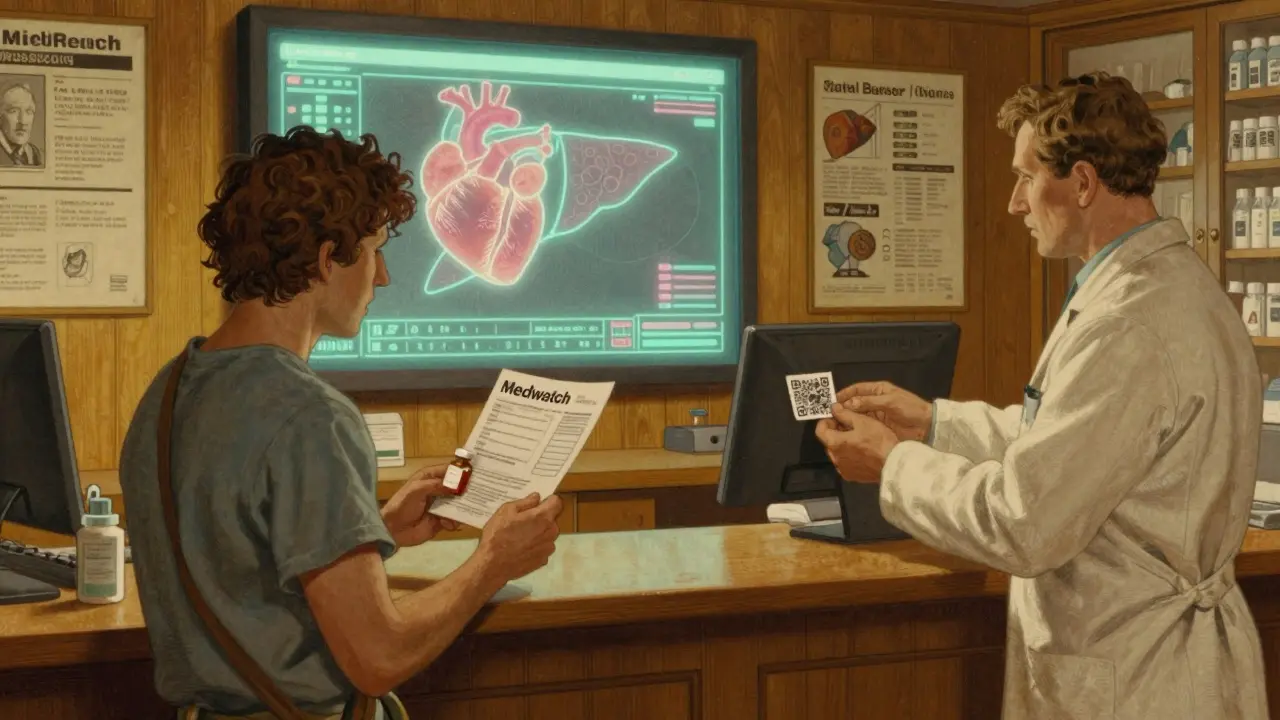
And now, 30 major pharmacy chains are handing out QR codes at the counter. Scan it, report in 90 seconds. That’s the future - simple, fast, everywhere.
Still Unsure? Here’s What to Do
If you’re confused about whether to report:
- Ask yourself: Did this happen after starting the drug?
- Did it go away after stopping it?
- Is it something you’ve never experienced before?
If you answered yes to any of those, report it.
Still stuck? Call 1-800-FDA-1088. A live person will walk you through it. No judgment. No pressure. Just help.
Or visit FDA.gov/MedWatch. There’s a free 12-module online training course for anyone who wants to learn more. Over 42,000 healthcare workers have taken it. You can too.
You don’t have to be an expert. You just have to care enough to speak up. Because the next person who takes that drug? They deserve to know what might happen. And that knowledge? It starts with your report.
Can I report an adverse event if I’m not a U.S. resident?
Yes. You don’t need to be a U.S. citizen or resident to report. If you took a drug sold in the United States and had a side effect, you can report it to MedWatch. The FDA accepts reports from anywhere in the world. Just make sure you’re reporting a product regulated by the FDA - not a drug sold only in another country.
Do I need to tell my doctor before reporting?
No, you don’t need permission. You’re not required to tell your doctor first. While it’s a good idea to discuss any side effects with your provider, your report to MedWatch is independent. The FDA doesn’t notify your doctor - they only use the data to improve safety for everyone.
What if I don’t know the exact name of the drug?
Try to find it. Check the bottle, prescription label, or pharmacy receipt. If you can’t, describe it: color, shape, markings, what it was for, and how often you took it. The FDA has a database of drug images and can often identify it from your description. Better to report with partial info than not at all.
Is my report anonymous?
Your report is confidential. The FDA doesn’t share your name or personal details publicly. However, you must provide contact information so they can follow up if they need more details. That information is kept private and only used for safety investigations. You can choose not to leave your name - but you’ll need to provide at least an email or phone number.
Can I report a side effect from a supplement or herbal product?
Yes. MedWatch accepts reports for dietary supplements, herbal remedies, and vitamins - even if they’re sold without a prescription. Many serious reactions come from supplements people assume are "natural" and safe. The FDA can’t regulate them as strictly as drugs, but your report helps them track risks and take action if needed.
How long does it take for a report to lead to a warning or recall?
There’s no set timeline. Some reports lead to action within weeks if there’s a clear pattern. Others take months or years. The FDA looks for trends - not single events. If 50 people report the same issue, that’s a signal. If only one does, it’s a data point. It’s the volume and consistency that matter.
What if I report and nothing happens?
That doesn’t mean your report didn’t matter. Many reports are used to build a safety profile over time. Even if a drug isn’t pulled from the market, your report might be included in a label update - like adding a warning about dizziness or liver risk. Those updates help future patients avoid the same problem. Your report is part of a larger system. You’re not wasting your time.