
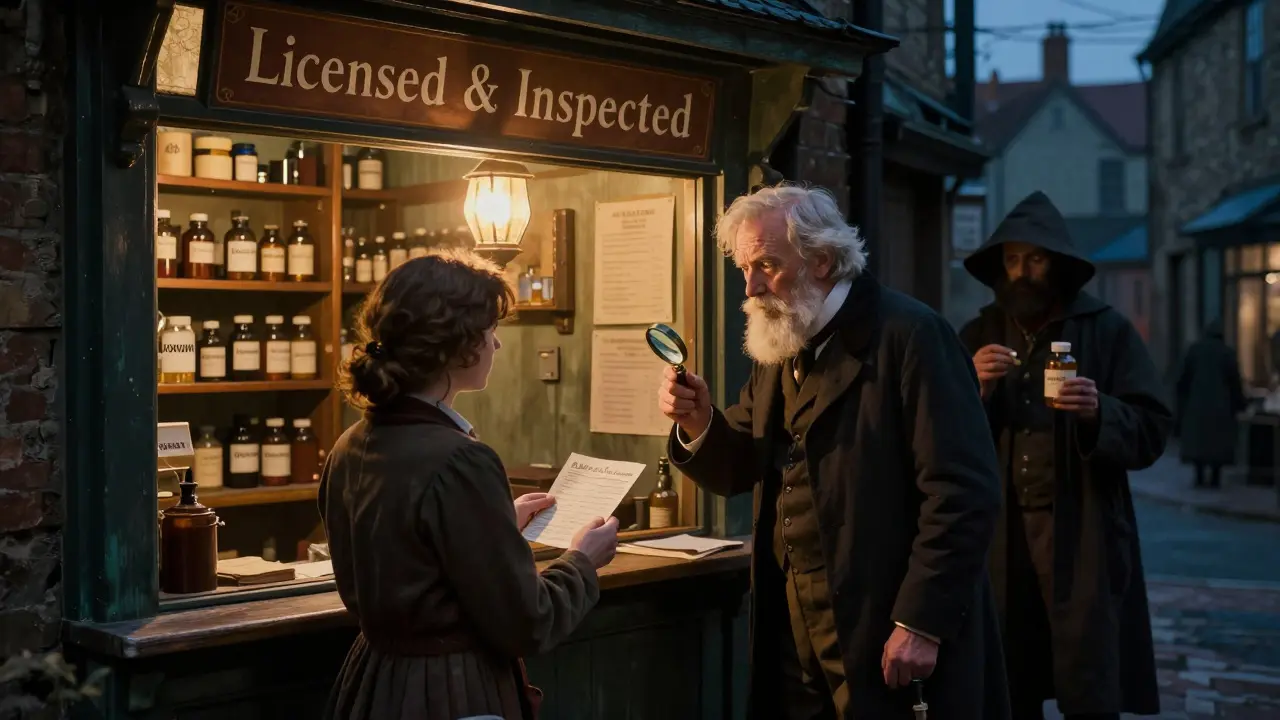
Every year, millions of people buy medications online. Some get the real thing. Others end up with pills that don’t work-or worse, are dangerous. The difference? A licensed pharmacy. If you’re unsure whether your pharmacy is legit, you’re not alone. Many consumers don’t know what to look for. But here’s the truth: checking a pharmacy’s license takes less than five minutes-and it could save your life.
Why Licensed Pharmacies Matter
Counterfeit drugs are not a distant threat. The FDA estimates that 1% to 3% of the $575 billion U.S. prescription drug market comes from unlicensed sources. That’s billions of dollars in fake or contaminated medicine. These drugs might have no active ingredient, the wrong dose, or even toxic substances like rat poison or floor cleaner mixed in. In 2023, the FDA shut down over 1,200 illegal online pharmacies. Many of them looked professional: they had logos, fake reviews, and even copied real pharmacy websites.
Legitimate pharmacies don’t just sell medicine-they follow strict rules. Pharmacists must pass the NAPLEX exam with a score of at least 75 (on a 0-150 scale), complete state-specific training, and renew their licenses annually. The pharmacy itself must be inspected, have a physical address, and employ a licensed pharmacist on-site or on-call. If any of that’s missing, it’s not a real pharmacy.
How to Check If a Pharmacy Is Licensed
You don’t need to be an expert to spot a fake pharmacy. Just follow these five steps:
- Check for a valid prescription requirement. Legitimate pharmacies will never sell controlled medications like oxycodone or Adderall without a prescription from a licensed doctor. If a site offers to “prescribe online” after a quick quiz, walk away.
- Verify the physical address. Type the pharmacy’s address into Google Maps. Look at Street View. Does it look like a real pharmacy? Or is it a warehouse, a residential house, or a PO box? Real pharmacies have storefronts, signs, and parking.
- Find the state pharmacy board license. Every state has a public database where you can search for licensed pharmacies. For example, California’s board lets you search by license number or pharmacist name. You’ll see the license status (active, suspended, expired), expiration date, and any past disciplinary actions. If you can’t find this info easily, the pharmacy is likely not legit.
- Look for pharmacist availability. A real pharmacy must have a licensed pharmacist available to answer questions. Call them. Ask about side effects, interactions, or storage. If they can’t answer-or if you’re redirected to a chatbot-you’re dealing with a front.
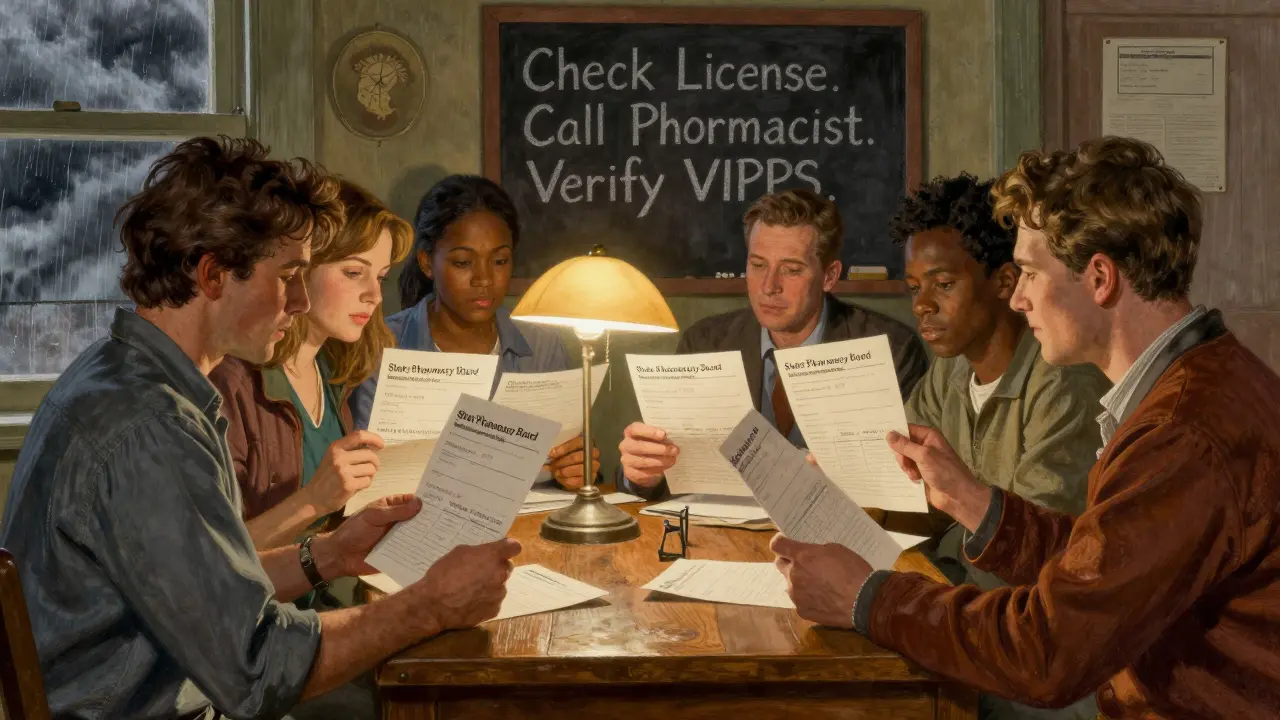
- Confirm VIPPS or NABP Verify accreditation. The Verified Internet Pharmacy Practice Sites (VIPPS) program, run by the NABP, is the gold standard for online pharmacies. Only pharmacies that pass strict inspections earn this seal. You can search for VIPPS-accredited pharmacies directly on the NABP website. The NABP Verify tool also shows license status across all 50 states. Both are free to use.
Red Flags That Mean Walk Away
Here are the most common signs a pharmacy is fake:
- Sells prescription drugs without a prescription
- Offers “miracle cures” or drugs not approved in the U.S. (like certain Russian or Indian versions of popular meds)
- Uses a .pharmacy or .ph domain-these are often fake. Real U.S. pharmacies use .com, .org, or .net
- Has no phone number, or the number doesn’t connect
- Claims to be “NABP accredited” but doesn’t show the official VIPPS seal (which links to the NABP site)
- Asks for payment via wire transfer, cryptocurrency, or gift cards
In 2023, a consumer in Florida lost $850 to a site that displayed a fake NABP seal. The seal looked real-but clicking it led to a dead link. The pharmacy had no license, no pharmacist, and no address. The FDA later confirmed it was a scam.

State-by-State Differences in Verification
Not all states make it easy. California charges $120 to verify a license by mail and takes 30 days. Florida offers free, instant online verification. Some states require fingerprint background checks ($65+), others accept online checks ($35). This inconsistency confuses even pharmacy professionals.
The NABP Verify program was created to fix this. It pulls data from 43 states in real time. If a pharmacist’s license is suspended in Texas, NABP Verify shows it instantly. It’s not perfect-some states still lag behind-but it’s the most reliable national tool available. For multi-state pharmacies, the Verified Pharmacy Program (VPP) simplifies compliance, though setup costs can hit $1,850.
What Real Users Say
On Reddit’s r/pharmacy, users share stories of catching fake pharmacies before it was too late. One user in Oregon found her pharmacy’s license had expired two months earlier. She switched immediately. Another in California discovered the pharmacist-in-charge had quit without notice-something the pharmacy didn’t disclose. Both cases were flagged through state board searches.
But confusion is common. In one survey, 38% of users didn’t know what “administrative suspension” meant. Others mistook license numbers, entering prefixes like “PH” or “R” when the system only accepted digits. Always read the instructions on your state’s verification page.
What’s Changing in 2026
Regulators are catching up. In January 2024, California required out-of-state pharmacies shipping to residents to provide an 800 number for direct pharmacist access. The FDA launched a $15 million initiative in 2024 to track illegal online pharmacies more aggressively. By 2027, experts predict national licensure standards will cut verification complexity by 60%.
Meanwhile, 68% of major pharmacy benefit managers (PBMs) now require NABP Verify credentials before adding a pharmacy to their network. That means if your insurance plan covers a pharmacy, it’s likely already been checked. Still, always verify yourself. Insurance networks aren’t perfect.
Don’t Guess-Verify
Buying medicine online is convenient. But convenience shouldn’t outweigh safety. A fake pill might look identical to the real one. You won’t know until it’s too late. The tools to check legitimacy are free, fast, and public. Use them.
Here’s your quick checklist before you order:
- ✅ Does the pharmacy require a valid prescription?
- ✅ Can you find a real physical address on Google Maps?
- ✅ Can you verify the license on your state’s board website?
- ✅ Is there a live pharmacist you can call?
- ✅ Does the site show the official VIPPS seal (linked to NABP)?
If you answer yes to all five, you’re safe. If even one is no-stop. Find another pharmacy. Your health isn’t worth the risk.
How do I know if an online pharmacy is licensed in my state?
Go to your state’s board of pharmacy website. Search by pharmacy name, license number, or pharmacist name. Most states offer free online lookup. For example, in California, visit the California Board of Pharmacy’s License Verification page. In Texas, use the Texas State Board of Pharmacy portal. If the pharmacy doesn’t appear in the database, it’s not licensed in your state.
Is NABP Verify the same as VIPPS?
No. NABP Verify is a tool that shows whether a pharmacy holds an active license in any U.S. state. VIPPS (Verified Internet Pharmacy Practice Sites) is a certification program that means the pharmacy has passed strict inspections for safety, privacy, and legal compliance. All VIPPS pharmacies are licensed, but not all licensed pharmacies are VIPPS-certified. For online pharmacies, VIPPS is the higher standard.
Can I trust pharmacies that are accredited by other organizations?
Only if they’re also licensed by a state board of pharmacy. Some organizations offer seals, but they’re not regulated like state boards. The FDA and NABP only recognize state licensure and VIPPS. If a pharmacy claims accreditation from a group you’ve never heard of, check their state license first. If it’s not there, ignore the other seals.
What should I do if I suspect a pharmacy is fake?
Report it. File a complaint with the FDA’s MedWatch program, your state board of pharmacy, and the Better Business Bureau. If you’ve already bought medicine from them, contact your doctor and pharmacist immediately. Do not take any pills from that pharmacy. Keep the packaging and receipts. The FDA uses these reports to shut down illegal operations.
Why do some legitimate pharmacies look suspicious?
Some legitimate pharmacies, especially small or rural ones, may have outdated websites, no live chat, or limited online presence. That doesn’t mean they’re fake. Always verify their license through your state board. A clean license record is the only thing that matters. Don’t judge by appearance-judge by official records.
matthew runcie
March 21, 2026 AT 21:45Still can't believe how many people just click 'buy' without looking.
shannon kozee
March 23, 2026 AT 15:13Shaun Wakashige
March 24, 2026 AT 14:30just buy from CVS
Solomon Kindie
March 25, 2026 AT 03:00you cant verify a pharmacy if you dont verify your own fear
the system is designed to make you feel safe so you keep buying
the real pharmacy is the one that knows you're scared and still sells you the pill
Johny Prayogi
March 25, 2026 AT 08:46Casey Tenney
March 26, 2026 AT 12:42Someone should go to jail for letting this happen.
Sandy Wells
March 28, 2026 AT 07:33Many are underfunded and understaffed.
Verification is a joke.
Chris Dwyer
March 30, 2026 AT 00:29Also, if you're on a budget, some legit pharmacies offer discounts. Just verify first, then shop smart.
Desiree LaPointe
March 30, 2026 AT 02:41They're barely scratching the surface.
And those 'VIPPS' seals? Half of them are paid for by pharmacies with shell addresses.
It's theater. With pills.
Jackie Tucker
March 31, 2026 AT 19:15They're the ones scrolling past this, clicking 'Buy Now', and wondering why they're dizzy.
We're preaching to the choir while the rest are dying in silence.
Thomas Jensen
April 2, 2026 AT 16:24They only shut down the small ones.
The big ones? They get licenses, then quietly switch to unregulated suppliers.
It's all a smokescreen.
And they want you to think you're safe by checking a website.
Wake up.
Natali Shevchenko
April 2, 2026 AT 17:27We think a license is a guarantee, when really it's just a bureaucratic checkbox.
What if the system itself is broken?
What if the pharmacist on-call is a bot?
What if the 'verified' seal is just a logo someone paid for?
Maybe the real question isn't whether the pharmacy is licensed - but whether we've forgotten how to be afraid.
We've turned safety into a checklist and called it progress.
But safety isn't a form you fill out.
It's a habit.
It's the voice in your head that says 'wait' - even when the website looks clean.
Even when the price is too good.
Even when everyone else is clicking 'Buy'.
Maybe the most licensed pharmacy in the world won't save you if you've stopped listening to yourself.