
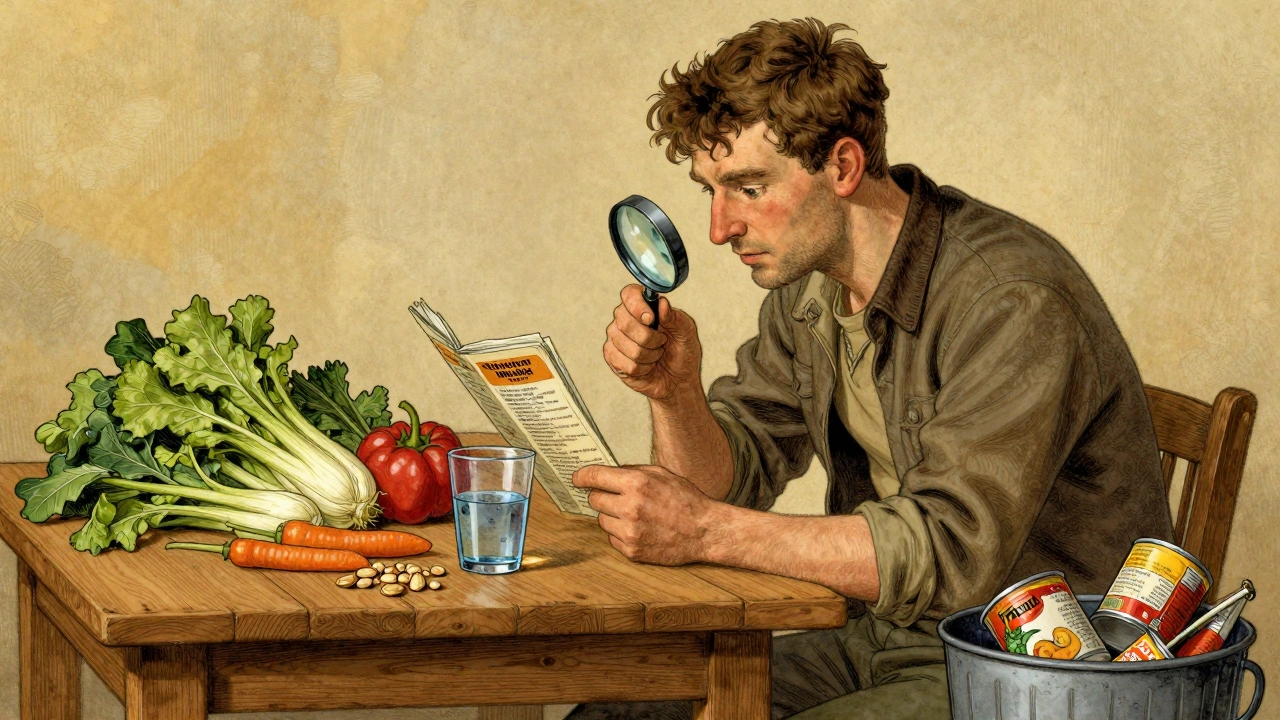
If you’ve been hit with sudden dizziness, ringing in your ears, or that heavy, full feeling in your head, you might be dealing with Meniere’s disease. It’s not just bad luck-it’s a real condition affecting the inner ear, and the way you eat can make a huge difference. For many people, cutting back on sodium and managing fluid intake isn’t just a suggestion-it’s the first line of defense against worsening symptoms.
Why Salt Makes Meniere’s Worse
Meniere’s disease is linked to too much fluid buildup in the inner ear, called endolymphatic hydrops. This pressure messes with your balance and hearing. Sodium pulls water into your body, and that extra fluid doesn’t just stay in your legs or face-it collects in your inner ear. The result? More vertigo, louder tinnitus, and sudden drops in hearing. Research shows that lowering sodium intake reduces this pressure. A 2024 study in Acta Otolaryngologica tracked 50 patients with moderate to severe Meniere’s who cut their sodium to 1,500 mg per day and drank 35 ml of water per kilogram of body weight daily. After six months, their hearing improved by an average of 12.3 decibels at key frequencies. Their dizziness scores dropped by more than half. Tinnitus got noticeably quieter. This wasn’t a fluke-it was a controlled trial with measurable results.How Much Sodium Is Safe?
Most doctors recommend keeping sodium under 2,000 mg per day. But the sweet spot for Meniere’s patients? Many experts now say 1,500 mg is better. That’s less than a teaspoon of table salt. The American Heart Association agrees-for heart health and Meniere’s, aiming for 1,500 mg is ideal. Some studies, like those from Dr. Richard Miyashita in Tokyo, suggest even 3,000 mg (3 grams) might help, but that’s the upper limit. If you’re still having attacks, go lower. The European Academy of Otology leans toward 1,200-1,500 mg for severe cases. There’s no one-size-fits-all, but if you’re not seeing improvement at 2,000 mg, drop to 1,500 and give it 3 months.Fluid Balance: Drink More, Not Less
You might think, “If fluid causes problems, I should drink less.” But that’s wrong. Dehydration triggers your body to hold onto water-even more of it in your inner ear. The key is balance. The 2024 study used 35 ml of water per kilogram of body weight. For a 70 kg person, that’s about 2.5 liters a day. Spread it out. Don’t chug it all at once. Sip water steadily from morning to evening. Avoid sugary drinks, energy drinks, and alcohol-they interfere with inner ear fluid regulation and can make tinnitus worse. Caffeine is another trigger. Coffee, tea, chocolate, and soda can narrow blood vessels in the inner ear, reducing circulation. That’s bad news when your ear is already struggling. Cutting caffeine doesn’t always fix everything, but it removes one more stressor.
What to Eat (and What to Avoid)
Most sodium doesn’t come from your salt shaker. It’s hidden. Seventy-seven percent of dietary sodium comes from processed and restaurant food. That means:- Avoid: canned soups, soy sauce, deli meats, pickles, frozen meals, chips, crackers, bread, salad dressings, and fast food.
- Choose: Fresh vegetables, lean meats, eggs, plain rice, oats, unsalted nuts, fruits, and plain yogurt.
- Read labels: Look for “low sodium” or “no salt added.” Anything over 400 mg per serving is too high.
- Season smart: Use garlic, lemon, pepper, herbs like basil and oregano, or salt-free spice blends. You’ll adjust in a few weeks.
Why Diet Beats Medication (At First)
Doctors often prescribe diuretics like hydrochlorothiazide to flush out excess fluid. But these drugs come with side effects: dizziness, low potassium, kidney stones, and dehydration. They help about half to two-thirds of people-but not everyone. Dietary changes? No side effects. No prescriptions. No cost beyond your grocery bill. A 2018 study found 68% of patients saw major symptom improvement just by sticking to a low-sodium diet. That’s better than most drugs. And it’s not just about vertigo. Hearing improvement, reduced tinnitus, and fewer fullness episodes all respond to diet. One study showed Tinnitus Handicap Inventory scores dropped from 58.7 to 32.4 after six months on a strict plan. That’s the difference between constant noise disrupting your life and being able to focus again.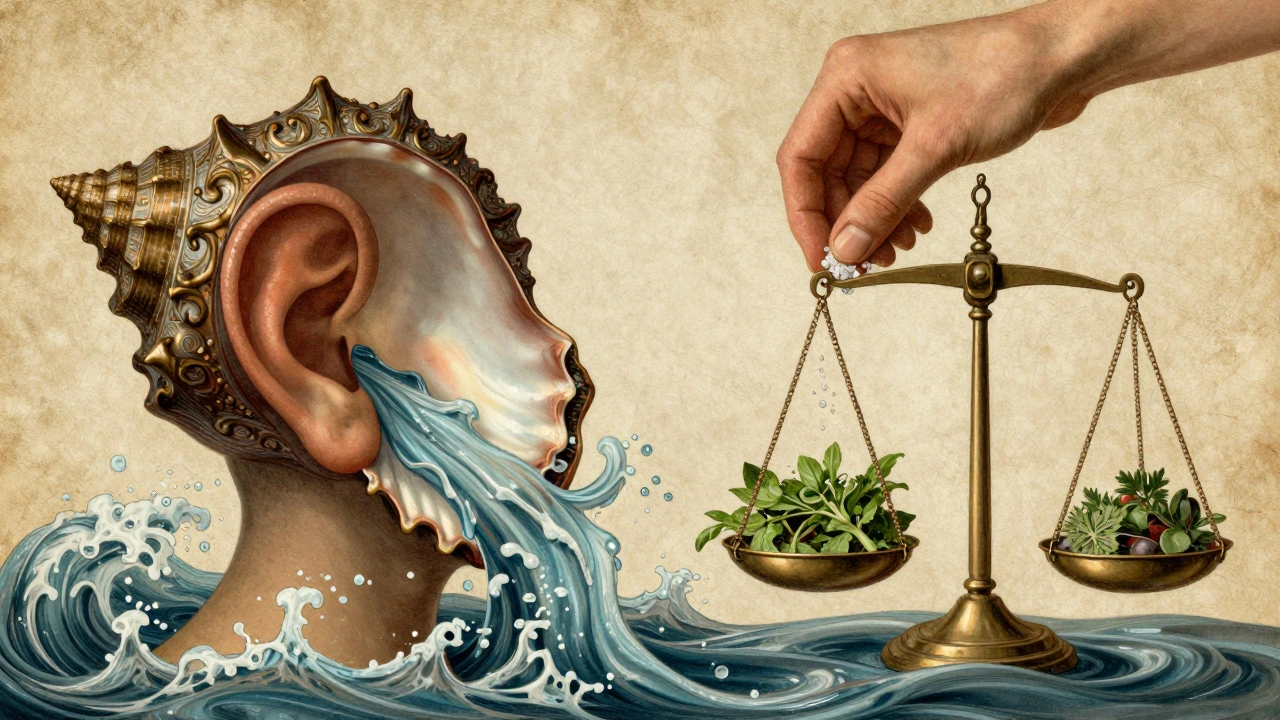
The Hard Part: Sticking With It
The biggest reason people fail? Taste. Food without salt feels bland at first. Social situations get tricky. Family dinners, work lunches, holidays-it’s hard to say no. Twenty-two percent of patients in one study gave up because they couldn’t handle the change. But here’s the thing: your taste buds adapt. After 4-6 weeks, you start noticing real flavors again. Fresh tomatoes taste sweeter. Herbs taste stronger. You don’t miss the salt-you start appreciating food more. Keep a food diary. Track what you eat and how you feel. Note vertigo days, tinnitus spikes, hearing changes. Patterns emerge. You’ll see which foods trigger you-even if they’re not obviously salty.What If Diet Doesn’t Work?
Diet isn’t magic. For some, it’s not enough. That’s okay. It’s still the foundation. If symptoms continue after 6 months of strict diet and hydration, talk to your doctor about next steps:- Intratympanic steroid injections: Dexamethasone injected into the ear reduces inflammation. About 60-75% of patients get relief.
- Gentamicin injections: These kill balance cells in the inner ear to stop vertigo. More effective (80-90%), but risky-15-30% chance of permanent hearing loss.
- Inner ear surgery: Reserved for severe, disabling cases that don’t respond to anything else.
What’s Next?
The NIH is running a major new trial called the Meniere’s Dietary Intervention Trial (NCT04567891). It’s comparing 1,500 mg vs. 2,300 mg sodium limits over 12 months with 300 patients. Results are due by the end of 2025. This could finally give us clear, evidence-backed guidelines. Until then, the best advice is simple: eat real food, avoid processed junk, drink water steadily, and keep sodium under 1,500 mg a day. It’s not glamorous. It’s not a pill. But for thousands of people, it’s the reason they can walk without falling, sleep without ringing, and hear their loved ones again.Can I still eat out with Meniere’s disease?
Yes, but you need to be specific. Ask for no salt, no soy sauce, no pre-seasoned items, and no butter. Stick to grilled meats, steamed veggies, plain rice, and salads with oil and vinegar on the side. Fast food is off-limits-most burgers, fries, and wraps have over 1,000 mg of sodium before you even add ketchup.
Does drinking more water make Meniere’s worse?
No. Dehydration makes it worse. Your body holds onto water when it’s thirsty, and that includes fluid in your inner ear. Aim for 35 ml of water per kilogram of body weight daily-spread evenly. Don’t drink all at once. Sip throughout the day. Avoid alcohol and sugary drinks-they disrupt fluid balance.
How long until I see results from a low-sodium diet?
Most people notice less dizziness and fullness within 2-4 weeks. Hearing and tinnitus improvements take longer-usually 3 to 6 months. Keep a symptom journal. Track your sodium intake and vertigo episodes. You’ll start to see patterns. Don’t quit too soon.
Is sea salt or Himalayan salt better than table salt for Meniere’s?
No. All salt is sodium chloride. Sea salt, Himalayan salt, kosher salt-they all contain the same amount of sodium by weight. The mineral traces don’t matter for Meniere’s. The number you care about is milligrams of sodium, not the color or texture of the salt.
Can I ever have salt again after my symptoms improve?
Some people can go back to a moderate 2,000 mg limit once symptoms are stable. But many need to stay under 1,500 mg long-term. Meniere’s is chronic. Think of it like managing high blood pressure-you don’t stop taking meds just because you feel fine. Same here. If you go back to high salt, symptoms often return.
Are there any supplements that help with Meniere’s?
No supplement has strong evidence for Meniere’s. Some people try magnesium or vitamin D, but studies are small or inconclusive. Focus on diet first. If you’re deficient in something, your doctor can test for it. Don’t waste money on unproven vitamins.
Gilbert Lacasandile
December 9, 2025 AT 15:56Been on this diet for 5 months now-my vertigo attacks dropped from 3-4 a week to maybe one every 6 weeks. Not magic, but it works. I started with 2,000 mg, then dropped to 1,500 after no improvement. Taste sucked at first, but now I actually prefer how food tastes without all that sodium junk.
Also, drinking water evenly through the day? Game changer. Used to chug it at night and wake up feeling like my head was a water balloon. Now I sip. No more midnight dizziness.
And yeah, no more canned soup. Ever.
Lola Bchoudi
December 10, 2025 AT 11:31As a vestibular therapist, I’ve seen this pattern repeat for over a decade. Endolymphatic hydrops is a volume regulation failure-not an infection, not a tumor, not stress (though stress exacerbates it). The sodium-fluid axis is the primary modifiable variable.
Patients who adhere to <1,500 mg Na+ and 35 mL/kg/day water show statistically significant improvements in low-frequency hearing thresholds and Dizziness Handicap Inventory scores. Non-adherence correlates with progression to bilateral involvement.
It’s not ‘alternative medicine.’ It’s neuro-otology 101.
Morgan Tait
December 11, 2025 AT 19:39They don’t want you to know this… but salt is just the tip of the iceberg. The real villain? MSG. It’s sodium chloride in disguise, but it’s injected into everything-chicken broth, ‘natural’ flavorings, even organic kale chips.
And the FDA? They’ve been in bed with Big Food since the 70s. They say ‘safe’-but safe for whom? Not for the guy losing his hearing at 42 because he ate a ‘low-fat’ frozen dinner.
Also, did you know the inner ear has its own sodium-potassium pump? It’s like a tiny battery. Salt overload fries it. They won’t tell you that on TV.
Stay vigilant. Read every label. Even ‘sea salt’ is poison here.
Katie Harrison
December 13, 2025 AT 17:18I’m Canadian, and I’ve got to say-this is the most practical, evidence-based health advice I’ve seen in years.
My sister had Meniere’s for 12 years. She tried meds, acupuncture, even a weird yoga thing with singing bowls. Nothing worked. Then she went low-sodium-no processed food, no soy sauce, no restaurant meals-and within 3 months, she could walk without holding onto walls.
Also, the part about water intake? So important. People think ‘drink less’ when they’re bloated. No. You need to hydrate to un-bloat. It’s counterintuitive, but biology doesn’t care about intuition.
Mona Schmidt
December 15, 2025 AT 01:56One thing missing from this post: the role of potassium. While sodium is the primary driver of endolymphatic pressure, potassium helps regulate the electrochemical gradient in the cochlea. Low potassium can worsen tinnitus and hearing fluctuations.
It’s not a substitute for sodium restriction, but pairing a low-sodium diet with potassium-rich foods-bananas, spinach, sweet potatoes, avocado-can enhance outcomes.
Also, please don’t confuse ‘no salt added’ with ‘low sodium.’ Some products use potassium chloride as a salt substitute, which is fine for most, but not if you’re on ACE inhibitors. Always check with your nephrologist.
Guylaine Lapointe
December 16, 2025 AT 00:01Wow. Another ‘diet fixes everything’ post. So now we’re blaming salt for Meniere’s? What’s next? Starvation cures cancer?
I’ve had Meniere’s for 15 years. I’ve eaten clean, I’ve gone salt-free, I’ve drunk 3 liters of water daily. I still get attacks. I still lost 60% of my hearing. This isn’t a lifestyle hack-it’s a neurological disorder.
Stop pretending this is simple. It’s not. And you’re giving false hope to people who need real treatment.
Sarah Gray
December 16, 2025 AT 21:52How quaint. You’re treating a complex neurovestibular disorder like a Whole30 challenge.
Have you considered that Meniere’s may be an autoimmune condition? Or triggered by viral latency in the vestibular nerve? Or even linked to gut dysbiosis? No? Because you’re too busy counting milligrams of sodium to read actual peer-reviewed literature.
Also, 1,500 mg? That’s less than what’s in a single McDonald’s sandwich. You’re not ‘eating real food’-you’re eating bland, nutrient-deficient cardboard while pretending it’s healing you.
Graham Abbas
December 18, 2025 AT 02:57There’s a poetry here, isn’t there? The body, this fragile vessel, trying to balance itself against the chaos of modern food-processed, salted, poisoned with hidden sodium like a silent war inside our ears.
We think we control what we eat. But the salt? It controls us. And when we finally listen-not to the craving, but to the silence of the inner ear-we begin to hear again. Not just sound. But stillness.
Maybe healing isn’t about fixing. Maybe it’s about returning to the quiet.
Haley P Law
December 19, 2025 AT 08:09OMG I DID THIS AND MY TINNITUS IS 80% BETTER 😭 I used to hear this loud ringing like a broken fire alarm 24/7. Now it’s just a whisper. I cried in the grocery store when I realized I could actually enjoy my avocado toast without my head feeling like it was underwater. THANK YOU FOR THIS POST. I’M TELLING EVERYONE. 🙏
Andrea DeWinter
December 21, 2025 AT 05:31For anyone new to this-start with one change at a time. Swap canned soup for homemade broth. Use lemon and herbs. Read labels while you’re eating dinner. Keep a simple journal: sodium intake vs. dizziness level (1-10).
You don’t need to be perfect. Just consistent. Even 80% compliance gives results. And after 3 weeks, your taste buds reset. You’ll start tasting the sweetness in carrots. The earthiness in mushrooms. It’s wild.
Also-skip the salt substitutes. They’re not magic. Just sodium in a different costume.
precious amzy
December 22, 2025 AT 04:45One must question the epistemological foundations of dietary interventionism in neuro-otology. The reduction of complex physiological phenomena to macronutrient manipulation reflects a Cartesian fallacy: the body as machine, the ear as circuit, salt as resistor.
What of epigenetic susceptibility? What of microbiome modulation? What of the phenomenological experience of vertigo as ontological dislocation? To reduce this to milligrams per day is not healing-it is commodification of suffering.
And yet… I still avoid soy sauce.
Maria Elisha
December 23, 2025 AT 09:15So… just don’t eat anything? That’s the plan? I’m not gonna spend my life reading tiny print on packaging just to not get dizzy. This sounds like a cult. I’ll take my hydrochlorothiazide and my tacos.
Andrea Beilstein
December 23, 2025 AT 11:26My mom had Meniere’s and she swore by the diet. She didn’t even know what endolymphatic hydrops was. She just stopped eating chips and started drinking water between meals. She went from needing a cane to hiking in the Rockies. No meds. No surgery.
People think it’s about willpower. It’s not. It’s about listening to your body. You don’t need a PhD to know when something makes you feel like you’re on a spinning boat.
Ryan Brady
December 24, 2025 AT 02:36USA is the only country that gets this right. In Europe they’re still drinking wine and eating salty bread like it’s 1990. No wonder they’re all dizzy.
Also, if you’re from Canada or Australia and you’re saying this works, you’re just copying us. We invented this. We’re the land of the free and the home of the low-sodium warrior.
👍🇺🇸
Raja Herbal
December 24, 2025 AT 16:56My uncle in Delhi had Meniere’s. He ate spicy curry every day. Salt? He used to lick it off his fingers. He started drinking coconut water and eating boiled lentils. No salt. No medicine. After 4 months, he said he could hear his granddaughter’s voice again.
So yeah. Maybe it’s not just about the sodium. Maybe it’s about food with soul.
Lola Bchoudi
December 25, 2025 AT 12:03Guylaine’s comment reflects a common frustration among long-term patients-but it also misses the point. Diet isn’t a cure-all. It’s a disease-modifying intervention. Like statins for cholesterol, or insulin for diabetes. You don’t say, ‘My cholesterol is still high, so statins don’t work.’ You adjust the dose.
For those who don’t respond to diet alone? Add intratympanic steroids. But don’t skip the foundation. You wouldn’t skip blood pressure control before bypass surgery. Same logic here.