

More than 1 in 5 adults in Australia take something over the counter to help them sleep. You might be one of them. A pill, a gummy, a liquid - anything to quiet the mind and drift off. But here’s the truth most labels won’t tell you: OTC sleep aids aren’t magic. They’re temporary fixes with real risks, especially if you use them too long.
What’s Actually in Your Sleep Aid?
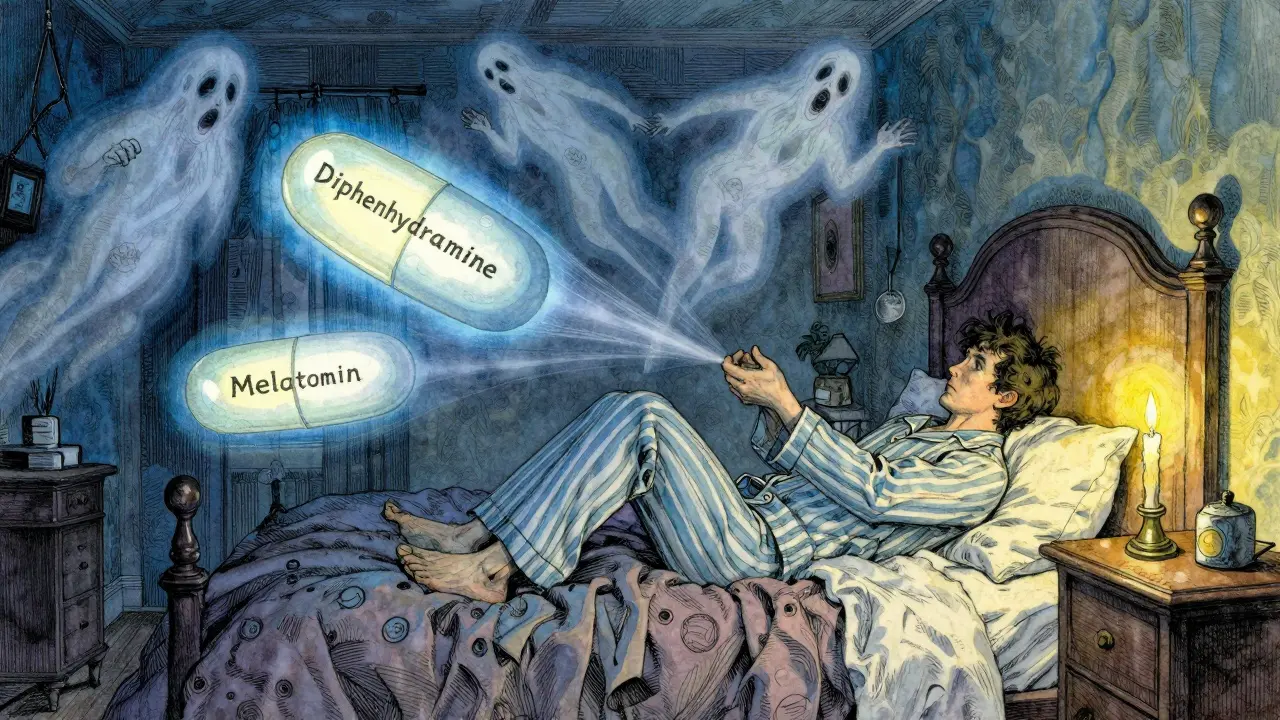
Most OTC sleep aids fall into two buckets: antihistamines and melatonin. That’s it. Everything else - valerian root, chamomile, magnesium - is barely backed by science. The real workhorses are diphenhydramine and doxylamine. You’ll find them in Benadryl, Sominex, Unisom SleepTabs. They’re not designed to help you sleep. They’re designed to stop your runny nose. Sleepiness? That’s just a side effect.Melatonin is different. It’s a hormone your body makes naturally to signal bedtime. Supplements try to mimic that. But here’s the catch: a 2017 study found that melatonin pills often contain way more or way less than what’s on the label. One product had 478% more melatonin than stated. That’s not a typo. That’s the supplement industry.
How Much Do They Actually Help?
Let’s be honest - the benefits are tiny. Clinical trials show these pills might help you fall asleep 3 to 13 minutes faster. They might add 20 to 60 minutes of sleep total. That’s less than one extra episode of your favorite show. For someone with chronic insomnia - which affects about 1 in 10 adults - that’s not enough. The American Academy of Sleep Medicine says outright: don’t use these for long-term sleep problems. There’s no solid proof they work, and the risks pile up.And here’s something most people don’t realize: you can get rebound insomnia. That means when you stop taking them, your sleep gets worse than before. About 30% of people who use these for more than two weeks experience this. It’s like your brain forgets how to sleep on its own.
The Hidden Side Effects You Can’t Ignore
Antihistamine-based sleep aids - diphenhydramine and doxylamine - are anticholinergic drugs. That’s a fancy way of saying they block signals in your brain and body. That’s why they cause dry mouth (32% of users), blurred vision (18%), constipation (24%), and trouble urinating (especially dangerous for men with prostate issues). But the real danger? Your brain.A 2015 study tracked over 3,400 people for more than seven years. Those who took anticholinergic meds - including OTC sleep aids - had a 54% higher risk of developing dementia. That’s not a small risk. That’s a red flag. And it’s worse for people over 65. The Beers Criteria, used by doctors across the U.S. and Australia, lists diphenhydramine as a drug to avoid in older adults. Why? Because it increases fall risk by 50%. One stumble, one hip fracture, and your life changes forever.
Melatonin sounds safer, right? Not exactly. A 2022 review found 45% of users feel groggy the next day. Nearly 70% report vivid dreams or nightmares. Higher doses - like 5mg or 10mg, which are common in stores - can cause nausea, dizziness, and even bedwetting in kids. The NHS warns that melatonin can cause leg pain that doesn’t go away. If that happens, stop. Don’t wait.
Who Should Never Use These?
If you have sleep apnea, avoid OTC sleep aids entirely. They relax your throat muscles, which can make breathing interruptions worse. That’s not just uncomfortable - it’s dangerous. The American Sleep Apnea Association says 22 million Americans have this condition. Many don’t even know it.Pregnant women should steer clear. Diphenhydramine is classified as Category B - meaning no proven harm in humans, but not enough studies to say it’s safe. Melatonin? There’s almost no data. The NIH’s LactMed database says: don’t use it unless you’ve talked to your doctor.
And if you’re over 65? Skip them. The risks far outweigh any tiny benefit. Dizziness, confusion, falls - these aren’t just inconveniences. They’re life-threatening.
How Long Is Too Long?
The FDA says: don’t use antihistamine sleep aids for more than two weeks. The Cleveland Clinic agrees. Yet a 2022 survey found 38% of users go past that. Nineteen percent use them for over a month. That’s not occasional use. That’s dependence.For melatonin, the European Food Safety Authority says 1mg is enough for most adults. Higher doses don’t help - they just increase side effects. Yet most bottles sell 3mg, 5mg, or even 10mg. Why? Because people think more is better. It’s not.
Start low. Try 0.5mg of melatonin. Take it only when you need it - not every night. If you’re using it daily for more than 10 days, you might be building tolerance. That means it stops working, and you’ll feel like you need more.

What Should You Do Instead?
The best treatment for chronic insomnia isn’t a pill. It’s CBT-I - Cognitive Behavioral Therapy for Insomnia. It’s not magic. It’s not quick. But it works. Studies show 70 to 80% of people who stick with it see lasting improvement. No side effects. No dependence. No rebound.It teaches you how to fix your sleep habits: consistent wake times, avoiding screens before bed, managing anxiety, and retraining your brain to associate bed with sleep - not stress.
And yes, it takes effort. But so does living with groggy mornings, brain fog, and fear of sleep. CBT-I is available online, through apps, and sometimes covered by Medicare in Australia. Ask your doctor. It’s the only thing that’s been proven to outperform medication over time.
Real People, Real Experiences
On Reddit, people say things like: “Diphenhydramine got me through a week of stress.” Or: “1mg melatonin fixed my jet lag.” Those are valid uses - short-term, occasional.But others say: “I took doxylamine for months. I started hallucinating at 3am.” Or: “I couldn’t sleep without melatonin. When I quit, I was worse than before.” These aren’t rare stories. They’re common.
Amazon reviews for top-selling sleep aids average 4 stars. But read the negative ones. Sixty-three percent mention next-day grogginess. Over half of melatonin users complain about weird dreams. These aren’t outliers. They’re the price of convenience.
The Bottom Line
OTC sleep aids aren’t evil. They’re not useless. But they’re not the solution most people think they are. If you’re having trouble sleeping once or twice a week because of travel, stress, or a weird schedule - a low-dose melatonin or a single antihistamine pill might help. Use it once. Then stop.If you’ve been struggling for more than two weeks? That’s not occasional. That’s a signal. Your body is trying to tell you something. Maybe your room is too bright. Maybe you’re scrolling until midnight. Maybe you’re anxious. Maybe you have sleep apnea.
Don’t keep reaching for the bottle. Talk to someone. A GP. A sleep specialist. A CBT-I therapist. There are better, safer ways to sleep - and they don’t come in a pill.
Doreen Pachificus
January 4, 2026 AT 11:38Been using 0.5mg melatonin for jet lag twice a year. Works like a charm. No grogginess. No weird dreams. Just sleep. I don’t get why people take 10mg like it’s candy.
Ethan Purser
January 5, 2026 AT 08:17Bro. We’re all just trying to survive modern life. You think your brain’s supposed to shut off after 12 hours of doomscrolling, Zoom calls, and existential dread? OTC sleep aids aren’t the problem - capitalism is. We’re medicating the symptoms of a broken system. 😔
Rory Corrigan
January 5, 2026 AT 12:25melatonin = 0.5mg max. diphenhydramine = nope. CBT-I is the real MVP. 🙌
Stephen Craig
January 7, 2026 AT 09:27The body doesn’t forget how to sleep. It learns that the pill is the only safe way to rest. That’s not dependence - it’s adaptation. We’ve outsourced sleep to chemistry because we refuse to change our lives.
Connor Hale
January 7, 2026 AT 20:20My grandma took Unisom every night for 8 years. She fell three times. Broke her hip. Never walked the same again. No one told her it was the pill. Just said she was getting old. That’s the tragedy here.
Roshan Aryal
January 8, 2026 AT 02:49Why are you all so obsessed with Western medicine? In India we use ashwagandha, jatamansi, and warm milk with turmeric. No side effects. No dementia risk. Just ancient wisdom. You people swallow chemicals like they’re vitamins while ignoring 5000 years of Ayurveda. Pathetic.
Jack Wernet
January 9, 2026 AT 05:54Thank you for this comprehensive and deeply necessary post. The data presented is both alarming and under-discussed. I will be sharing this with my patients and colleagues. Sleep is not a luxury - it is a biological imperative, and we have failed to treat it as such.
Charlotte N
January 10, 2026 AT 18:56so i tried melatonin... like... 3mg... and then i had this dream where i was being chased by a giant pillow... and then i woke up and my cat was on my face... and i just... cried... why does this happen... why... why... why...
Joseph Snow
January 12, 2026 AT 06:04Did you know the FDA doesn’t regulate supplements? That’s why melatonin pills have 478% more than labeled. This whole post is a distraction. Big Pharma wants you scared of OTC meds so you’ll pay $800 for a sleep clinic. Wake up. The system is rigged.
melissa cucic
January 12, 2026 AT 09:14I’ve been doing CBT-I for six months now. It’s not easy. Some days I feel like giving up. But I haven’t taken a pill in 147 days. My sleep is deeper. My mornings are clearer. And I finally stopped dreading bedtime. It’s not magic - it’s discipline. And it’s worth it.
Akshaya Gandra _ Student - EastCaryMS
January 12, 2026 AT 14:58i never knew melatonine could make you wet the bed 😭 i thought it was just for jetlag... now im scared to even look at the pharmacy aisle
Jacob Milano
January 13, 2026 AT 08:09You know what’s wild? The people who say ‘I just need one pill to get through this rough week’? They’re the ones who end up taking it for years. Not because they want to - because they’re too tired to try anything else. We’re not lazy. We’re exhausted. And no pill fixes that.