
Why Phenytoin Is Different From Other Seizure Medications
Phenytoin has been used for over 80 years to control seizures, and it’s still a go-to drug for many people. But unlike newer antiepileptics, phenytoin doesn’t play nice with small changes. A 5 mg increase might do nothing. A 10 mg increase could send your blood levels into the danger zone. That’s because phenytoin has narrow therapeutic index - the difference between a helpful dose and a toxic one is tiny. The safe range is 10 to 20 mcg/mL. Go above 20, and you risk dizziness, nausea, and shaky movements. Hit 40 or higher, and you could slip into confusion, coma, or worse.
What makes it worse? Phenytoin doesn’t follow normal rules. At low doses, your body clears it predictably. But as levels climb, the enzymes that break it down get overwhelmed. That’s called zero-order kinetics. Once you hit that point, even a small bump in dose can cause a massive spike in concentration. It’s like filling a bucket with a hose that suddenly turns into a fire hydrant.
Why Generic Switches Can Be Risky
Generic phenytoin is cheaper. That’s good. But here’s the catch: even though generics are legally required to be "bioequivalent" to the brand name (Dilantin), the rules allow up to a 20% variation in how much drug your body absorbs. For most drugs, that’s fine. For phenytoin? It’s a red flag.
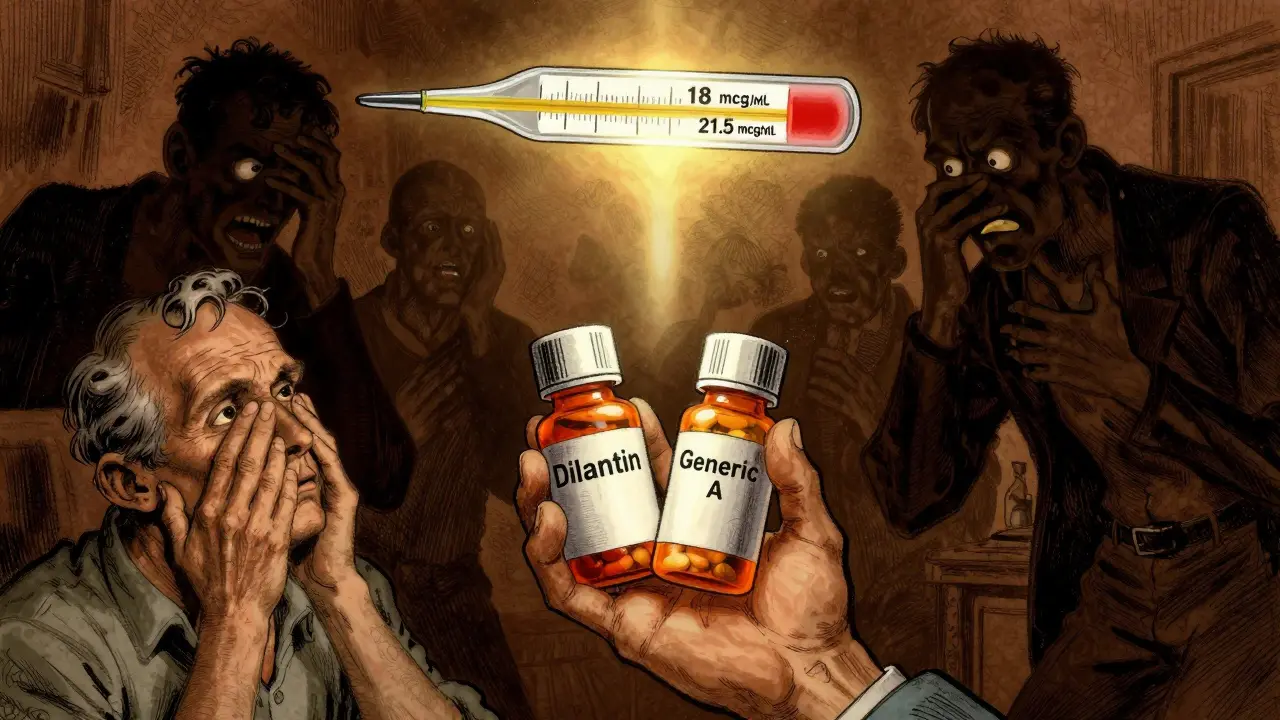
Imagine you’ve been stable on your brand-name pills for years. Your doctor switches you to a generic because of cost. The new pill meets FDA standards - it’s "equivalent." But what if your body absorbs 15% less from the new one? Your level drops from 18 mcg/mL to 15.3. Still in range. But then you switch again - maybe to another generic - and this time you absorb 18% more. Now you’re at 21.5. Toxic.
Studies show that switching between different generic brands - not even brand to generic - can cause measurable changes in blood levels. One patient might need 300 mg of Generic A to stay stable, but 375 mg of Generic B. That’s not a typo. That’s phenytoin’s unpredictable behavior in action.
When to Check Your Phenytoin Levels
Don’t wait for symptoms. If you’re starting phenytoin, switching brands, changing doses, or adding new meds, get your levels checked at the right time.
- First check: 2-3 days after starting or changing dose. This tells you if your body is handling it at all.
- Steady-state check: 5-7 days after starting or changing. This is when levels stabilize.
- After a switch: Check within 5-10 days. This is non-negotiable. The NHS Tayside guidelines say it plainly: monitor after any formulation change.
- Timing matters: Always take the sample right before your next dose (trough level). Don’t check it 2 hours after swallowing a pill - you’ll get a false high.
And if you’re on IV phenytoin? A level can be checked 2-4 hours after the infusion. But for oral doses? Wait 12-24 hours. Rushing this step gives you misleading data.

Protein Binding and the Hidden Danger
Here’s something most people don’t know: 90-95% of phenytoin in your blood is stuck to proteins. Only the 5-10% floating free is active. That’s why total phenytoin levels can be misleading.
If you’re sick, malnourished, or have liver disease, your protein levels drop. Suddenly, the same total level means more free drug - more toxicity. A total level of 15 mcg/mL might look fine. But if your albumin is low, your free level could be 3 mcg/mL - dangerously high.
That’s why doctors should check free phenytoin in patients with low albumin, kidney failure, or severe illness. If that’s not available, use the correction formula: Corrected level = Measured level / ((0.9 × Albumin / 42) + 0.1). But don’t trust it blindly. The formula is a rough guide. Your symptoms matter more.
Drugs That Mess With Phenytoin
Phenytoin doesn’t just interact with other drugs - it gets thrown off by them. Some make it stronger. Others make it weaker.
- Make phenytoin stronger: Fluconazole, metronidazole, cimetidine, amiodarone, valproate, and even some antibiotics like sulfa drugs. These block the enzymes that break phenytoin down.
- Make phenytoin weaker: Alcohol, rifampin, carbamazepine, and theophylline. These speed up its breakdown.
And here’s the kicker: if you start or stop one of these drugs while on phenytoin, your levels can swing wildly - even if you didn’t change your phenytoin dose. That’s why every new prescription needs a second look. Don’t assume your seizure control is still stable.

Long-Term Monitoring Beyond Blood Levels
Phenytoin doesn’t just affect your brain. It affects your bones, your gums, your skin, and your vitamins.
- Gingival hyperplasia: Swollen, overgrown gums. Brushing helps, but it won’t fix it. Your dentist needs to know you’re on phenytoin.
- Hirsutism and facial changes: Thickening of facial features and unwanted hair growth - especially in women. It’s not just cosmetic. It impacts quality of life.
- Bone health: Phenytoin lowers vitamin D and calcium. Over time, this can lead to osteomalacia - soft, weak bones. Get your vitamin D, calcium, and alkaline phosphatase checked every 2-5 years.
- Blood counts: Rarely, phenytoin can cause low white blood cells or platelets. A simple CBC every 6-12 months catches this early.
These side effects don’t care if you’re on brand or generic. They happen with any phenytoin. That’s why monitoring isn’t just about levels - it’s about your whole body.
What to Do If You’re Switching Formulations
Here’s a simple plan if your pharmacy switches your phenytoin:
- Don’t panic. Not every switch causes problems - but many do.
- Ask for a level check. Request a trough level before the switch and again 5-10 days after.
- Watch for symptoms. Dizziness? Nausea? Trouble walking? Slurred speech? Call your doctor. Don’t wait for the lab result.
- Keep a log. Note your dose, the pharmacy name, and any side effects. This helps your doctor spot patterns.
- Stick with one brand. If you find a generic that works, ask your doctor to prescribe it by name. Avoid multiple switches.
Some patients do fine switching. Others crash. There’s no way to know until you test. That’s why the American Academy of Family Physicians says monitoring during switches is clinically useful - even if routine monitoring isn’t.
Bottom Line: Phenytoin Demands Attention
Phenytoin isn’t a drug you can take and forget. It’s a high-maintenance medication. It needs regular blood tests. It needs awareness of other drugs. It needs attention to your protein levels and bone health. And when you switch generics? It needs extra vigilance.
Generic drugs save money. But with phenytoin, the savings shouldn’t come at the cost of safety. If you’re on phenytoin, talk to your doctor about a monitoring plan. Don’t wait for a crisis. Check your levels. Track your symptoms. Know your numbers. Your brain - and your body - will thank you.
dean du plessis
December 27, 2025 AT 12:30Elizabeth Ganak
December 27, 2025 AT 17:16Todd Scott
December 29, 2025 AT 09:59Andrew Gurung
December 29, 2025 AT 10:51Nicola George
December 31, 2025 AT 04:27John Barron
January 1, 2026 AT 16:52Jane Lucas
January 1, 2026 AT 23:59Kylie Robson
January 3, 2026 AT 23:20Monika Naumann
January 5, 2026 AT 10:42Elizabeth Alvarez
January 5, 2026 AT 15:31Miriam Piro
January 7, 2026 AT 04:54Gerald Tardif
January 8, 2026 AT 05:12Satyakki Bhattacharjee
January 8, 2026 AT 10:21Paula Alencar
January 9, 2026 AT 14:11