
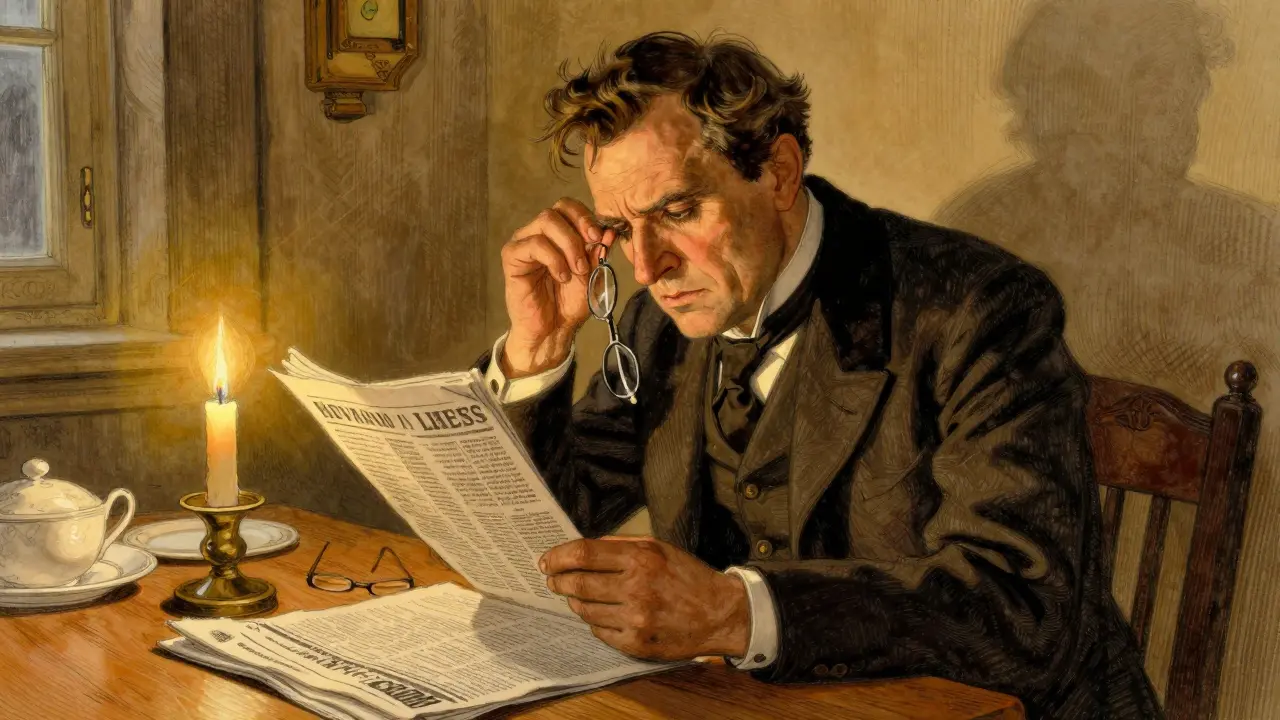
By the time you hit your mid-40s, you might start holding your phone farther away to read the text. Or you’re squinting at the menu at dinner, wishing the print was bigger. It’s not your eyes getting lazy - it’s your lens. This is presbyopia, and if you’re over 40, you’re almost certainly experiencing it. It’s not a disease. It’s not your fault. It’s just what happens to every human being as they age.
Why Your Eyes Can’t Focus Up Close Anymore
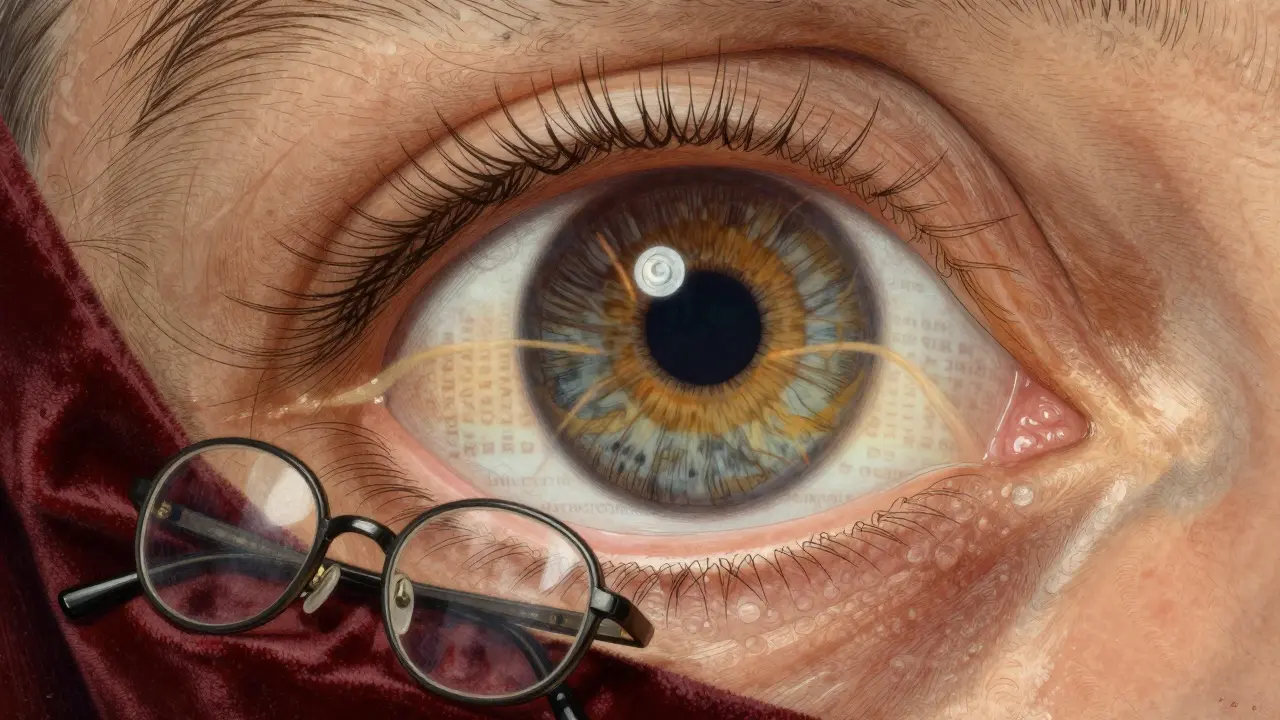
Your eye has a natural lens, right behind the iris. When you were young, that lens was soft and flexible, like a jellybean. It could change shape instantly - bulging to focus on your phone, flattening to see the road ahead. That’s called accommodation. By age 10, your lens can adjust by about 14 diopters. By 60? It’s down to 0.5. That’s why you can’t read a book unless it’s at arm’s length.The lens doesn’t break. It just gets stiffer. Over decades, it keeps adding layers - like an onion growing ring by ring. Those extra layers make it harder to bend. Light no longer focuses sharply on the retina when you look at something close. The result? Blurry text, tired eyes, headaches after reading.
This isn’t the same as being farsighted. Farsightedness comes from an eyeball that’s too short. Presbyopia? It’s all about the lens losing its spring. And no amount of eye exercises, blue light filters, or vitamin A supplements will stop it. As Dr. Emily Chew from the National Eye Institute says, “It’s as inevitable as gray hair.”
When Does It Start? And How Fast Does It Get Worse?
Most people first notice presbyopia between 40 and 45. You might not realize it at first. Maybe you’re just leaning back in your chair to read the news. Or you’re squinting at the microwave clock. By 45, you’re probably reaching for reading glasses - or buying a cheap pair from the drugstore.The progression is predictable. Around 45, you’ll likely need +1.00 diopters of correction. By 50, it’s +1.50 to +2.00. By 65, most people need +2.50 to +3.00. That’s why your readers from five years ago don’t work anymore. Your eyes keep changing, slowly but steadily.
The near point of focus - the closest distance your eye can see clearly - moves from about 7 cm at age 15 to over 100 cm by age 60. That’s more than three feet. Imagine trying to thread a needle from that far away. That’s what daily tasks feel like without correction.
Reading Glasses: The Simple Fix
The easiest solution? Reading glasses. They’re cheap, widely available, and work immediately. You can pick up a pair at Walmart for under $10. They come in strengths from +0.75 to +3.50, in 0.25-diopter steps. Most people start with +1.00 or +1.25.But here’s the catch: over-the-counter readers are one-size-fits-all. They assume both eyes need the same power. They don’t account for astigmatism. And if you pick the wrong strength, you’ll get headaches, eye strain, or blurred vision. About 35% of people buy the wrong power, according to Optometry Times.
They’re perfect for occasional use - checking your phone, reading a label, flipping through a cookbook. But if you’re switching constantly between your computer and the road, they’re a hassle. You’re always taking them off and putting them back on. And if you need different strengths for different distances - say, reading a book versus using a tablet - they won’t cut it.
Progressive Lenses: The Seamless Alternative
If you’re already wearing glasses for distance, progressives might be your best bet. These are single lenses with three zones: top for distance, middle for computer distance, bottom for reading. No lines. No switching glasses. Just move your head slightly to see clearly at any range.They cost more - $250 to $450 - and they take time to get used to. Most people need 2 to 4 weeks to adapt. During that time, you might feel dizzy, especially when walking down stairs. Peripheral vision can feel distorted. About 25% of first-time wearers complain about this.
But the payoff? Freedom. No more fumbling for glasses. No more holding your phone at arm’s length. Newer designs like Essilor’s Eyezen Progressive 2.0, launched in March 2023, have wider near zones and reduced distortion based on data from 10,000 wearers. For someone who works on a computer all day, these make a huge difference.
Other Options: Contacts, Surgery, and What’s Coming
Some people try monovision contacts - one eye corrected for distance, the other for near. It works for about 80% of users. But 15% lose depth perception, which can be dangerous when driving or playing sports.Surgical options exist too. LASIK monovision costs $2,000 to $4,000 per eye. It’s effective - 85% of patients are satisfied - but 35% get dry eyes, and 10-15% need a touch-up within five years. Refractive lens exchange replaces your natural lens with an artificial one, similar to cataract surgery. It’s permanent. It costs $3,500 to $5,000 per eye. But it carries risks: halos at night, reduced contrast sensitivity, and a tiny chance of infection (0.04%).
There’s also a tiny implant called Presbia’s Flexivue Microlens, approved in Europe in 2022. It’s placed in the cornea and improves near vision without removing the natural lens. Early results show 78% of patients achieve 20/25 near vision after a year.
And research is moving fast. Johnson & Johnson’s Acuvue Oasys Multifocal, approved in early 2023, uses new technology to improve near vision in contacts. And there’s a new eye drop in Phase 1 trials - VP-025 - that temporarily improves focusing power for up to six hours. It’s not a cure, but it could mean fewer glasses for people on the go.

What You Should Do Right Now
If you’re over 40 and struggling to read small print, don’t guess. Get a proper eye exam. A comprehensive check-up costs $79 to $250 in the U.S. and includes cycloplegic refraction - a test that relaxes your eye muscles to find your true prescription. Without it, your add power could be off by 0.25 to 0.50 diopters, making your glasses ineffective.Start with reading glasses if you’re only having trouble with close-up tasks. Try a few different strengths at the store. If you need them all day, or you’re already wearing glasses for distance, schedule an appointment with an optometrist. They can fit you for progressives or discuss other options.
Don’t wait until your eyes hurt. The American Academy of Ophthalmology recommends a full eye exam starting at age 40 - not just for presbyopia, but for glaucoma, macular degeneration, and diabetic eye disease, which also start showing up around this age.
Real People, Real Experiences
On Reddit, users share stories like: “First noticed it reading a restaurant menu at 42. Thought I was going crazy.” Or: “Went from +1.00 to +2.50 in five years. My readers kept getting thicker.”One graphic designer in Melbourne switched to occupational progressive lenses with a 14mm corridor. Now she can read her design software without lifting her head. Another user on Trustpilot said Zenni’s progressives took three weeks to adjust to - but now she doesn’t miss a beat.
And the failures? People who bought cheap readers with the wrong power and got headaches. People who tried monovision contacts and couldn’t drive at night. People who had LASIK and ended up needing reading glasses anyway.
There’s no one-size-fits-all. But there’s always a solution. The key is matching the tool to your life.
What’s Next for Presbyopia?
Right now, 1.8 billion people worldwide have presbyopia. By 2030, that’ll be 2.1 billion. The market for solutions is growing fast - projected to hit $25 billion by 2030. More people are turning to online retailers like Warby Parker and Zenni for affordable progressives. Optical chains are dedicating more shelf space to frames designed for progressive lenses.But the real shift is in expectations. We’re no longer accepting blurry text as just “part of getting older.” We’re demanding better tools. Better lenses. Better choices. And with new tech on the horizon - from eye drops to micro-lenses - the future of presbyopia correction isn’t just about reading glasses anymore. It’s about keeping your vision clear, no matter your age.
Dusty Weeks
January 1, 2026 AT 05:45bro i just bought +1.50 readers from walmart and now my cat looks like a blurry ghost 😅
Sally Denham-Vaughan
January 3, 2026 AT 03:15i was 43 when i first held my coffee mug at arm’s length to read the label. thought i was going crazy. turned out my eyes just got old. no shame in it. we all do it. and yes, the drugstore glasses saved my life. no need to overcomplicate it 🙌
Richard Thomas
January 4, 2026 AT 10:35it’s fascinating how the lens doesn’t break-it just accumulates. like a tree growing rings, each year adding another layer of resistance to change. we think of aging as decay, but it’s more like sedimentation. the body isn’t failing; it’s layering experience, literally. the lens becomes rigid not because it’s broken, but because it’s lived. and maybe that’s the quiet poetry of growing older: we don’t lose our ability to focus on the near, we just learn to see the far with more patience.
Todd Nickel
January 4, 2026 AT 20:12the progressive lens adaptation period is often underestimated. most people expect instant results, but neuroplasticity requires time. the brain needs to relearn spatial mapping with new optical inputs. studies show that users who actively engage in structured visual tasks-like reading printed text at varying distances for 15 minutes daily-adapt 40% faster than those who wait passively. also, frame fit matters more than people admit. if the lens optical center doesn’t align with your pupil when looking down, you’ll get distortion even with perfect prescription.
Austin Mac-Anabraba
January 5, 2026 AT 06:29you people act like presbyopia is some mysterious tragedy. it’s biology. your lens got old. deal with it. no one’s forcing you to read tiny text. if you can’t handle it, stop using phones. or better yet, don’t live in a society obsessed with micro-fonts and 10-point menus. the real problem isn’t your eyes-it’s your entitlement to perfect vision at 55.
Phoebe McKenzie
January 6, 2026 AT 11:50you’re all so naive. buying drugstore readers like it’s a harmless hobby? you’re straining your eyes, worsening the condition, and wasting money. if you’re over 40 and haven’t had a cycloplegic refraction, you’re not just blind-you’re negligent. and don’t even get me started on monovision contacts. you think it’s fine until you’re backing out of a parking lot and can’t tell if that’s a curb or a kid on a bike. this isn’t ‘just aging’-it’s a public health failure.
sharad vyas
January 6, 2026 AT 18:20in india, we call this ‘dadi ka nazar’-grandma’s vision. my mother used to read newspapers with a magnifying glass made from a water-filled bottle. now she uses a cheap pair from the pharmacy. no drama. no surgery. just life. we don’t fight nature here. we adapt. and we laugh while doing it.
Paul Ong
January 7, 2026 AT 14:56progressives changed my life no more switching glasses no more losing them at work i got the eyezen 2.0 and now i can read my phone while walking to the fridge
Andy Heinlein
January 8, 2026 AT 14:22just got my first pair of progressives and wow. the first week was weird like walking on a boat but now i feel like a spy with perfect vision at all distances. also i bought them online for $189 and they’re better than my old $400 pair. tech is wild.
gerard najera
January 8, 2026 AT 18:19the eye drop trial sounds promising. if it works, it could change everything.
Bill Medley
January 9, 2026 AT 05:34the data presented is accurate and well-sourced. the distinction between presbyopia and hyperopia is correctly articulated. clinical recommendations align with current guidelines from the American Academy of Ophthalmology. no significant errors detected.
Ann Romine
January 9, 2026 AT 15:46i’m curious-has anyone tried the Flexivue Microlens? i’ve read the european trials, but i’m wondering about real-world long-term effects. especially in people who work long hours on screens. does the implant affect glare or night vision? just wondering if anyone here has personal experience.