
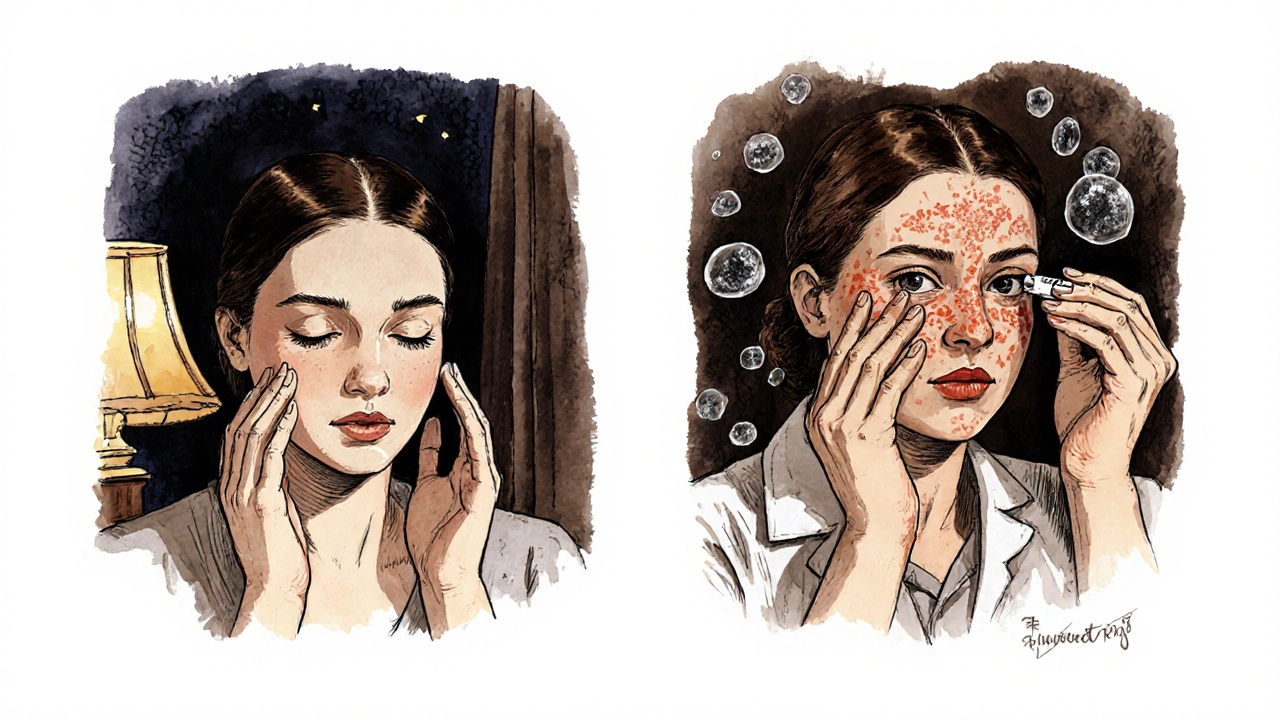
When it comes to clearing acne and smoothing fine lines, few skincare ingredients have stood the test of time like tretinoin and adapalene. Both are retinoids-vitamin A derivatives that transform how your skin behaves. But they’re not the same. Choosing between them isn’t about which is ‘better.’ It’s about which one matches your skin’s needs, your goals, and your tolerance for side effects.
What Retinoids Actually Do to Your Skin
Retinoids don’t just sit on the surface. They slip into skin cells and tell them to behave differently. Think of them as cellular managers. They speed up cell turnover, so dead skin doesn’t clog pores. They reduce oil production. They fade dark spots by breaking up excess pigment. And they boost collagen, the protein that keeps skin firm and plump. Both tretinoin and adapalene do this-but they do it in slightly different ways. Tretinoin works deeper, reaching into the dermis where wrinkles form. Adapalene stays mostly in the epidermis, the top layer, making it gentler but less powerful for deep aging.Tretinoin: The Gold Standard for Aging Skin
Tretinoin has been around since the 1970s. It was the first retinoid approved by the FDA for acne, but its real superpower is anti-aging. Studies show that 0.05% tretinoin cream improves fine wrinkles by 42% after six months. It also reduces mottled pigmentation by 58%-more than adapalene. It’s available by prescription in strengths from 0.01% to 0.1%. The microsphere version, Retin-A Micro, releases the ingredient slowly, which cuts down on irritation. A newer option, Altreno (0.05% tretinoin lotion), is designed to be gentler while still delivering results. But tretinoin has a reputation for being harsh. In clinical trials, 32% of users get redness, 28% get flaking, and 21% feel stinging. Many people quit within the first month because they think their skin is ‘breaking out’-when it’s actually purging, a normal part of the process.Adapalene: The Gentle Starter
Adapalene came onto the scene in the 1990s and became available over-the-counter in 2016. That changed everything. Suddenly, people could try a retinoid without a doctor’s visit. It’s a synthetic retinoid, chemically stable, and doesn’t break down in light. That means you can use it in the morning if you want (though nighttime is still best). It’s also less irritating. In a 2002 study comparing adapalene 0.1% to tretinoin 0.025%, adapalene users had 45% less irritation. For acne, adapalene works just as well as low-dose tretinoin. After eight weeks, it clears 69-74% of acne lesions. It’s especially good for sensitive skin, rosacea-prone skin, or anyone who’s never used a retinoid before. The catch? It doesn’t go deep enough to fix wrinkles on its own. A 2018 study found adapalene 0.3% improved wrinkles by 35%-compared to tretinoin’s 42%. If your main goal is anti-aging, adapalene alone won’t cut it long-term.Head-to-Head: Which One Wins?
| Feature | Tretinoin | Adapalene |
|---|---|---|
| Generations | First-generation | Third-generation |
| Available Strengths | 0.01%, 0.025%, 0.05%, 0.1% | 0.1% (OTC), 0.3% (Rx) |
| Best For | Photoaging, deep wrinkles, stubborn pigmentation | Mild to moderate acne, sensitive skin, beginners |
| Stability | Degrades in light and air | Stable in light and air |
| Time to See Results | 12 weeks for aging, 8-12 weeks for acne | 16 weeks for aging, 8-12 weeks for acne |
| Typical Irritation | High (32% redness, 28% flaking) | Moderate (15% redness, 12% flaking) |
| Cost (OTC) | Prescription only (avg. $45, $10-20 with insurance) | $14.99 (Differin Gel) |

Real People, Real Results
Across Reddit, Amazon, and dermatology forums, users consistently report the same patterns:- 68% of first-time users prefer starting with adapalene because the initial purge is shorter and milder.
- Those treating aging often switch from adapalene to tretinoin after 6 months when results stall.
- 78% of users experience dryness or peeling at first-but 87% who stick with it past 12 weeks see major improvement.
How to Use Them Without Ruining Your Skin
The biggest reason people quit retinoids? They use them wrong.- Start slow. Use a pea-sized amount 2-3 nights a week. Don’t go daily right away.
- Apply to dry skin. Wait 20 minutes after washing your face. Wet skin increases irritation.
- Use the sandwich method. Apply moisturizer, then retinoid, then another layer of moisturizer. This cuts irritation by nearly half.
- Never skip sunscreen. Retinoids make your skin 3.2 times more vulnerable to sun damage. Use SPF 30+ every single day.
- Wait 4-6 weeks. Don’t judge results before then. The ‘retinization period’ is real-and temporary.
What About Other Options?
There are other retinoids, like tazarotene (Tazorac), which is stronger than tretinoin but also more irritating. It’s usually reserved for stubborn cases. Combination products are growing fast. Epiduo (adapalene + benzoyl peroxide) clears acne faster than adapalene alone. It’s a great option if you’re dealing with inflamed pimples.
Who Should Use What?
- Choose adapalene if: You’re new to retinoids, have sensitive skin, struggle with redness or rosacea, or just want to clear acne without drama.
- Choose tretinoin if: You’re over 35, have visible wrinkles, sun damage, or dark spots, and you’re willing to tolerate some irritation for better results.
- Consider both: Start with adapalene. If you’re not happy with your aging signs after 6 months, switch to tretinoin.
What the Experts Say
Dermatologists agree: adapalene is the best entry point for most people. Dr. Diane Berson calls it the optimal starter for 80% of new users. Dr. Joshua Zeichner says newer tretinoin formulations like Altreno have made it easier to tolerate. But Dr. Zoe Diana Draelos warns: adapalene alone won’t fix moderate to severe photodamage. The American Academy of Dermatology backs this up. Their 2023 guidelines recommend adapalene for mild acne and sensitive skin, and tretinoin for aging and severe acne.The Bottom Line
Tretinoin and adapalene aren’t rivals. They’re teammates in your skincare journey. Adapalene is the friendly guide that helps you get started without panic. Tretinoin is the expert who takes you further once you’re ready. Most people don’t need both at once. Pick one based on your goal. Stick with it for at least six months. Use it correctly. Protect your skin from the sun. And don’t give up during the first few weeks. The results aren’t magic. But they’re real. And for millions of people, they’ve meant clearer skin, fewer breakouts, and a face that looks more like their own-just younger, calmer, and healthier.Can I use adapalene and tretinoin together?
No, you shouldn’t use them together. Both are retinoids, and stacking them increases irritation without adding significant benefit. If you want to switch from one to the other, wait at least 2-4 weeks after stopping the first to let your skin recover.
How long does it take to see results?
For acne, you’ll start seeing improvement in 8-12 weeks. For wrinkles and pigmentation, it takes 12-24 weeks. Most people see their best results after 6-12 months of consistent use. Patience is key-retinoids work slowly but lastingly.
Why does my skin get worse before it gets better?
That’s called purging. Retinoids speed up cell turnover, which brings clogged pores to the surface faster. You might see more breakouts for 2-6 weeks. It’s not an allergic reaction-it’s your skin clearing out. If it lasts longer than 8 weeks or feels unbearable, consult a dermatologist.
Can I use adapalene during pregnancy?
No. Both tretinoin and adapalene are FDA Category C, meaning they may harm a developing fetus. Avoid them if you’re pregnant, planning to become pregnant, or not using reliable contraception. Talk to your doctor before starting either.
Is over-the-counter adapalene strong enough?
Yes, for most people. The 0.1% OTC version is just as effective as low-dose tretinoin for acne. If you’re not seeing results after 12 weeks, your dermatologist may prescribe the 0.3% strength. For aging, OTC adapalene helps but won’t replace tretinoin’s deeper action.
Can I use retinoids with vitamin C or niacinamide?
Yes, and it’s often recommended. Vitamin C helps with brightening and sun protection. Niacinamide reduces redness and strengthens the skin barrier. Use them in separate steps-vitamin C in the morning, retinoid at night. Avoid mixing them in the same product unless formulated together.
What if my skin gets too dry?
Reduce frequency to once or twice a week. Use a gentle, fragrance-free moisturizer twice daily. Apply moisturizer before and after your retinoid (the sandwich method). If dryness persists after 4 weeks, consider switching to a lower strength or a gentler retinoid like adapalene.
Gus Fosarolli
November 29, 2025 AT 00:32tretinoin made my face look like a dried-out mango peel for three weeks straight. i thought i’d ruined my skin forever. then one day i woke up and my pores were invisible. no joke. i still use it twice a week like a nervous god. the purge is real, but so is the glow.
also, never trust anyone who says ‘just use it daily.’ that’s how you end up crying in the shower at 2 a.m. asking your cat for advice.
Evelyn Shaller-Auslander
November 29, 2025 AT 10:35i started with differin and it was like a hug for my skin. no burning, no peeling, just… quieter acne. after 4 months i switched to tretinoin cause my wrinkles were getting sassier. now i use it every other night with a thick layer of ceramide cream. my skin’s never been calmer.
ps: sunscreen is not optional. i forgot once and my nose looked like a lobster. never again.
ABHISHEK NAHARIA
December 1, 2025 AT 04:21in india, we have been using natural remedies for centuries - neem, turmeric, aloe - and now you westerners pay $50 for a tiny tube of synthetic chemical and call it science? this is not progress. this is capitalism dressed in lab coats.
retinoids are just glorified vitamin A. our grandmothers didn’t need prescriptions to have glowing skin. they ate food, slept well, and didn’t stare at screens for 12 hours a day. maybe the real problem isn’t your skin - it’s your lifestyle.
Hardik Malhan
December 1, 2025 AT 04:51adapalene’s ppar-gamma agonism modulates sebaceous follicle hyperkeratinization more selectively than tretinoin’s RAR-alpha/beta activation, which explains its lower irritancy profile despite comparable efficacy in inflammatory acne lesions.
clinical trials show 0.3% adapalene achieves comparable collagen upregulation to 0.05% tretinoin over 24 weeks, but with significantly reduced TEWL. the real bottleneck is patient adherence, not formulation.
Casey Nicole
December 2, 2025 AT 17:55i used tretinoin and my skin looked like a sad potato. then i got a dermatologist who actually knew what they were doing and now i’m using a $200 serum from a brand that sounds like a luxury yoga retreat. my skin is literally glowing. you’re not doing it right if you’re not spending at least $150.
also, i only use it on my ‘good skin days.’ you know, when i feel like it.
Kelsey Worth
December 3, 2025 AT 02:39so i tried adapalene and my face broke out like a teen again. then i read somewhere that you’re supposed to wait 20 mins after washing? i was like… wait, what? i just slapped it on like i was putting on hand sanitizer.
turns out i was doing it wrong. now i use the sandwich method and my skin is actually chill. who knew skincare wasn’t just slapping stuff on and hoping for the best?
shelly roche
December 4, 2025 AT 09:56if you’re new to retinoids, start slow. like, really slow. my best friend cried because she thought she ruined her skin. she used it every night. she’s now using adapalene every third night and her skin is glowing like she’s lit from within.
also, moisturizer is your best friend. not your enemy. don’t be scared of it. your skin isn’t a battlefield - it’s a garden. water it gently.
and yes, sunscreen. every. single. day. even if it’s cloudy. even if you’re inside. yes, even then.
Nirmal Jaysval
December 4, 2025 AT 20:13you people are overcomplicating this. i used tretinoin for 2 weeks and my acne vanished. no moisturizer, no sandwich, no waiting. just slap it on and go to bed. if your skin can’t handle it, maybe you’re just weak. my dad used kerosene on his acne in 1978. you think he cared about % concentrations?
stop reading blogs. go buy the cheapest tretinoin you can find and stop whining.
Emily Rose
December 5, 2025 AT 03:48the fact that we’re debating tretinoin vs adapalene like it’s a boxing match is wild. they’re both tools. use the one that fits your life. if you’re scared of irritation, start with adapalene. if you’re ready to fight for your glow, go tretinoin. no shame in either.
and if you’re on the fence? try the OTC stuff first. you don’t need to burn your skin to prove you’re serious about skincare. real confidence is patience. not pain.