
Statin-Antifungal Interaction Checker
Check Your Medication Combination
Interaction Results
Interaction Risk Level:
Dosing Guidance:
Recommended Action:
Watch For These Signs:
Muscle pain, weakness, dark brown/tea-colored urine. If you experience these, stop your statin and contact your doctor immediately.
Key Information:
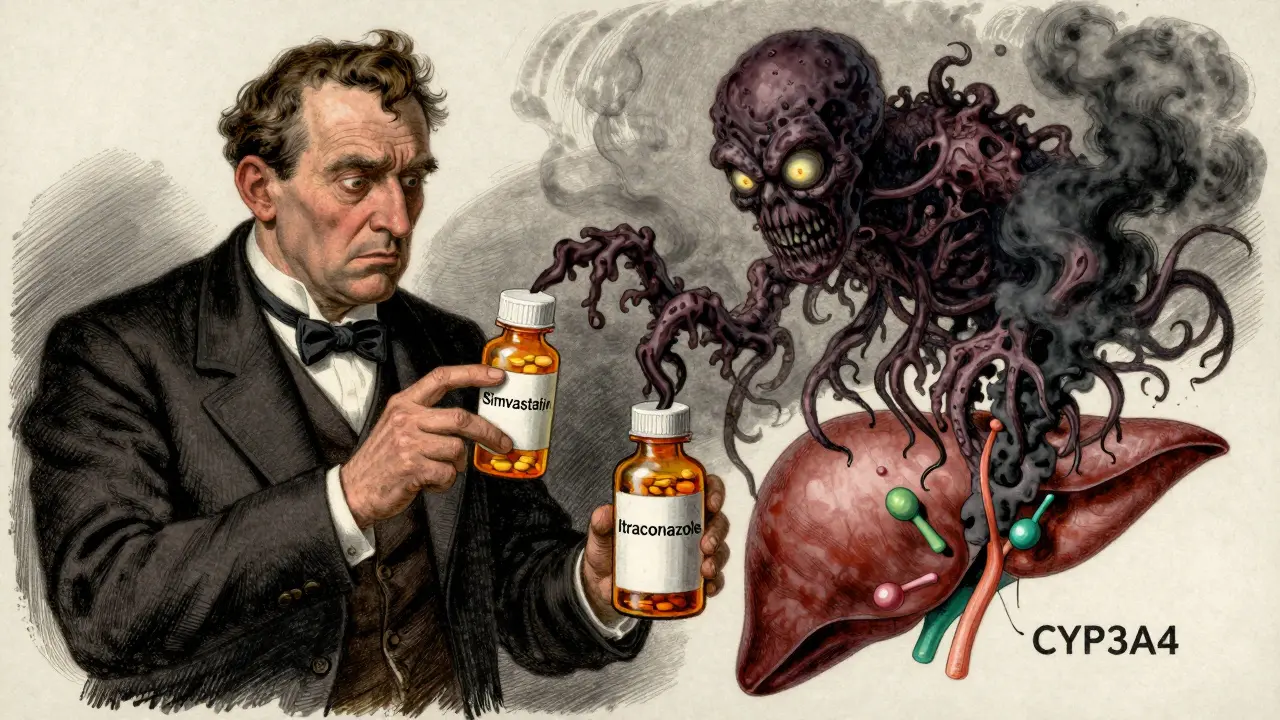
This interaction affects how your body processes statins through the CYP3A4 enzyme. When this enzyme is inhibited by antifungals, statins can build up to dangerous levels.
When you take a statin to lower your cholesterol, you’re doing something good for your heart. But if you also need an antifungal for a stubborn infection-like athlete’s foot, a yeast infection, or a fungal nail problem-you could be putting yourself at serious risk. The problem isn’t the drugs themselves. It’s what happens when they meet inside your body.
Why This Combination Can Be Dangerous
Statins like simvastatin, lovastatin, and atorvastatin work by blocking an enzyme in your liver that makes cholesterol. But your body doesn’t break them down on its own. It relies on a group of liver enzymes called CYP3A4 to process them safely. Now, many antifungal drugs-especially the azole class like itraconazole, voriconazole, and ketoconazole-are powerful inhibitors of that same enzyme. When you take them together, your body can’t clear the statin fast enough. The statin builds up. And when it builds up too much, it starts attacking your muscles. That’s when rhabdomyolysis can happen. It’s a rare but life-threatening condition where muscle tissue breaks down and leaks into your bloodstream. Your kidneys can’t handle the overload. You might need dialysis. In the worst cases, it can kill you.Which Statins Are Most at Risk?
Not all statins are created equal when it comes to this interaction. Some are much more likely to cause trouble.- High risk: Simvastatin, lovastatin, and atorvastatin. These are broken down almost entirely by CYP3A4. If you’re on simvastatin 40 mg or higher and start itraconazole, your statin levels can jump by more than 10 times. That’s not a small increase-it’s a red flag.
- Moderate risk: Pitavastatin and rosuvastatin. They use CYP3A4 a little, but also have other pathways. Still, with voriconazole or high-dose fluconazole, they can build up enough to cause muscle pain or weakness.
- Low risk: Pravastatin, fluvastatin, and rosuvastatin (at lower doses). These are mostly cleared by other systems. You can usually keep taking them safely even with antifungals.
Which Antifungals Are the Biggest Culprits?
The strength of the interaction depends on how hard the antifungal shuts down CYP3A4.- Strong inhibitors: Ketoconazole, itraconazole, voriconazole. These are the worst offenders. The FDA says you should not take simvastatin or lovastatin with these at all. Even atorvastatin needs serious caution.
- Moderate inhibitor: Fluconazole. It’s weaker, but still dangerous if you’re on high-dose simvastatin. A 200 mg daily dose of fluconazole can push simvastatin levels up by 350%. That’s enough to trigger muscle damage in older adults or people with kidney issues.
- Safer option: Isavuconazole. Approved in 2015, this newer antifungal barely touches CYP3A4. If you need long-term treatment, this might be the best choice.

Real Cases, Real Consequences
A 68-year-old man in Florida was prescribed fluconazole for a fungal toenail infection. He’d been on simvastatin 40 mg for five years with no issues. After seven days of the antifungal, he couldn’t walk. His muscles ached. His urine turned dark. His creatine kinase (CK) level-normally under 200-shot up to 18,400. He spent three days in the hospital. He didn’t die, but he lost muscle strength and needed months of rehab. That’s not an outlier. Between 2010 and 2019, over 1,200 cases of rhabdomyolysis were linked to statin-azole combinations in U.S. hospital records. Simvastatin and itraconazole made up nearly 40% of those cases. Fluconazole with simvastatin was close behind. Pharmacists in community clinics report seeing 2-3 cases a year. Most are older patients-people over 70-with diabetes, high blood pressure, or kidney problems. They’re on multiple meds. No one thought to check the interaction.What Should You Do?
If you’re on a statin and your doctor prescribes an antifungal, don’t assume it’s safe. Ask these questions:- Which statin am I on? (Check the bottle: simvastatin, atorvastatin, etc.)
- What antifungal are you prescribing? (Is it fluconazole, itraconazole, or something else?)
- Is there a safer alternative? Can we switch my statin to pravastatin or fluvastatin?
- Can we use isavuconazole instead of itraconazole?
- What signs should I watch for? Muscle pain, weakness, dark urine?
What Doctors Do to Prevent This
Hospitals and clinics have learned the hard way. Many electronic health systems now have built-in safety blocks. If you’re prescribed simvastatin 40 mg and someone tries to add itraconazole, the system will pop up a warning-and often refuse to let the prescription go through. At Mayo Clinic, this feature cut dangerous prescriptions by 87%. Guidelines from the American College of Cardiology and the Infectious Diseases Society of America are being updated in early 2024. They’ll give doctors clear step-by-step rules:- Stop simvastatin and lovastatin completely if you’re taking ketoconazole, itraconazole, or voriconazole. Don’t wait. Don’t reduce the dose. Stop it.
- If you’re on fluconazole, limit simvastatin to 10 mg daily. Limit atorvastatin to 20 mg daily.
- Switch to a safer statin. Pravastatin 40 mg, fluvastatin 80 mg, or rosuvastatin 20 mg are usually fine with any azole antifungal.
- Check your CK levels before starting the antifungal and again after 7-10 days. If your CK is over 10 times the normal level, stop the statin immediately.

Why This Keeps Happening
You’d think this would be easy to avoid. But it’s not. A 2022 study found that nearly 1 in 5 patients still get dangerous combinations. The biggest problem? Outpatient care. A primary care doctor prescribes fluconazole for a yeast infection. The patient is already on simvastatin. The doctor doesn’t know the statin. The pharmacist doesn’t know the statin. No one checks. Elderly patients are at highest risk. They take more meds. Their kidneys don’t clear drugs as well. Their muscles are more fragile. And they often don’t tell their doctor about every pill they take-especially over-the-counter antifungals like clotrimazole cream or oral fluconazole bought online.What You Can Do Right Now
If you’re on a statin:- Keep a list of all your medications-prescription, over-the-counter, and supplements. Bring it to every appointment.
- If you’re prescribed an antifungal, ask: “Is this safe with my statin?” Don’t wait for them to bring it up.
- Know your statin’s name. Don’t rely on “the cholesterol pill.”
- Watch for muscle pain, weakness, or dark urine. If you notice any of these after starting an antifungal, stop the statin and call your doctor immediately.
- If you buy antifungals online or over the counter, tell your doctor. Even topical antifungals can be absorbed enough to cause problems in some people.
The Bigger Picture
This isn’t just about one interaction. It’s about how complex modern medicine has become. Most people take five or more medications. Each one can interact with another. Statins and antifungals are just one example. The same thing happens with antibiotics, heart meds, and even grapefruit juice. The good news? We’re getting better at preventing this. EHR systems, pharmacist-led reviews, and clearer guidelines are cutting the number of cases. Between 2015 and 2022, rhabdomyolysis from this interaction dropped by 34%. But it’s still happening. And it’s still preventable. You don’t need to be a doctor to protect yourself. You just need to ask the right questions-and listen to the answers.Can I take fluconazole with my statin?
It depends on your statin. If you’re on simvastatin, you can only take fluconazole with a max dose of 10 mg of simvastatin. For atorvastatin, keep it under 20 mg daily. If you’re on pravastatin, fluvastatin, or rosuvastatin, fluconazole is usually safe. Always check with your doctor or pharmacist before starting fluconazole.
What are the signs of rhabdomyolysis?
The most common signs are severe muscle pain, weakness, and dark brown or tea-colored urine. You might also feel unusually tired or have nausea. These symptoms usually appear within 7 to 14 days after starting the antifungal. If you notice any of these, stop your statin and call your doctor right away.
Is there a statin that’s safe with all antifungals?
Yes. Pravastatin and fluvastatin are the safest choices because they don’t rely on the CYP3A4 enzyme. Rosuvastatin is also low-risk, especially at doses of 20 mg or less. If you need long-term antifungal treatment, switching to one of these is often the best move.
Can I use over-the-counter antifungal creams with my statin?
Topical antifungals like clotrimazole or terbinafine cream are usually safe because very little gets into your bloodstream. But if you’re using them over large areas of skin, for long periods, or have broken skin, talk to your doctor. Oral antifungals-even if bought without a prescription-are much riskier and should never be taken with high-risk statins.
Why do some people get rhabdomyolysis and others don’t?
It’s not random. Older adults, people with kidney disease, those taking multiple medications, and people with a genetic variation called CYP3A5*3/*3 (poor metabolizers) are at higher risk. Even a small increase in statin levels can push them into danger. That’s why dose limits and drug switches matter so much.
pragya mishra
January 20, 2026 AT 18:17My grandma took simvastatin and fluconazole for her toenail fungus-didn’t tell her doctor about the statin. Ended up in the ER with dark urine and couldn’t walk for weeks. She’s 76, has diabetes, and they just assumed she knew what she was on. No one asked. No one checked. This isn’t rare-it’s a waiting game for people like her. Why are we still letting this happen?
Pharmacists need to be forced to flag this. Not ‘recommended.’ Forced. And doctors need to stop treating patients like they’re mind readers.
Art Gar
January 22, 2026 AT 15:41It is, of course, entirely predictable that the confluence of pharmacokinetic inhibition and polypharmacy in an aging population would yield adverse outcomes of sufficient severity to warrant clinical intervention. The CYP3A4 pathway, as elucidated in the seminal work of Wright et al. (2008), remains a well-documented vulnerability in statin metabolism. That this remains a public health concern in 2024 is not indicative of systemic failure, but rather of insufficient adherence to evidence-based protocols by primary care providers who lack formal pharmacology training.
Edith Brederode
January 23, 2026 AT 08:12OMG this is SO important 😭 I just started fluconazole last week and I’m on rosuvastatin-thank you for this!! I literally just Googled ‘can I take fluconazole with cholesterol meds’ and almost panicked. Your breakdown saved me. I’m switching to pravastatin next week and telling my doctor to put a big red flag on my chart. 🙏💊
clifford hoang
January 24, 2026 AT 10:51Let’s be real-this isn’t about drug interactions. It’s about the pharmaceutical industry selling you a problem so they can sell you a solution. Statins were never meant to be lifelong. They’re a Band-Aid for a diet and lifestyle crisis. And antifungals? They’re overprescribed because doctors don’t want to say, ‘Just wash your feet.’
They’re using CYP3A4 as an excuse to keep you dependent. The real danger? The system. Not the drugs. They’re just tools. And tools don’t kill people-people who profit from fear do.
Try turmeric. Try garlic. Try not being a walking pharmacy. 🤔👁️
Arlene Mathison
January 24, 2026 AT 15:46Okay real talk-this is the kind of post that makes me want to hug my pharmacist. Seriously. I’ve had my statin for 12 years and never knew any of this. I thought if it was on the bottle, it was safe. Nope. I just called my doc and switched to pravastatin. I’m telling everyone I know. This isn’t just medical advice-it’s survival info. Share this. Save a life. 💪
Renee Stringer
January 25, 2026 AT 06:53People still don’t understand how dangerous this is. I’ve seen it. A friend’s father died from this. Not because he was careless-he was just trusting. He assumed his doctor knew. He assumed the pharmacist checked. He assumed the system worked. It didn’t. And now he’s gone. We need mandatory checks. Not suggestions. Mandatory. No more excuses.
Crystal August
January 25, 2026 AT 09:45Why do we even need statins? Why not just eat less junk? Why not move? Why not stop pretending medicine can fix everything we broke with our lifestyles? This whole thing is a scam. The real problem isn’t the interaction-it’s that we’re medicating ourselves into oblivion instead of changing our habits. Just say no to pills. Say yes to walking.
And stop buying antifungals online. That’s just dumb.
Thomas Varner
January 27, 2026 AT 09:14...I just got prescribed fluconazole for a yeast infection... and I’m on atorvastatin 40mg... I’m gonna call my pharmacist before I even open the bottle... I didn’t even know this was a thing... holy crap... thanks for the warning... I’m switching to fluvastatin tomorrow... I’m so glad I saw this... 🤯