
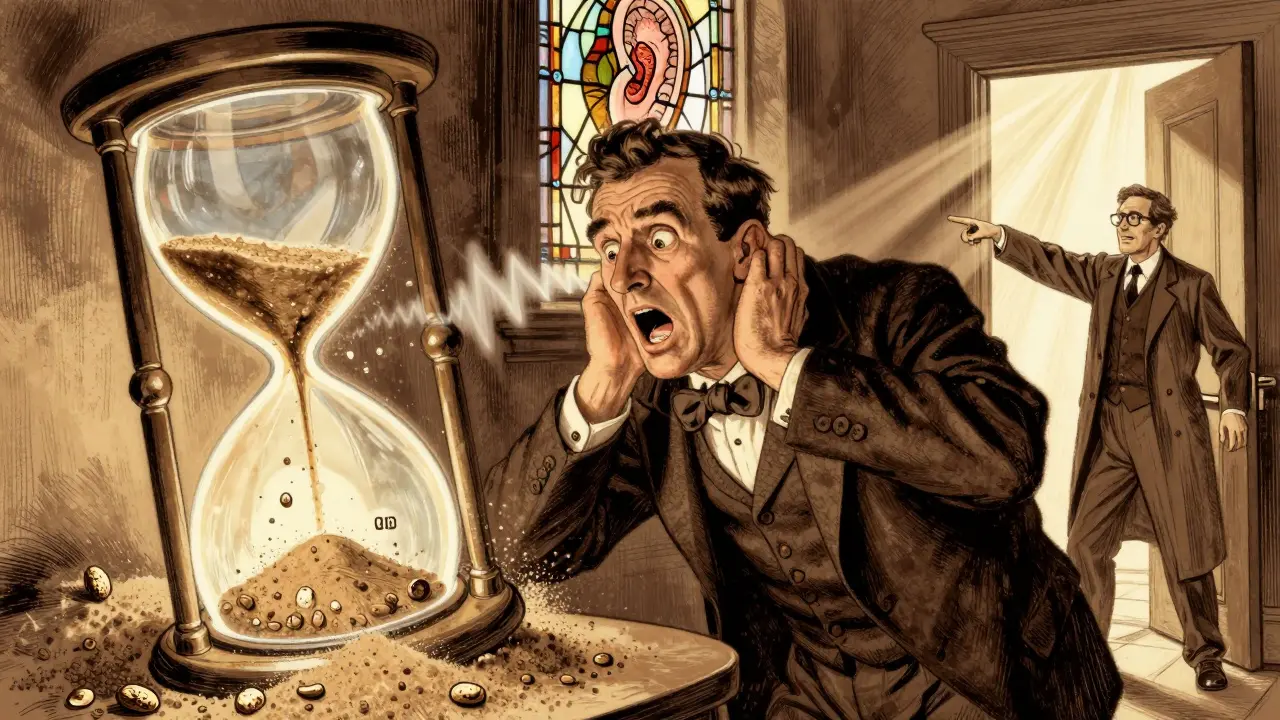
When your hearing drops suddenly-like a switch flipped in the middle of a conversation-it’s not just alarming, it’s a medical emergency. Sudden sensorineural hearing loss (SSNHL) doesn’t wait for a convenient time. It strikes without warning, often in one ear, and if you don’t act fast, you could lose that hearing forever. The good news? If you start treatment within 72 hours, your chances of recovery jump dramatically. The key? Steroid therapy-fast, targeted, and time-sensitive.
What Exactly Is Sudden Sensorineural Hearing Loss?
SSNHL isn’t just ear stuff. It’s a rapid drop in hearing-30 decibels or more-across at least three connected frequencies, happening in three days or less. Think of it like your ear’s internal amplifier suddenly failing. You might notice it when you pick up the phone and one side sounds muffled, or when background noise drowns out speech. Tinnitus (ringing) and dizziness often come with it. It’s not an ear infection. It’s not wax. It’s damage to the inner ear or the nerve pathway to the brain.
It affects 5 to 27 people per 100,000 each year in the U.S., mostly between 50 and 60, but it can hit anyone-even kids. About one in three people recover some hearing on their own, but that leaves two-thirds at risk of permanent loss. That’s why waiting is dangerous. Every hour counts.
Why Steroids Are the First Line of Defense
The body’s natural response to inner ear damage often involves inflammation and poor blood flow. That’s where steroids come in. Oral corticosteroids like Prednisone reduce swelling, calm immune overreactions, and may improve circulation in the cochlea-the tiny, fragile structure that turns sound into signals your brain understands.
The standard starting dose? 1 mg per kilogram of body weight per day, capped at 60 mg daily. That’s usually 60 mg of Prednisone taken as a single morning dose for 7 to 14 days, then slowly tapered. This isn’t a casual prescription. It’s a full-force intervention. Studies show 47% to 62% of people who start steroids within the first two weeks recover significant hearing. That’s more than double the recovery rate of those who wait.
Dexamethasone is another option. It’s stronger and lasts longer in the body-up to 72 hours versus 36 for Prednisone. Some doctors prefer it because you can take less of it. But in real-world outcomes, both drugs work about the same. The choice often comes down to side effects and access.
What If Oral Steroids Don’t Work?
Not everyone responds to pills. About 30% to 40% of patients have only partial recovery-or none at all-after a full oral course. That’s where intratympanic (IT) steroid injections come in.
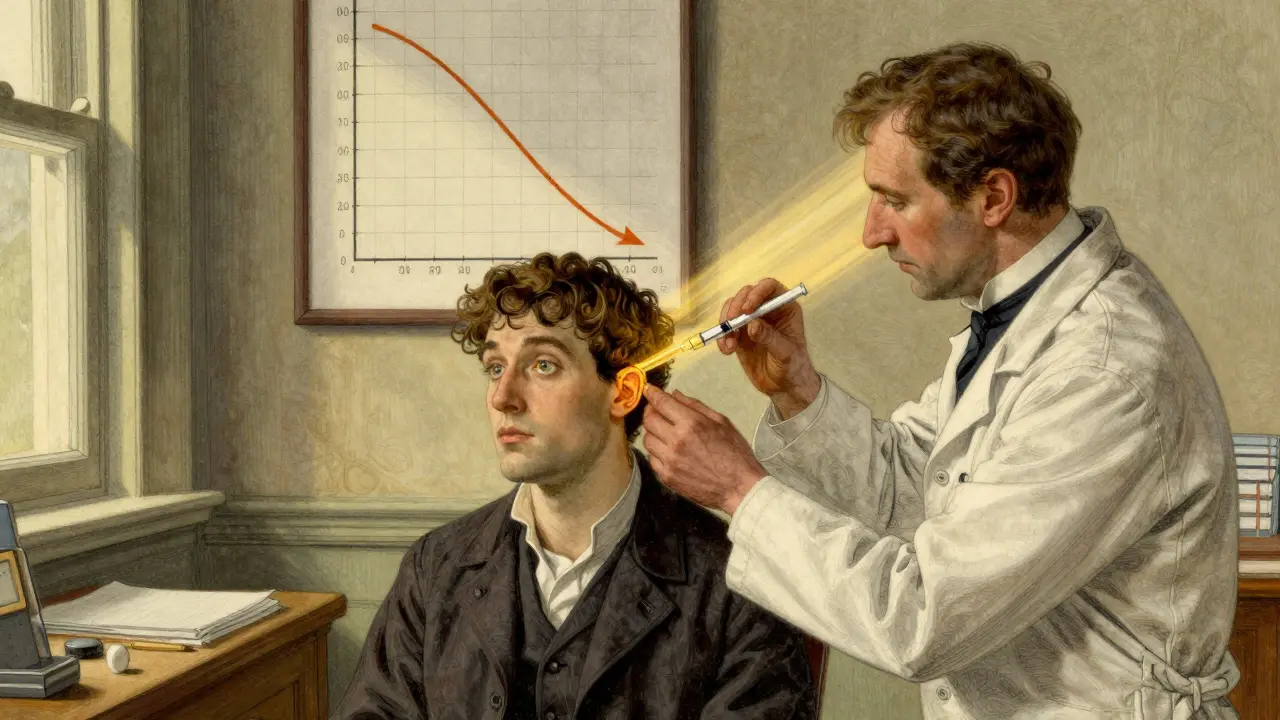
This isn’t surgery. It’s a simple office procedure. A doctor injects a small amount of Dexamethasone (24 mg/mL) directly through the eardrum into the middle ear. From there, it seeps into the inner ear. No systemic side effects. No stomach upset. No blood sugar spikes.
Success rates? Between 42% and 65% of patients who get IT injections after oral steroids fail show meaningful hearing improvement. The best results happen when the injection is done 2 to 6 weeks after symptoms start. It’s not a first step-it’s a rescue.
One Reddit user wrote: “IT steroid injections saved my hearing after oral steroids failed. But the procedure was painful-8/10 during the injection.” That’s common. It feels like pressure, then a brief sting. Most people tolerate it fine, especially compared to the alternative: living with permanent hearing loss.
The Clock Is Ticking: Time Matters More Than Anything
Here’s the hard truth: After 72 hours, your odds start dropping. After two weeks, they plummet. A 2015 study found that 61% of patients treated within 14 days improved significantly. Only 19% did if they waited past four weeks. After six weeks, steroids rarely help at all.
That’s why primary care doctors are now trained to do a quick tuning fork test-Weber and Rinne tests-right in the office. If one ear sounds noticeably worse, they’re supposed to refer you to an ENT immediately. No waiting for an appointment next week. No “let’s see how it goes.”
But here’s the problem: 65% of people miss that 72-hour window. Some think it’s just an ear infection. Others wait because they don’t have insurance, or they’re scared of steroids, or they just don’t realize how urgent it is. A 2023 survey found 43% of poor outcomes were directly tied to delays in treatment.
Side Effects and Risks: What You Need to Know
Yes, steroids come with risks. 60 mg of Prednisone daily is a high dose. Common side effects include:
- Insomnia (41% of users)
- Increased blood sugar (28% in diabetics)
- Mood swings or anxiety (22%)
- Weight gain (average 4.7 kg over two weeks)
- Stomach upset (18%)
That’s why some patients-especially those with diabetes, high blood pressure, or a history of mental health issues-ask for IT injections instead. They’re safer for the body overall, even if they’re less convenient.
One patient wrote: “I took Prednisone and couldn’t sleep for 10 days. I gained weight, felt like I was losing my mind. But I could hear again. Worth it.”
Still, doctors are now more cautious. The 2019 AAO-HNSF guideline downgraded steroids from a “strong recommendation” to a “recommended option,” partly because the evidence isn’t perfect. Only two of 11 studies on steroids met high-quality standards. But as Dr. Richard J. R. Nash put it: “We lack definitive proof, but the cost of doing nothing is permanent deafness.”
What Doesn’t Work-And Why You Should Avoid It
There’s a lot of noise out there. Online forums push antivirals, blood thinners, hyperbaric oxygen, even herbal remedies. Don’t fall for it.
Multiple meta-analyses have shown antivirals (like Valacyclovir) and thrombolytics (like TPA) provide no benefit over placebo. Hyperbaric oxygen therapy (HBOT) might help a bit-adding 6% to 12% improvement-but it’s expensive ($200-$1,200 per session), hard to find (only 37% of U.S. hospitals offer it), and only works if started within 28 days. Insurance rarely covers it.
And forget about “natural cures.” No supplement, acupuncture, or essential oil has been shown to restore hearing in SSNHL. Time and steroids are the only proven tools.

What Happens After Treatment?
Recovery isn’t always complete. Some people regain 90% of hearing. Others get back 50%. A few don’t recover at all. That’s why follow-up is non-negotiable.
You need a repeat audiogram after treatment ends and another one at six months. If your hearing doesn’t improve, you might need a hearing aid. If it’s only in one ear, you could be a candidate for a CROS hearing device, which sends sound from the dead ear to the good one.
Doctors who skip follow-up audiograms are 23% more likely to face malpractice claims. Documentation matters-not just for your care, but for legal protection.
What’s Next for SSNHL Treatment?
Research is moving toward personalization. Right now, we give steroids to everyone. But not everyone responds. New studies are looking at blood markers-like specific inflammatory proteins-that might predict who will benefit from steroids and who won’t. A phase 2 trial (NCT04567821) is already underway.
The Military Health System updated its guidelines in November 2024, standardizing Prednisone at 60 mg/day for 14 days with taper. That’s now the gold standard. And the 2025 AAO-HNSF guideline update will likely refine dosing even further.
For now, steroids remain the backbone of treatment. Eighty-nine percent of ENTs still start with them. Experts agree: steroids will be first-line for at least the next decade. But the future is targeted-better drugs, better delivery, better prediction.
What Should You Do If You Lose Hearing Suddenly?
Here’s your action plan:
- Don’t wait. Go to an ER or ENT immediately.
- Ask for a hearing test (audiogram) within 72 hours.
- If diagnosed with SSNHL, start oral steroids right away-60 mg Prednisone daily.
- If no improvement after two weeks, ask about intratympanic injections.
- Get follow-up audiograms at treatment end and six months later.
- Ignore online myths. No supplements, no antivirals, no miracle cures.
If you’re a primary care provider: Learn the tuning fork tests. Refer immediately. Don’t say “come back in a week.”
SSNHL doesn’t care if you’re busy, scared, or broke. But treatment does. Act fast. Your hearing might depend on it.
Can sudden hearing loss fix itself without treatment?
About one in three people recover some hearing on their own, but that leaves two-thirds at risk of permanent loss. Waiting increases the chance of irreversible damage. Steroid therapy within 72 hours improves recovery odds by up to 60% compared to doing nothing.
Are steroid injections better than pills for sudden hearing loss?
Oral steroids are the first-line treatment because they’re systemic and reach the inner ear through the bloodstream. But if pills don’t work or cause bad side effects, intratympanic injections (directly into the ear) are a highly effective second option. They avoid systemic side effects and work just as well for many patients-especially those with diabetes or high blood pressure.
How long do I need to take steroids for sudden hearing loss?
The standard course is 7 to 14 days of high-dose oral Prednisone (60 mg/day), followed by a gradual taper over the same period. Stopping too early can reduce effectiveness. Never stop steroids suddenly-this can cause dangerous withdrawal symptoms.
Can I use over-the-counter meds or supplements to treat sudden hearing loss?
No. There is no scientific evidence that vitamins, herbs, acupuncture, or OTC pain relievers help restore hearing in sudden sensorineural hearing loss. Delaying proven treatment with unproven remedies can lead to permanent damage. Steroids are the only treatment with consistent clinical backing.
Is hyperbaric oxygen therapy worth trying?
It may add a small benefit-6% to 12% more recovery-when used with steroids within 28 days. But it’s expensive ($200-$1,200 per session), hard to access (only 37% of U.S. hospitals offer it), and rarely covered by insurance. It’s not a substitute for steroids, just a possible add-on in select cases.
Why do some doctors hesitate to prescribe steroids for sudden hearing loss?
Some point to weak evidence: only two of 11 studies on steroids met high-quality standards. Others worry about side effects like high blood sugar or mood changes. But most agree the risk of permanent hearing loss outweighs the risks of steroids. The 2019 guideline downgraded steroids to a “recommended option,” not because they don’t work, but because evidence isn’t perfect. Still, 89% of ENTs use them as first-line treatment.
Matthew Hekmatniaz
January 2, 2026 AT 01:45Just had my cousin go through this last year. She ignored it for 4 days thinking it was allergies. By the time she got to the ENT, she’d lost 70% of hearing in her right ear. Got the steroids, did the injection after 2 weeks, and now she’s at 85% recovery. Still has tinnitus, but she can hear her grandkids again. Don’t wait. Seriously.
Also, shoutout to the doc who did the injection-she used numbing drops and made it feel like a weird pressure. Not fun, but way better than losing it forever.
Liam George
January 2, 2026 AT 18:37Let me guess-Big Pharma wrote this whole thing. Steroids? Of course they’re ‘first-line.’ They’re cheap, patentable, and profitable. Meanwhile, hyperbaric oxygen and low-level laser therapy have been shown in peer-reviewed studies to regenerate cochlear hair cells-but you won’t hear that from the AAO-HNSF. Why? Because they’re funded by pharmaceutical grants.
The real conspiracy? They downgraded steroids to ‘recommended option’ not because the evidence is weak-but because they’re trying to steer you toward expensive, unproven alternatives that keep the revenue stream flowing. You think they care about your hearing? They care about your insurance co-pay.
sharad vyas
January 3, 2026 AT 11:29In India, many people don’t even know this condition exists. My uncle lost hearing after a cold, thought it was normal, waited six months. Now he uses hearing aid. I told him about steroids but he said, ‘Doctor said it’s just ear wax.’
Maybe we need more awareness in villages. Not everyone can go to ENT in city. Maybe community health workers should be trained to do simple hearing test. Small step, but maybe it saves someone.
Dusty Weeks
January 5, 2026 AT 08:57so i took prednisone for this and yeah it was wild. no sleep for 2 weeks, i cried over a cereal commercial, and my face puffed up like a chipmunk. BUT I COULD HEAR MY DOG BARK AGAIN 😭🐶
worth it. also stop saying ‘natural remedies’-you can’t cure inner ear damage with lavender oil. grow up.
Sally Denham-Vaughan
January 6, 2026 AT 14:59My sister got this after a flight. Thought she had an ear infection. Went to urgent care, got antibiotics. Nothing. Then she went to an ENT on her own and got diagnosed in 48 hours. Steroids, injection, done.
She’s fine now. But honestly? The hardest part wasn’t the meds-it was the guilt. She felt stupid for waiting. If you’re reading this and you’re even a little worried-go. Don’t second-guess yourself. Your brain needs to hear the world. Don’t let it go silent.
Ann Romine
January 8, 2026 AT 10:25I’m a grad student in audiology. One thing the post doesn’t mention: the role of autoimmune inner ear disease (AIED) in SSNHL. About 10% of cases are immune-mediated, and those patients often respond better to steroids-but they also need long-term immunosuppression. If someone doesn’t improve after 2 weeks, it’s worth testing for ANCA, anti-HSP70, or other autoantibodies.
Also, the 72-hour window is ideal, but recovery can still happen up to 30 days out, especially with IT injections. Don’t give up if you miss the window.
Todd Nickel
January 8, 2026 AT 16:35It’s worth noting that the 47%–62% recovery rate cited in the post comes from studies with selection bias-most included patients who presented within 7 days, not the full 14-day window. The real-world effectiveness drops closer to 30% when you factor in delayed presentations, comorbidities, and non-compliance with tapering. Also, the 2019 AAO-HNSF downgrade wasn’t just about evidence quality-it was about risk-benefit analysis in elderly patients with diabetes and osteoporosis. Prednisone isn’t harmless. It’s a tool, not a miracle. And while IT injections avoid systemic side effects, they’re still invasive, and the success rate varies wildly based on injection technique. Not every clinic does them well. That’s why documentation and follow-up are critical. One poorly placed injection can cause tympanic membrane perforation or vertigo. This isn’t a DIY procedure.
Alex Warden
January 10, 2026 AT 11:55USA has the best healthcare system in the world. If you can’t get a steroid prescription in 72 hours, you’re doing something wrong. Stop whining about insurance. Go to the VA if you’re a vet. Go to a county hospital. There’s no excuse. Other countries don’t have this luxury-we do. Use it.
LIZETH DE PACHECO
January 11, 2026 AT 19:27For anyone scared of steroids: I was too. I had bipolar disorder. My doctor and I made a plan-low dose, mood tracker, daily check-ins. I didn’t lose my mind. I kept my hearing. You’re not alone. Ask for support. Talk to your doctor. There are ways to make this safe. And your hearing? It’s worth the fight.