

You're looking at a new health plan, and the monthly premium looks great. But if you take a daily medication, the monthly premium is only half the story. A common trap people fall into when switching plans is assuming that because a drug is "generic," it will be cheap on every plan. That's simply not true. Depending on the plan's insurance formularies, that same generic pill could cost you $5 or $50.
Getting this wrong can lead to thousands of dollars in unexpected costs. For instance, moving from a plan that waives the deductible for generics to a High-Deductible Health Plan (HDHP) might mean you pay the full retail price for your meds for the first few months of the year. To avoid this, you need to look past the marketing brochures and dive into the actual drug lists.
The Quick Essentials
- Check the Tier: Most plans use a tiered system. Tier 1 is usually the cheapest; Tier 2 or 3 for generics can cost significantly more.
- Verify the Formulation: An "extended-release" (ER) version of a drug might be in a different, more expensive tier than the "immediate-release" version.
- Watch the Deductible: Some plans make you pay the full price of generics until you hit your annual deductible; others offer a flat copay from day one.
- Confirm the Pharmacy: Using a non-preferred pharmacy can sometimes triple your cost, even for a basic generic.
Understanding How Drug Tiers Work
When you look at a plan, you'll see a Formulary is a list of prescription drugs covered by a health insurance plan, organized into tiers that determine your out-of-pocket cost. Think of it as a menu where the price depends on which section the item is in.
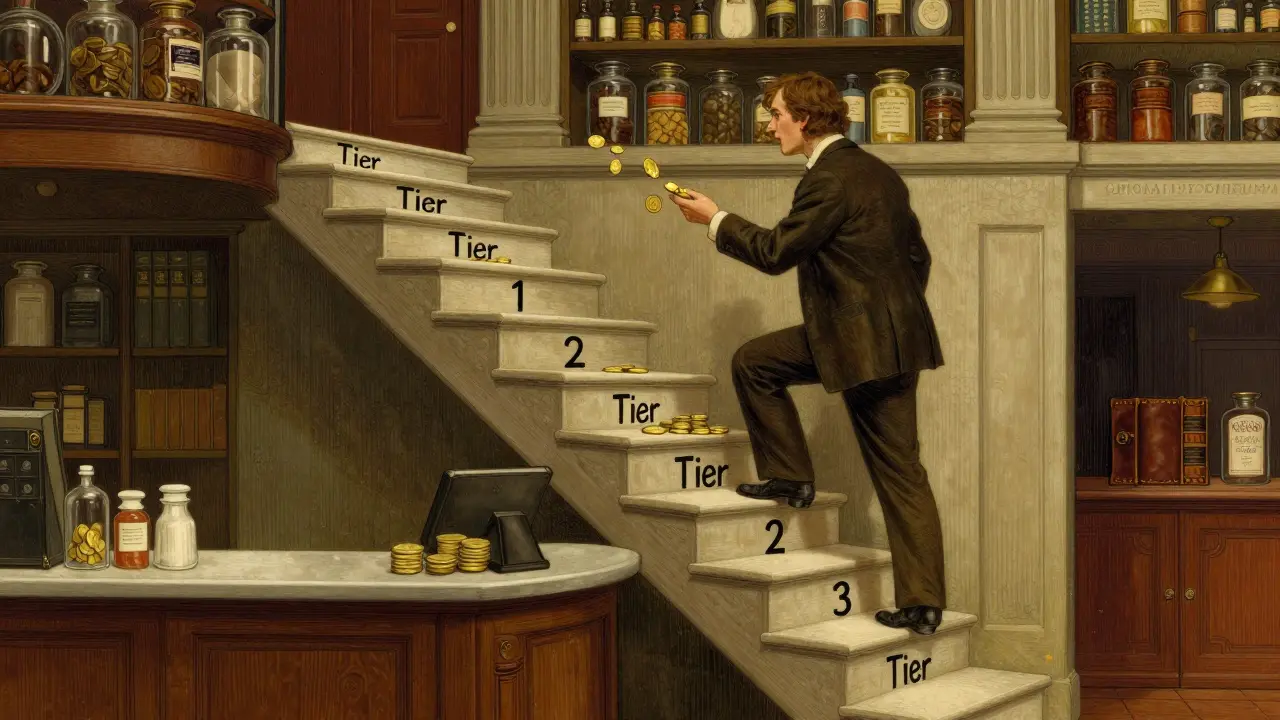
In most marketplace plans, you'll encounter a 4-tier structure. Tier 1 is the gold standard for savers-it's reserved exclusively for generic drugs with the lowest cost-sharing. In these plans, you're often looking at copays between $3 and $20. However, as you move into more complex plans, like some Medicare Advantage offerings, you might see 5 tiers. This adds a layer of complexity because generics can be split into "preferred" (Tier 1) and "non-preferred" (Tier 2). A non-preferred generic could suddenly cost you $40 instead of $10, even though the active ingredient is exactly the same.
| Plan Type | Typical Generic Tier | Estimated Copay | Deductible Impact |
|---|---|---|---|
| Silver SPD (Marketplace) | Tier 1 | ~$20 | Often Waived for Generics |
| Standard HDHP | Tier 1 | Varies | Full Deductible Must be Met |
| Medicare Part D | Tier 1 / 2 | $0 - $10 | Initial Deductible Applies |
| Medicare Advantage | Multi-Tier | $0 - $40 | Varies by Plan |
The Deductible Trap: Integrated vs. Separate
One of the biggest mistakes people make is ignoring how the deductible interacts with their meds. In many High-Deductible Health Plans (HDHPs), you have an "integrated" deductible. This means you pay 100% of the drug cost until you hit your total medical deductible (which could be thousands of dollars). If you're switching to one of these, your first few prescriptions of the year will be shockingly expensive.
On the flip side, some states and specific plan designs, like the Silver Standardized Plan Design (SPD), offer a huge advantage by waiving the deductible for Tier 1 generics. This means you pay a flat $20 fee immediately. According to KFF analysis, this single feature can save low-income users over $1,200 a year. If you have a chronic condition requiring daily medication, a plan that waives the generic deductible is almost always better than a cheaper premium plan that requires the deductible to be met first.
Why "Generic" Doesn't Always Mean "Cheap"
You might think, "I take a generic, so I'm safe," but there's a catch: the manufacturer. Insurance companies often have contracts with specific pharmaceutical companies. If your plan switches from Manufacturer A to Manufacturer B, and you insist on Manufacturer A, your drug might move from Tier 1 to Tier 2. Suddenly, your "cheap" generic is no longer preferred.
Then there's the issue of formulation. A great example is metformin. One plan might cover the immediate-release version in Tier 1, but put the extended-release (ER) version in Tier 2. If you don't check the exact version you use, you'll be surprised at the pharmacy counter. About 68% of people switching plans fail to verify this specific detail, which is why so many encounter "sticker shock" in January.
Step-by-Step Guide to Evaluating Your New Plan
Don't rely on a general summary. Use this systematic approach to ensure your medications remain affordable:
- Get the Full List: Request the complete formulary PDF, not just the "top drugs" summary. Use the search function (Ctrl+F) to find your exact medication.
- Check the Specifics: Look for the exact dosage (e.g., 500mg vs 1000mg) and the formulation (ER, XR, or immediate release).
- Identify the Tier: Note if the drug is Tier 1, Tier 2, or requires "Prior Authorization" (which means your doctor must prove you need it before the insurance will pay).
- Run the Math: If the plan has a deductible, add the estimated cost of your drugs for the first 3 months to your total annual cost.
- Verify the Pharmacy: Check if your local pharmacy is "In-Network" or "Preferred." Using an out-of-network pharmacy can increase costs by 300% or more.

Navigating Medicare and Marketplace Tools
If you're overwhelmed, use the tools designed to simplify this. For those in Medicare, the Medicare Plan Finder is an essential tool. It allows you to enter your specific drugs and see the actual projected annual cost, including the deductible. For marketplace users, the Healthcare.gov plan selector provides similar comparisons.
Interestingly, people who use these tier-specific calculators see a significant drop in prescription-related complaints. The data shows a 37% reduction in errors for those who actually map out their meds before clicking "enroll." If you have a complex regimen, expect to spend 2-3 hours on this process-it's a boring afternoon of research, but it can save you thousands of dollars.
What is a preferred generic?
A preferred generic is a medication that the insurance company has negotiated a lower price for with a specific manufacturer. These are usually placed in Tier 1 and have the lowest copay. A "non-preferred generic" contains the same active ingredient but is made by a different company, resulting in a higher cost for you.
Do I have to pay my deductible before my generic drugs are covered?
It depends on your plan. High-Deductible Health Plans (HDHPs) typically require you to meet the full deductible first. However, some plans (like certain Silver SPD marketplace plans) waive the deductible for Tier 1 generics, meaning you pay a flat copay from day one.
Why did my generic drug cost increase after I switched plans?
This usually happens for three reasons: your drug moved to a higher tier (e.g., Tier 1 to Tier 2), you are now in a plan with an integrated deductible that must be met first, or you are using a pharmacy that is not in the new plan's preferred network.
What is "Prior Authorization" and how does it affect generics?
Prior Authorization means the insurance company requires your doctor to submit a form explaining why a specific drug is medically necessary before they will cover it. Some generics, especially more expensive ones, may require this even if they are on the formulary.
How do I know if my generic is "extended release" or "immediate release"?
Check your current prescription bottle or ask your pharmacist. Look for suffixes like "ER," "XR," "SR," or "CR." When searching a new plan's formulary, search for these specific terms to ensure you're looking at the correct version of the drug.
Next Steps for a Smooth Transition
If you've found that your essential medication is non-preferred or too expensive in a new plan, you have a few options. First, talk to your doctor about a "therapeutic alternative"-a different drug in the same class that might be in Tier 1. Second, ask your pharmacist if there's a different generic manufacturer that the plan prefers.
For those with very high costs, look into manufacturer coupons or patient assistance programs. Just keep in mind that some coupons cannot be used if you've already used your insurance, so always ask the pharmacist to run the price both ways: with insurance and with the coupon.