

Vitamin K Intake Tracker
Track your vitamin K intake from high-K foods to maintain stable INR levels while on warfarin.
Your Daily Intake:
Total Vitamin K: 0 mcg
Your intake is consistent with previous days.
When you're on warfarin, your life isn't just about taking a pill every day. It's about what you eat-specifically, how much vitamin K you get. One day you eat a big salad, the next you skip greens, and suddenly your blood thinning levels go haywire. That’s not just inconvenient-it’s dangerous. Too much vitamin K can make warfarin less effective, raising your risk of clots. Too little can make your blood too thin, leading to dangerous bleeding. The fix? A simple food diary. Not a fancy journal. Not a trend. A real, daily record of what you eat and how much vitamin K it contains.
Why Vitamin K Matters More Than You Think
Warfarin works by blocking vitamin K’s ability to help your blood clot. That’s why it’s so effective at preventing strokes and clots. But here’s the catch: vitamin K doesn’t just disappear after you eat it. It sticks around, and your body uses it every day to make clotting factors. If you suddenly eat a lot of vitamin K-like a big serving of cooked kale or spinach-your body has more of it to work with. That means warfarin has to work harder. Your INR drops. Your blood clots faster. If you go days without greens, your vitamin K levels drop. Now warfarin works too well. Your INR spikes. You bleed easier. The numbers don’t lie. According to the FDA, inconsistent vitamin K intake causes 32% of warfarin-related ER visits. That’s not rare. That’s common. And it’s preventable.What Foods Are High in Vitamin K?
You don’t need to avoid these foods. You just need to keep them consistent. The biggest sources are leafy greens and cruciferous vegetables:- Cooked kale: 817 mcg per 100g
- Cooked spinach: 483 mcg per 100g
- Cooked broccoli: 220 mcg per 100g
- Raw romaine lettuce: 138 mcg per 100g
- Soybean oil, canola oil: 20-40 mcg per tablespoon
- Fortified nutrition drinks like Ensure: 25 mcg per 8 oz
Paper vs. Digital: Which Food Diary Works Better?
You can track vitamin K on paper or on your phone. Both work-but not equally. Paper diaries are simple. You write down what you ate, how much, and your INR number from your last blood test. Many clinics still use them, especially for older patients. The Veterans Health Administration found 43% of their clinics still rely on paper logs. They’re cheap, no batteries needed, and if you’re not tech-savvy, they’re easier to use. But here’s the problem: people forget. They lose them. They guess portion sizes. One study found patients underreported vitamin K intake by up to 37% using paper logs. That’s not just a mistake-it’s a safety risk. Digital apps fix that. The Vitamin K Counter & Tracker app (updated September 2023) lets you scan barcodes or search a database of 1,200+ foods. It shows you how much vitamin K you’ve eaten so far that day. It tells you if you’re on track. It even flags foods you haven’t logged before. A 2022 clinical trial found users of this app stayed in their target INR range 72% of the time. Paper users? Only 62%. But not all apps are created equal. Out of 27 vitamin K apps studied, only 3 had real clinical validation. The Vitamin K-iNutrient app scored 94.7% accuracy in lab tests. Most free apps? They’re off by 30% or more. That’s like taking the wrong dose of warfarin every time you log a meal.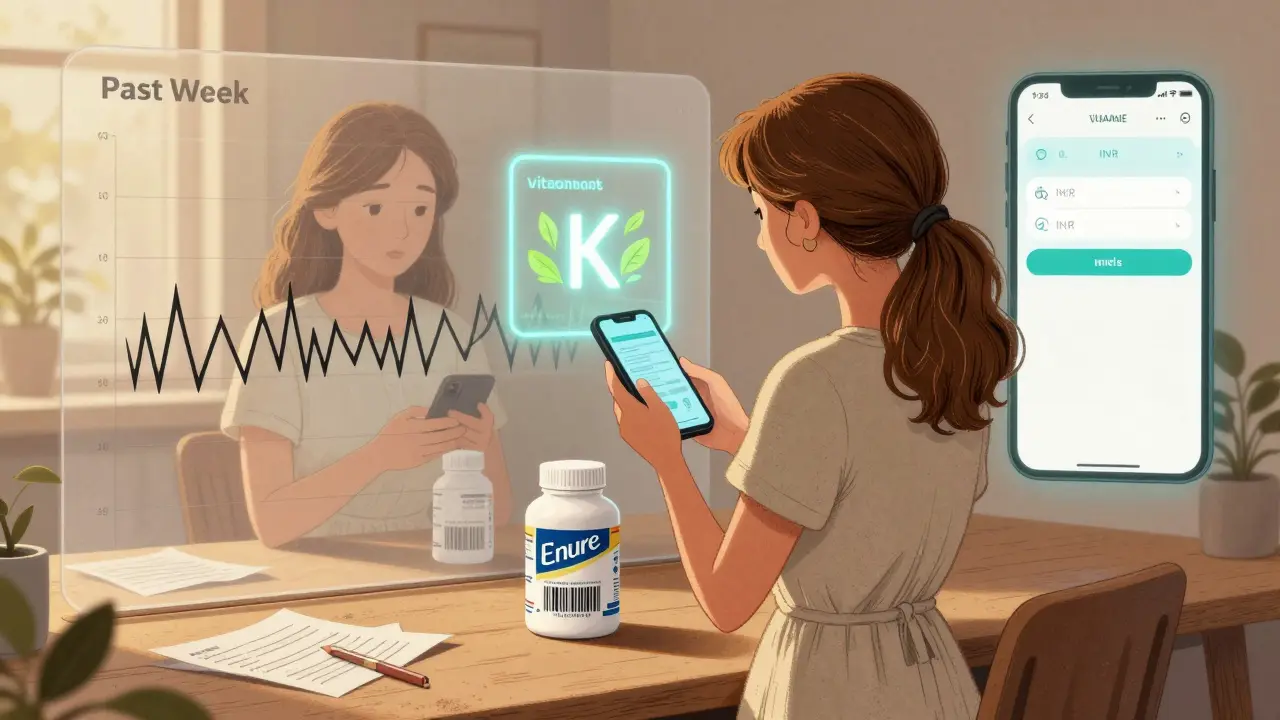
What Most People Get Wrong
Here’s the biggest myth: “I should avoid vitamin K foods.” No. That’s not the goal. The goal is consistency. A 2019 study showed patients who ate the same amount of vitamin K every day-even if it was high-had 18% fewer INR swings than those who ate variable amounts. Eating 150 mcg every day is safer than eating 50 mcg one day and 250 the next. Another mistake? Ignoring hidden sources. Soybean oil is in salad dressings, fried foods, and even some breads. Multivitamins often contain 25-100 mcg of vitamin K. If you take one on Monday but not Friday, your INR will change. Same with herbal supplements like green tea extract or natto supplements-they’re loaded with K2. Portion size is another silent killer. Most people don’t measure. They eyeball. A “handful” of spinach might be 1 cup or 3 cups. That’s a 300 mcg difference. That’s enough to swing your INR.How to Make Your Food Diary Actually Work
You don’t need to be perfect. You need to be consistent. Here’s how:- Start with your baseline. For 7 days, log everything you eat. Don’t change your diet. Just record it. This gives you a picture of your usual intake.
- Choose one method. Pick paper or app-but stick with it. Don’t switch halfway through.
- Track the big 5: leafy greens, broccoli, Brussels sprouts, soybean/canola oil, and fortified drinks.
- Use visual guides. A cup of cooked greens = fist-sized. A tablespoon of oil = the tip of your thumb. These help you estimate portions without a scale.
- Log multivitamins and supplements. Write down the brand and dose. If you take them, take them at the same time every day.
- Check your INR weekly. If your INR changes more than 0.5 units from your last reading, review your food log. Did you eat more kale? Skip your oil? Take a new supplement?
What to Do When Things Go Off Track
Your INR is high? You’re bleeding easily? Look at your food diary. Did you eat a big bowl of kale? Skip your usual oil? Start a new supplement? That’s your clue. Your INR is low? You’re at risk of a clot? Did you eat less greens? Skip your Ensure? Stop taking your multivitamin? That’s your signal. Don’t change your warfarin dose yourself. Call your doctor. Bring your food diary. Show them what you ate. They’ll adjust your dose based on your habits-not guesswork.
The Future Is Integrated
New tools are coming. In January 2024, the FDA approved the first AI-powered system that takes a photo of your food and estimates vitamin K content with 89% accuracy. Epic’s MyChart platform now includes vitamin K tracking. Soon, your EHR might auto-adjust your warfarin dose based on your food logs. But none of that matters if you don’t track. The most advanced app won’t help if you don’t open it. The best paper log won’t work if you leave it at home.Real Stories, Real Results
One user on Reddit said: “Using the app cut my INR swings from monthly to quarterly. Tracking broccoli stopped my dose changing every two weeks.” Another said: “I lost two weeks of paper logs. Switched to the app. Hated typing everything in, but it saved me from another ER trip.” These aren’t outliers. They’re proof that tracking works.Final Thought: It’s Not About Dieting. It’s About Stability.
You don’t need to eat kale every day. You don’t need to avoid it. You just need to know how much you’re eating-and keep it the same. Your food diary isn’t a punishment. It’s your safety net. It’s the thing that keeps you out of the hospital. It’s the quiet, daily habit that lets you live without fear of clot or bleed. Start today. Log your next meal. Not tomorrow. Not next week. Today.Can I still eat leafy greens on warfarin?
Yes-just keep your intake consistent. Eating the same amount of greens every day is safer than switching between lots and none. A cup of cooked spinach daily is fine if you do it every day. The problem isn’t the food-it’s the change.
Do I need to track every single food?
No. Focus on the big sources: leafy greens, broccoli, Brussels sprouts, soybean/canola oil, and fortified drinks like Ensure. Other foods have minimal vitamin K and won’t affect your INR much. Don’t stress over a carrot or an apple.
Is the Vitamin K Counter & Tracker app worth the $2.99?
Yes-if you’re serious about staying stable. It’s the most accurate app available, with verified USDA data and real-time feedback. Free apps often have 30%+ errors. That’s not worth the risk. $2.99 is less than your weekly coffee. Your safety is worth more.
What if I forget to log a meal?
Don’t panic. Just log it as soon as you remember. But don’t guess. If you can’t recall, write “unknown” or “missed.” Consistency over perfection. Missing one meal won’t ruin your INR-but ignoring patterns will.
Should I take my multivitamin with warfarin?
Only if you take it every day at the same time. Many multivitamins contain vitamin K (25-100 mcg). If you take it one day and skip it the next, your INR will fluctuate. Talk to your doctor about switching to a K-free multivitamin if you struggle with consistency.
How often should I check my INR if I’m using a food diary?
Follow your doctor’s schedule. But if you’ve been tracking for 30+ days and your INR is stable, you might be able to space out tests. Some clinics extend intervals from weekly to monthly once consistency is proven. But never skip a test without approval.
Can I use MyFitnessPal or Lose It! to track vitamin K?
Not reliably. A 2023 study found general nutrition apps are 3.2 times less accurate for vitamin K than specialized tools. They’re great for calories, but not for warfarin safety. Use an app built for anticoagulation patients.
Lori Anne Franklin
December 26, 2025 AT 15:18Okay but like… I started using the Vitamin K Counter app and my INR hasn’t bounced once in 3 months. I used to panic every time I got a call from the clinic. Now I just check my log before I eat dinner. It’s not magic, it’s just… consistency. Also, I now know my husband’s salad is 3 cups of spinach, not 1. He’s not allowed to ‘eyeball’ anymore.
Angela Spagnolo
December 28, 2025 AT 04:25I… I didn’t realize soybean oil was a problem. I use it in everything. Like… everything. My stir-fries, my dressings, even the pre-made mashed potatoes. I just thought it was ‘healthy fat.’ Now I’m terrified I’ve been sabotaging myself for years. I’m gonna start writing down every single thing. Even the weird stuff. Like… the oil on my toast? Yeah. That’s a thing now.
Sarah Holmes
December 28, 2025 AT 23:51How is it possible that a medical condition as serious as warfarin management is left to the mercy of consumer-grade apps? The FDA approves a photo-based AI system for vitamin K estimation, yet 90% of the apps on the market are unvalidated garbage. This isn’t healthcare-it’s a casino. And patients are the ones losing their blood. Someone needs to be held accountable.
Kuldipsinh Rathod
December 29, 2025 AT 20:07I’m from India and we eat a lot of spinach and mustard greens. I used to think I had to stop. But now I eat the same amount every day-just one big bowl. My doctor was shocked. He said I’m one of the most stable patients he’s seen. It’s not about avoiding food. It’s about rhythm. Like music.
SHAKTI BHARDWAJ
December 30, 2025 AT 14:25Oh my god I just realized I’ve been taking a multivitamin with vitamin K and skipping it on weekends… that’s why I bled through my toothbrush last month. I’m not even mad. I’m just… wow. That’s it. I’m deleting that app. I’m buying the Vitamin K-iNutrient one. And I’m telling my entire family to stop feeding me kale unless it’s exactly 1 cup. No more ‘I thought you liked it’.
Matthew Ingersoll
January 1, 2026 AT 14:12As someone who’s lived with warfarin for 14 years, I’ve tried paper logs, Excel spreadsheets, and half a dozen apps. The only thing that worked was a simple notebook with a ruler drawn next to each food entry. I measured portions with a ruler. Not my hand. Not my eye. A ruler. I went from 3 ER visits a year to zero. It’s boring. It’s tedious. But it saved my life. No app can replace that discipline.
carissa projo
January 2, 2026 AT 12:33Let me say this gently, because I know how overwhelming this feels: you don’t have to be perfect. You don’t have to log every crumb. You just have to be *aware*. That’s the gift this gives you-the awareness. The power to see the pattern before it breaks you. That’s not just medical advice. That’s peace of mind. And it’s yours for the taking. Start small. Log one meal. Then another. Then you’ll see: you’re not fighting your body. You’re listening to it.
Jody Kennedy
January 4, 2026 AT 11:27Just switched to the Vitamin K Counter app last week. Hated it at first. Too many clicks. But now I’m addicted. Like, I open it before I even make coffee. Yesterday I ate a salad and it flagged the dressing as 38 mcg of K. I didn’t even know dressing had that much! I swapped it for olive oil and my INR stayed put. Also, I’m not going to lie-I felt like a superhero. Like, I’m not just taking a pill. I’m actively controlling my fate. And that feels… good.
jesse chen
January 5, 2026 AT 10:09I’ve been using paper logs since 2018. Lost two notebooks. Forgot to bring one to the clinic once. So I switched to the app. And now I cry every time I see my INR graph. It’s so smooth. Like a calm ocean. Before? It was a rollercoaster in a hurricane. I didn’t know how much stress I was carrying until it was gone. Also, my 72-year-old mom started using it. She says it’s ‘easier than her bingo app.’ That’s high praise.
Joanne Smith
January 6, 2026 AT 10:53Oh wow, so the ‘free’ app I’ve been using for 2 years is off by 30%? That’s not a typo. That’s a death sentence waiting to happen. I just deleted it. And yes, I paid $2.99 for the real one. Worth every penny. I’d rather pay for a coffee that gives me anxiety than a free app that gives me a stroke. Also, I’m now calling my doctor before I take any new supplement. Even the ‘natural’ ones. Turns out ‘natural’ doesn’t mean ‘safe for warfarin.’ Who knew?
Ryan Cheng
January 8, 2026 AT 01:02Consistency isn’t about being perfect. It’s about being predictable. Your body doesn’t care if you eat kale or broccoli-it cares if it gets the same amount every day. I used to think I had to eat exactly 1 cup of spinach. Now I eat 1 cup of kale, then 1 cup of spinach the next day, then 1 cup of broccoli. Total K? Same. INR? Stable. It’s not the food. It’s the pattern. And patterns are easier to maintain than rules.
wendy parrales fong
January 8, 2026 AT 21:27I started logging yesterday. Just one meal. Broccoli and rice. 1 cup broccoli. Logged it. Felt weird. Like I was cheating on my diet. But then I realized-I’m not on a diet. I’m on a life plan. And this? This is the quietest, most powerful thing I’ve ever done for myself. I’m not trying to be perfect. I’m just trying to be here. And that’s enough.