

When the FDA sends a warning letter to a drug manufacturer, it’s not a gentle reminder. It’s a red flag that says: your manufacturing practices are putting patients at risk, and you have 15 working days to fix it-or face serious consequences.
What Exactly Is an FDA Warning Letter?
An FDA warning letter is the agency’s formal notice that a pharmaceutical or medical device manufacturer has violated federal regulations, specifically the Current Good Manufacturing Practices (CGMP) outlined in 21 CFR Parts 210 and 211. These aren’t vague suggestions. They’re legal requirements. If you’re making pills, injections, or sterile products, you must follow every rule-or risk being shut down. The FDA issues these letters after an inspection turns up serious problems. Maybe a worker’s bare forehead was exposed in a cleanroom. Maybe sterile tape was used on a filling line without proper validation. Maybe no one checked if incoming raw materials were contaminated with toxic chemicals like diethylene glycol. These aren’t hypotheticals. They happened. And they were documented. Unlike a Form 483-which is just a list of inspection observations-a warning letter is official. It’s published online. It’s seen by investors, buyers, regulators overseas, and patients. It can tank a company’s stock, delay product launches, and trigger import bans.What’s in a Warning Letter?
Every FDA warning letter follows the same structure. No surprises. Three parts:- Violation Details: Specific, dated observations from the inspection. For example: "On May 12, 2025, inspectors observed unqualified personnel handling sterile components in ISO 5 area without proper gowning." No vague language. No "some instances." This is exact.
- Regulatory Citations: Every violation is tied to a specific law. Usually 21 CFR 211.34 (personnel hygiene), 211.110 (equipment cleaning), or 211.160 (testing and release). The FDA doesn’t guess. They quote the code.
- Required Actions: What you must do next. Not "improve your system." Not "review procedures." They demand: "Provide complete CAPA documentation for all batches from January 2023 to present. Include root cause analysis, verification of effectiveness, and evidence of implementation. Submit within 15 working days."
Why Are These Letters So Common Now?
In 2018, the FDA issued about 14 warning letters per month to pharmaceutical manufacturers. By 2023, that number jumped to 27 per month-a 92% increase. Why? First, more inspections. The FDA’s 2023 budget for foreign drug facility inspections rose to $112.7 million, up 28.5% from 2020. More eyes on more factories. Second, more focus on sterile products. After the 2022 fungal meningitis outbreak tied to contaminated injectables, the FDA started zeroing in on aseptic processing. In 2023, 78% of warning letters cited failures in sterile manufacturing controls. Media fills, gowning, environmental monitoring-you name it, they’re checking it. Third, data integrity. In 2019, only 42% of warning letters mentioned data manipulation or record-keeping issues. By 2023, that number hit 67%. If your electronic records can be altered, deleted, or backdated without a trace, the FDA will find it. And they’ll call you out.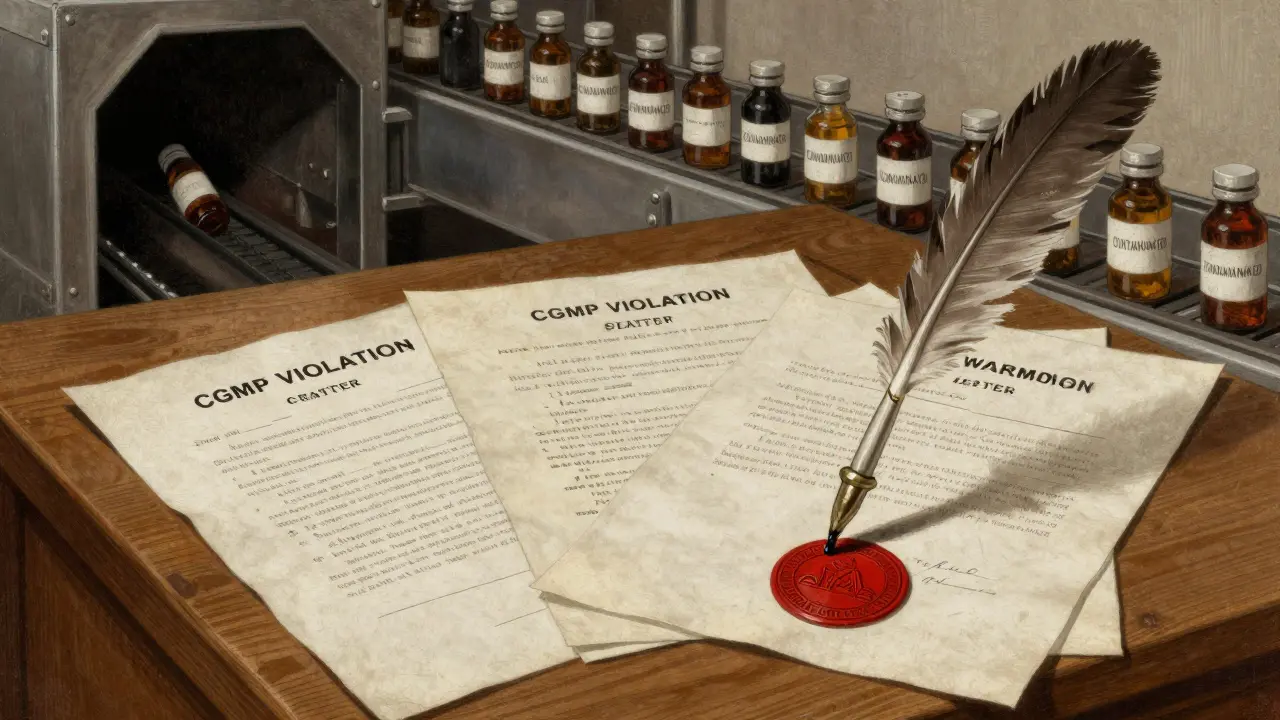
Who Gets Warning Letters-and Why?
In 2022, Indian manufacturers received 39% of all warning letters. U.S. companies got 32%. That doesn’t mean Indian factories are worse. It means they’re inspected more. And the FDA is stricter with foreign sites. A 2023 report found that foreign facilities get warning letters 22% more often than U.S. ones for the same violations. That’s not bias-it’s risk. The FDA can’t walk into every facility. So they prioritize based on history, past violations, and supply chain criticality. But here’s the catch: repeat offenders get hit harder. Glenmark Pharmaceuticals got a warning letter in July 2025-not just for new problems, but because they had the same issues at their Himachal Pradesh plant back in 2019. The FDA doesn’t forget. They track.What Happens If You Ignore It?
Ignoring a warning letter is like ignoring a court summons. The FDA doesn’t wait. If you don’t respond-or if your response is weak-they can:- Issue an import alert-blocking your products from entering the U.S.
- Launch a product seizure-confiscating your inventory
- Pursue a consent decree-a court-enforced plan with monthly reporting, third-party audits, and federal oversight
- Start a criminal investigation-yes, people have gone to jail for falsifying records
How Do You Respond-And Actually Fix It?
A good response isn’t a letter. It’s a project. Most companies think they just need to write an apology. They don’t. The FDA wants:- Root cause analysis: Not "human error." Not "we forgot." You need data. Why did the technician not gown properly? Was training inadequate? Was supervision missing? Was the procedure unclear?
- Corrective actions: What did you change? New training? New gowning protocol? New audit checklist? Prove it.
- Preventive actions: How will you stop this from happening again? Did you update your quality management system? Add automated alerts? Install real-time monitoring?
- Verification: Did the fix work? Show results from 3-5 new batches. Test data. Environmental samples. CAPA tracking logs.
What’s the Real Cost?
It’s not just money. It’s time. And stress. According to EY’s 2023 survey, the median cost to respond to a warning letter is $1.8 million for U.S. facilities and $2.7 million for foreign ones. Most companies spend 6-12 months on remediation. Small manufacturers are hit hardest. One Reddit user, a quality manager at a 15-person lab, said they spent $250/hour on three consultants just to draft the response. They nearly went under. And the FDA doesn’t always respond quickly. A 2022 survey found 54% of companies waited over 120 days for feedback-double the agency’s 45-day target. That’s months of uncertainty. No new product approvals. No revenue.What’s Next for FDA Enforcement?
The FDA’s 2023-2027 Strategic Plan says they want to reduce repeat violations by 25% by 2027. That means more follow-up inspections. More scrutiny on companies with past letters. They’re also rolling out the Risk-Based Certificate of Pharmaceutical Product Pilot Program. That means if you’re exporting to countries like Canada or the EU, your FDA history will be checked before you get approval. And data integrity? It’s not going away. If your records aren’t secure, traceable, and accurate-you’re a target.Final Reality Check
The FDA doesn’t want to shut you down. They want you to make safe medicine. But they won’t wait. They won’t negotiate. They won’t give you a second chance if you don’t prove you’ve changed. If you’re in manufacturing, your quality system isn’t just paperwork. It’s your license to operate. And if it’s broken, the FDA will tell you-loudly, publicly, and in writing. Don’t wait for the letter. Audit yourself. Fix the gaps. Train your team. Document everything. Because when the letter comes, it won’t be a surprise.What triggers an FDA warning letter?
An FDA warning letter is triggered when an inspection reveals serious violations of Current Good Manufacturing Practices (CGMP), such as inadequate sterility controls, failure to investigate out-of-specification results, poor personnel hygiene, or data integrity issues. These are not minor errors-they are systemic failures that could compromise patient safety. The FDA issues a warning letter only after determining the violations are significant enough to warrant formal enforcement action, typically following a Form 483 that wasn’t adequately addressed.
How long do I have to respond to an FDA warning letter?
You have 15 working days to submit an initial response. This isn’t a deadline for full remediation-it’s the date by which you must outline your corrective and preventive actions (CAPA) plan. The FDA expects a detailed, data-backed strategy, not just a promise. Complex issues may require additional time, but you must request an extension in writing and provide a realistic timeline.
Can I ignore an FDA warning letter?
No. Ignoring a warning letter will lead to escalation. The FDA may issue an import alert, seize your products, or pursue a consent decree-a legally binding court order that places your facility under federal oversight. In extreme cases, individuals can face criminal charges for falsifying records or endangering public health. The consequences are not theoretical-they’ve happened to real companies.
What’s the difference between a Form 483 and a warning letter?
A Form 483 is a list of inspectional observations given at the end of an FDA audit. It’s informational and not public. A warning letter is a formal enforcement action issued after the FDA determines those observations reflect serious, unaddressed violations. It’s published online, legally binding, and can trigger penalties. Form 483s are common; warning letters are serious.
How long does it take to recover from a warning letter?
Most companies take 6 to 12 months to fully remediate and regain FDA trust. Some, like Teva Pharmaceuticals, have cleared import alerts in as little as 11 months by implementing deep cultural and system changes. Recovery isn’t just about fixing the cited issue-it’s proving you’ve improved your entire quality system. The FDA will conduct follow-up inspections, often after 6-12 months, to verify your changes are sustainable.
Do warning letters affect a company’s stock price?
Yes. According to a 2023 IQVIA analysis, companies with active FDA warning letters experienced 18.4% lower stock performance over a 12-month period compared to industry averages. Investors view warning letters as signs of operational risk, regulatory exposure, and potential revenue loss. The public nature of these letters makes them a material financial event.
Are warning letters only for pharmaceuticals?
No. While most warning letters are issued to pharmaceutical manufacturers, the FDA also sends them to medical device makers, biologics producers, and even dietary supplement companies. Any facility regulated under the Federal Food, Drug, and Cosmetic Act can receive one if they violate CGMP or related standards. The core issue is always patient safety and product integrity.
What are the most common violations cited in FDA warning letters?
The top three violations in 2023 were: (1) inadequate investigation of out-of-specification (OOS) test results (63.4% of letters), (2) insufficient oversight by the quality unit (57.8%), and (3) failures in aseptic processing controls (78.3% for sterile products). Other frequent issues include poor documentation, lack of validation, data manipulation, and failure to conduct proper environmental monitoring in cleanrooms.
Abby Polhill
December 24, 2025 AT 08:42Let’s be real - CGMP violations aren’t just about paperwork. When you see a letter citing 21 CFR 211.110 for inadequate equipment cleaning, you’re looking at a system that’s been rotting from the inside. I’ve seen labs where the SOPs were printed in 2010 and never updated. The inspectors don’t care about your ‘we’re a small team’ excuse. If your cleaning validation is based on ‘it looks clean,’ you’re one batch away from a recall. The FDA’s not being harsh - they’re just the last line before someone dies because someone didn’t bother to swab a valve.
And don’t get me started on data integrity. If your LIMS allows backdating without an audit trail, you’re not cutting corners - you’re playing Russian roulette with pediatric doses.
Lindsey Kidd
December 24, 2025 AT 21:17Yikes 😳 I work in pharma QA and this hit HARD. Just last week we had a mock audit and someone used a non-sterile wipe on a fill line. We had to shut down for 3 hours to retrain everyone. The FDA doesn’t joke - they’re watching. If you’re not documenting everything, you’re already behind. #QualityIsNotOptional
Austin LeBlanc
December 26, 2025 AT 13:07Oh please. You people act like the FDA is some kind of saintly guardian. They’re bureaucrats with a checklist. Half these violations? They’re nitpicking because they’re under pressure to show ‘results.’ I’ve worked in plants where the same ‘violation’ was cited for 5 years - same issue, same letter, same response. The system’s broken. They don’t want to fix it - they want to scare you into paying consultants. And guess who profits? The same firms that write your CAPA reports for $500/hour. Wake up.
Also, why are we still using paper logs in 2025? That’s the real problem.
Aurora Daisy
December 27, 2025 AT 07:49Oh, so now it’s ‘systemic failures’ when Indian factories get nailed? Funny how the same standards magically become ‘cultural differences’ when it’s your own plant. The FDA doesn’t care if you’re ‘under-resourced’ - they care if your vials are safe. Your ‘we’re just small’ excuse doesn’t fly when someone’s kidneys fail because your raw material wasn’t tested. Get over it. If you can’t meet basic hygiene standards, maybe you shouldn’t be making medicine.
And yes, I’ve seen UK plants with better gowning protocols than half the US sites I’ve audited. It’s not about geography - it’s about competence. Or lack thereof.
Isaac Bonillo Alcaina
December 27, 2025 AT 08:42There is a fundamental misstatement in the post: the FDA does not issue warning letters ‘after an inspection turns up serious problems.’ They issue them when the observations on the Form 483 are not adequately addressed in writing within the required timeframe. The distinction is critical. A Form 483 is an observation; a warning letter is a legal consequence of non-response or inadequate response. The failure to make this distinction undermines the entire argument. Moreover, the phrase ‘putting patients at risk’ is not a legal standard - it is rhetorical. The legal standard is violation of 21 CFR 210/211. Please correct your terminology. Precision matters.
Harsh Khandelwal
December 29, 2025 AT 00:58Bro, the FDA’s just flexin’ on the global south. You think they’re gonna audit a factory in Texas the same way they hit up some guy in Hyderabad? Nah. They got a whole ‘foreign supplier risk’ playbook. And don’t get me started on how they treat small labs - $250/hr consultants? That’s a mafia tax. I know a guy who got a warning letter for using a plastic spoon to stir a batch. No lie. The inspector said ‘non-validated tool.’ The spoon was clean! But now his whole company’s on import alert. Meanwhile, Big Pharma gets a slap on the wrist and a ‘please improve’ note. This ain’t about safety - it’s about control. And the little guys? They’re just collateral.
Delilah Rose
December 29, 2025 AT 13:32I’ve been in this industry for 18 years, and I’ve seen warning letters come and go - some companies bounce back, others vanish. What I’ve learned is that the ones who survive don’t treat it like a compliance problem. They treat it like a cultural reset. One company I worked with had a quality manager who started holding weekly ‘failure forums’ where anyone could bring up a near-miss without fear. No blame, just learning. They went from 3 warning letters in 4 years to zero for 7 straight years. It wasn’t about new software or fancy audits - it was about trust. People need to feel safe speaking up. If your team is terrified of reporting a mistake because they’ll get fired, you’re not fixing a process - you’re hiding a ticking bomb. And the FDA? They don’t need to find the violation - they just need to see that you’re not trying to fix it. That’s when they pull the trigger.
It’s not about the SOPs. It’s about the people who live them.
Spencer Garcia
December 30, 2025 AT 08:07Key takeaway: CAPA isn’t a document. It’s a process. Document the root cause, fix the system, prove it worked. No fluff. And if you’re still using Excel for batch records in 2025, you’re already late.
Bret Freeman
December 30, 2025 AT 11:31Let me tell you about the time I worked at a facility that got a warning letter for ‘inadequate environmental monitoring.’ They spent $2 million on new air filters, hired 12 new QC staff, and rewrote every SOP. Took 11 months. Then the FDA came back - and cited the same violation. Not because it wasn’t fixed - because the new guy didn’t know the new procedure. The training was a PowerPoint. No hands-on. No verification. No accountability. The FDA doesn’t care how much you spent. They care if the person holding the swab knows what they’re doing. And if your culture rewards silence over truth? You’re not fixing anything. You’re just buying time until the next letter. And the next. And the next.
This isn’t about compliance. It’s about courage. And most companies? They’re too scared to be brave.