
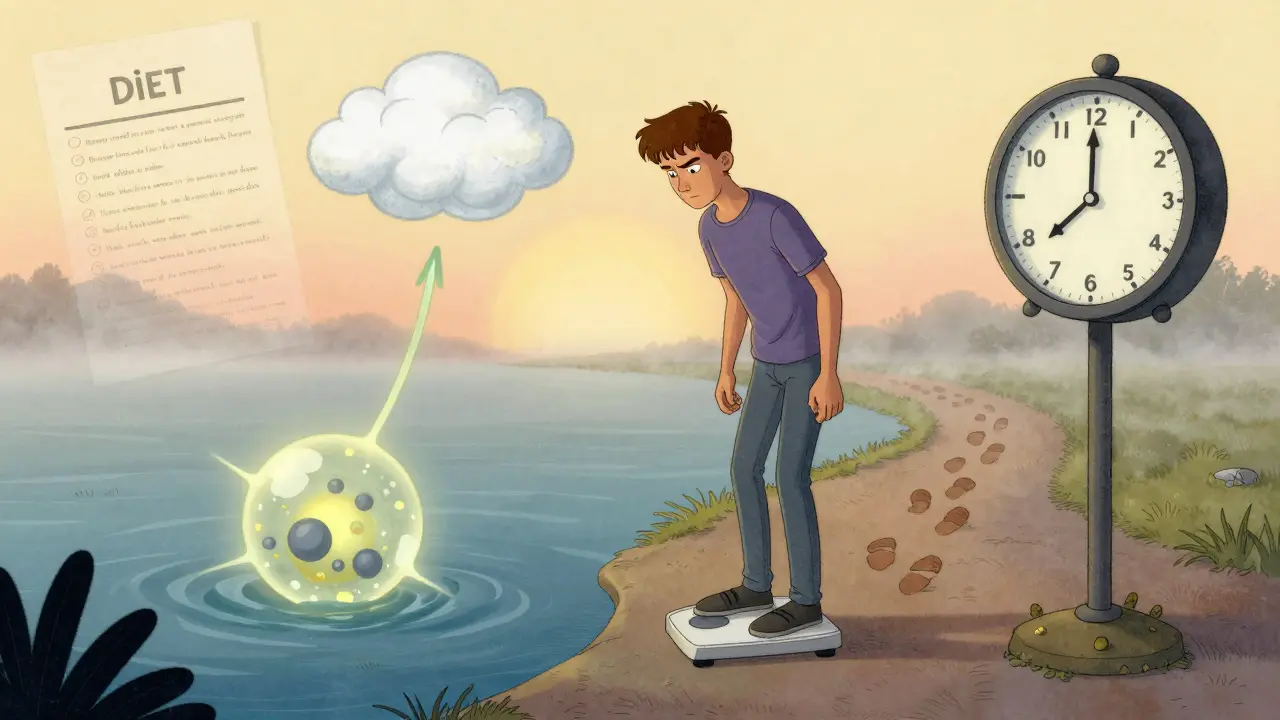
Most people know what it feels like to lose weight. The scale drops, clothes fit better, energy improves. But then, slowly, the pounds creep back. And not just a few - often, it’s all of it, plus extra. Why does this happen? It’s not laziness. It’s biology. And if you’re trying to keep the weight off, you need to understand that weight maintenance isn’t a finish line - it’s a new starting point.
Why Weight Comes Back (It’s Not Your Fault)
Your body doesn’t want you to stay lean. After you lose weight, your metabolism slows down more than it should based on your new size. Studies show a 15-25% drop in resting metabolic rate beyond what’s expected from losing muscle and fat. That means you burn fewer calories just sitting still. Your hunger hormones go haywire too. Leptin, the hormone that tells your brain you’re full, plummets by nearly half after losing 10% of your body weight. Ghrelin, the hunger hormone, spikes. You feel hungrier, even when you’ve eaten enough.
This isn’t a personal failure. It’s a survival mechanism. Your body thinks it’s in famine mode. Evolution didn’t care if you looked good in jeans - it cared if you survived the next winter. So when you lose weight, your brain works overtime to get you back to your old set point. That’s why 75-80% of people regain all or most of their lost weight within five years, according to long-term studies from the National Institutes of Health.
What Actually Works: The Science of Keeping It Off
The National Weight Control Registry has tracked over 10,000 people who’ve lost at least 30 pounds and kept it off for a year or more. Their habits aren’t glamorous - but they’re consistent. Here’s what they do:
- 90.6% exercise daily - averaging 60 minutes of moderate activity like brisk walking, cycling, or swimming. That’s about 2,800 calories burned per week.
- 78.2% eat breakfast every day. Skipping it doesn’t save calories - it leads to overeating later.
- 62.3% weigh themselves at least once a week. Daily weighing? Even better. People who weigh daily are 37% more likely to stay on track.
- 75% watch less than 10 hours of TV per week. Sedentary habits are linked to weight regain.
- They eat around 1,800-2,000 calories a day, with 52% carbs, 19% protein, and 28% fat. Not a fad diet - just balanced, consistent eating.
One key insight from research: Weight maintenance starts on day one of your weight loss journey. A 2018 study from the University of Florida found people began regaining weight within days of finishing a 12-week diet program. That means you can’t wait until you’ve hit your goal to start thinking about maintenance. You need to build habits during the loss phase - not after.
Daily Habits That Make a Difference
You don’t need to be perfect. You need to be consistent. Here’s what works in real life:
- Daily weighing: A Reddit user on r/loseit said, “Weighing daily kept me accountable when I started slipping.” It’s not about obsession - it’s about catching small gains before they become big ones. A 1-2 pound uptick is easy to fix. Ten pounds? Not so much.
- Meal timing: Eating at the same times each day helps regulate hunger hormones. Skipping meals or eating late at night disrupts this rhythm.
- Food tracking: You don’t need to log every bite forever, but tracking for 2-3 days a week helps you spot patterns. Did you eat more after stress? After a bad night’s sleep? Awareness changes behavior.
- Move more than you think: You don’t need to hit the gym for an hour. Take the stairs. Park farther away. Walk after dinner. These tiny movements add up to 200-400 extra calories burned daily.
- Plan for slip-ups: Holidays, vacations, work stress - these are high-risk times. Successful maintainers plan ahead. Pack healthy snacks. Choose restaurants with good options. Set a “slip limit” - like, “I’ll have one dessert, not three.”
One 2020 study found 67% of people who regained weight said a single “bad meal” spiraled into a full relapse. That’s the all-or-nothing trap. One slice of cake doesn’t ruin your progress. But if you think, “I blew it, might as well quit,” then you’ve lost control. The goal isn’t perfection. It’s persistence.

What Doesn’t Work (And Why)
Many commercial programs treat weight loss and maintenance as separate phases. They get you to lose 20 pounds - then hand you a pamphlet and say, “Good luck!” That’s like teaching someone to drive, then taking away the steering wheel. It’s no surprise most people fail.
Some apps and programs promise “maintenance mode,” but their features are weak. Noom’s maintenance content scores 3.8/5. WW’s is better at 4.2/5, but even they admit most users stop using the app after the initial loss. That’s not a product flaw - it’s a system flaw. If you’re relying on an app to keep you accountable, you’re setting yourself up for failure.
And then there’s the medication route. Drugs like Wegovy and Zepbound can help - a lot. In trials, people lost 15-20% of their body weight. But they only work as long as you keep taking them. Stop, and the weight comes back. Plus, they cost over $1,300 a month without insurance. And they’re not magic. You still need to eat mindfully and move. They just take the edge off hunger. They’re tools, not solutions.
The Real Key: Behavior, Not Willpower
Experts like Dr. Rena Wing and Dr. Eric Ravussin say weight regain isn’t about willpower. It’s about biology meeting environment. If your kitchen is full of processed snacks, your job is sedentary, and your social circle eats out every weekend - no amount of willpower will win.
So change your environment. Keep fruit on the counter. Don’t buy junk food. Find a walking buddy. Join a group that meets weekly - not just for support, but for structure. The most successful maintainers don’t do it alone. They have systems.
One man in the National Weight Control Registry lost 120 pounds and kept it off for 15 years. His secret? He walks 5 miles every morning. Rain or shine. He doesn’t do it to lose weight. He does it because it’s part of who he is now. That’s the shift: from “I’m on a diet” to “I’m someone who moves every day.”
What’s Next? The Future of Maintenance
The NIH just launched a $150 million initiative focused solely on weight maintenance - because they know the old model isn’t working. Researchers are testing new tools: AI meal planners that adapt to your habits, continuous glucose monitors that show how food affects your energy, and virtual reality workouts that make exercise feel like a game.
But the real breakthrough won’t come from tech. It’ll come from changing how we talk about weight. We need to stop blaming people for regaining weight. We need to stop selling quick fixes. We need to treat maintenance like a lifelong skill - like brushing your teeth or managing stress.
By 2027, experts predict combination approaches - medication plus behavior change - will become standard. But even then, the most powerful tool will still be consistency. Not intensity. Not perfection. Just showing up, day after day.
Getting Started: Your 3-Step Plan
Here’s how to begin your maintenance journey right now:
- Start weighing daily. Buy a simple digital scale. Weigh yourself at the same time each morning, after using the bathroom, before eating. Record it in a notebook or app. Don’t obsess over the number - just notice trends.
- Build one non-negotiable habit. Pick one thing you can do every day: walk 20 minutes. Eat breakfast. Drink water before meals. Don’t try to do everything. Just lock in one habit. Stick with it for 30 days.
- Plan your high-risk weeks. Mark your calendar for holidays, vacations, work deadlines. Write down your plan: “On Thanksgiving, I’ll have one serving of everything I want. I’ll walk after dinner. I won’t weigh myself until Friday.”
You don’t need to be a gym rat. You don’t need to eat kale every day. You just need to know your triggers, track your behavior, and keep moving - even when it’s hard.
Why do I feel hungrier after losing weight?
After weight loss, your body produces less leptin (the fullness hormone) and more ghrelin (the hunger hormone). This is a biological defense mechanism designed to restore your previous weight. It’s not a lack of discipline - it’s your body fighting to return to its old set point. This effect can last for years.
Do I need to count calories forever?
No. But you need to be aware of portion sizes and food quality. Most successful maintainers stop logging every meal after a few months. Instead, they use awareness: “Does this meal feel balanced?” “Am I eating because I’m hungry or because I’m bored?” Tracking for a few days a week helps you stay in tune.
Can I maintain weight loss without exercising?
It’s extremely rare. The National Weight Control Registry found that 90.6% of successful maintainers exercise daily. Movement isn’t just about burning calories - it helps regulate appetite, improves sleep, and reduces stress eating. You don’t need to run marathons. But you do need to move regularly - at least 60 minutes a day of moderate activity.
Is it possible to maintain weight loss long-term?
Yes - but it’s rare. Only about 25% of people who lose weight manage to keep it off for five years or more. However, those who do share common habits: daily weighing, regular exercise, consistent meal timing, and avoiding sedentary behavior. It’s not about genetics - it’s about behavior.
Should I use weight loss medications for maintenance?
Medications like semaglutide (Wegovy) or tirzepatide (Zepbound) can help reduce hunger and support maintenance, especially for people with obesity. But they’re not a cure. If you stop taking them, weight regain is likely. They’re best used as part of a broader strategy that includes diet, movement, and behavioral support - not as a standalone solution.
Final Thought: This Is a Marathon, Not a Sprint
You didn’t gain the weight in a week. You won’t lose it in a week. And you won’t keep it off by trying to be perfect. You’ll keep it off by showing up - even on the days you don’t feel like it. By choosing movement over stillness. By eating when you’re hungry, not when you’re stressed. By knowing that a slip isn’t a failure - it’s just data.
Weight maintenance isn’t about restriction. It’s about building a life where healthy choices are easy, automatic, and sustainable. That’s the real goal. Not the scale. Not the mirror. The life you live - every day, for years to come.
Elaine Parra
March 23, 2026 AT 03:25Rama Rish
March 24, 2026 AT 11:11Kevin Siewe
March 26, 2026 AT 09:31Chris Farley
March 27, 2026 AT 00:29Sean Bechtelheimer
March 27, 2026 AT 12:58Seth Eugenne
March 29, 2026 AT 06:08Alex Arcilla
March 30, 2026 AT 21:34Jefferson Moratin
March 31, 2026 AT 15:42Caroline Dennis
April 1, 2026 AT 23:53Zola Parker
April 3, 2026 AT 18:53florence matthews
April 5, 2026 AT 18:15Kenneth Jones
April 7, 2026 AT 09:23